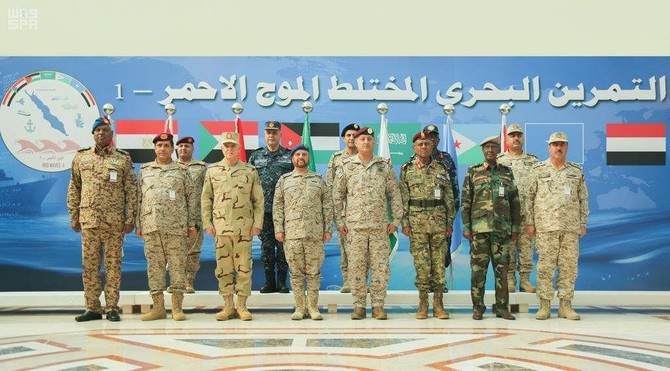
JEDDAH: A military drill aimed at boosting maritime security in the Red Sea ended Thursday, with a top Saudi naval officer saying it was the first exercise of its kind. Saudi Arabia, Somalia, Egypt, Sudan, Djibouti, Yemen and Jordan were among the countries that took part in Red Wave 1.
Gen. Ali Al-Ghamdi said it was the first joint drill promoting naval security in the Red Sea region, considered one of the most important economic sea routes in the world.
He added that several units took part in the exercise, along with Typhoon fighter jets, and exercises included training on shooting naval and air targets.
The exercise was part of the effort to bolster naval security for the Red Sea countries, protect regional waters, promote military cooperation and exchange expertise among participants.
Saudi Arabia’s military Chief of Staff Gen. Fayyad bin Hamed Al-Ruwaili and his counterparts from participating armed forces were also present for the drill.
Last year, Saudi Arabia’s Ministry of Defense organized a massive military exercise to support security, stability and cooperation in the region.
Attended by 23 brotherly countries, the ‘Gulf Shield-1’ drill was considered the largest in the region in terms of the number of participating countries and the techniques used in accordance with the most modern military systems in the world.
Irregular warfare, coastal defense, combat search and rescue, naval warfare exercises and extensive flying operations were conducted during the sea phase of the exercise.
Pakistan was the leading contributor to Joint Gulf Shield-1, both in terms of personnel and assets.


Saudi Arabia’s defense ministry concludes naval drills for Red Sea countries


Saudi Arabia’s defense ministry concludes naval drills for Red Sea countries
- The exercise involved several scenarios that increased combat capability during various naval operations
- Al-Ghanmi said the drill was aimed at bolstering naval security for the Red Sea countries

Saudi Cabinet condemns ‘blatant’ Iranian aggression; affirms Kingdom’s right to respond to threats
RIYADH: Saudi Arabia has warned it reserves the “full right” to respond to Iranian aggression following a series of “blatant and cowardly” strikes targeting the capital and the Eastern Province.
The warning came during a late-night Cabinet session on Tuesday, chaired by Crown Prince and Prime Minister Mohammed bin Salman via videoconference, according to the Saudi Press Agency (SPA).
During the session, the Cabinet “reaffirmed Saudi Arabia’s full solidarity with the brotherly countries whose territories were subjected to blatant Iranian aggression”, signaling a united front against regional threats.
The session followed a dramatic escalation of hostilities, including a direct drone attack on the US Embassy in Riyadh.
Major General Turki al-Malki, spokesperson for the Ministry of Defense, confirmed that while air defenses intercepted multiple threats, the embassy compound sustained a “limited fire and minor material damage.”
General Al-Malki further announced that Saudi forces successfully intercepted and destroyed eight additional drones targeting the cities of Riyadh and Al-Kharj early Tuesday morning.
In a sharp rebuke of the embassy strike, the Saudi Ministry of Foreign Affairs (MOFA) cited a flagrant violation of the 1949 Geneva Convention and the 1961 Vienna Convention on Diplomatic Relations.
“The repetition of this flagrant Iranian behavior... will push the region toward further escalation,” the Ministry stated, underscoring that these provocations occurred despite Riyadh’s explicit policy of not allowing its airspace or territory to be used as a launchpad for strikes against Iran.
Global condemnation and solidarity
The Cabinet expressed deep appreciation for the wave of international support as world leaders condemned Tehran’s “indiscriminate” behavior.
In a joint show of force, the US and GCC member states (Bahrain, Kuwait, Qatar, Saudi Arabia and the UAE) along with Jordan stood united, labeling the strikes a “dangerous escalation” and reaffirming a collective right to self-defense.
Leaders from the United Kingdom, France, and India. — including Prime Minister Narendra Modi — voiced strong solidarity with the Kingdom. The UK government confirmed its forces are engaged in “defensive actions” to maintain regional stability.
Amid the heightened military tension, the Cabinet reviewed the Kingdom’s hospitality efforts for GCC citizens currently stranded at Saudi airports due to regional airspace closures. The crown prince reaffirmed that the state would mobilize all capabilities to support brotherly nations in any measures they take to restore regional peace and stability.