

Bangladesh poll landslide raises democracy fears: analysts

1 / 5
Bangladeshi Prime Minister Sheikh Hasina drinks water during an interaction with journalists in Dhaka, Bangladesh, Monday, Dec. 31, 2018. (AP)
2 / 5
Bangladesh Prime Minister Sheikh Hasina speaks during a press conference in Dhaka on December 31, 2018. (AFP)
3 / 5
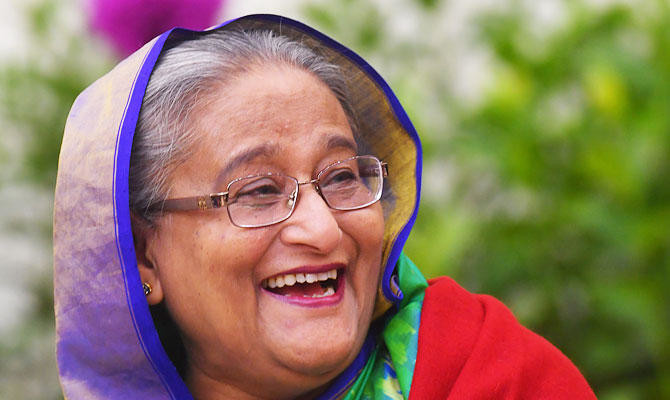
Bangladesh Prime Minister Sheikh Hasina smiles while speaking at a press conference in Dhaka on December 31, 2018. (AFP)
4 / 5
Bangladesh Prime Minister Sheikh Hasina smiles while speaking at a press conference in Dhaka on December 31, 2018. (AFP)
5 / 5
Bangladeshi Prime Minister Sheikh Hasina greets the gathering in Dhaka, Bangladesh, Monday, Dec. 31, 2018. (AP)
Updated 01 January 2019
Follow

Bangladesh poll landslide raises democracy fears: analysts

  • “The country has turned into a totalitarian one-party system. It is not BNP’s problem but the whole nation is facing the biggest crisis,” BNP secretary general Fakhrul Islam Alamgir told AFP

DHAKA: A crushing victory for Prime Minister Sheikh Hasina in an election overshadowed by allegations it was fixed raises fears about the future of democracy in Bangladesh, analysts say.
Hasina’s Awami League party extended its decade-long grip on power by winning an unprecedented 98 percent of seats while key opposition parties are now floundering in the wilderness with next to no representation in parliament.
The Muslim-majority nation is now an entrenched “one-party system,” political analyst Ataur Rahman told AFP, likening it to Southeast Asian ruling parties of the 1970s and 80s.
“There will be less space for freedom of press, civil society... (and) political parties” after the election, said Rahman, who heads the Dhaka-based Center for Governance Studies.
Hasina, Bangladesh’s longest-serving leader, has been accused of locking up dissenters and presiding over enforced disappearances as well as muzzling freedom of speech through a draconian anti-press law toughened this year.
She denies any authoritarianism.
The main opposition Bangladesh Nationalist Party (BNP) endured its worst ever electoral performance Sunday while the country’s largest Islamist party has been crushed in government crackdowns.
The Jamaat-e-Islami’s leaders and many of its activists have gone underground to avoid arrest since the party was banned from putting up candidates under its own banner in 2012.
Five of its top leaders have been hanged over war crimes charges dating back to Bangladesh’s 1971 independence war.
The BNP has claimed the detention of thousands of its activists ahead of the poll prevented it from running anything close to an effective campaign.
It rejected the results, saying the vote was “90 percent rigged” due to ballot box stuffing and a climate of fear which deterred voters from going to polling booths.
The BNP picked up only six seats compared with 288 for the Awami League and its allies in a 300-seat parliament, raising questions about where it goes from here.
“The country has turned into a totalitarian one-party system. It is not BNP’s problem but the whole nation is facing the biggest crisis,” BNP secretary general Fakhrul Islam Alamgir told AFP.
And one Western diplomat, who asked to remain anonymous, said: “The health of Bangladesh’s democracy is now seriously in question.”
“Bangladesh has decided to follow the Cambodian precedent and not Malaysia’s.”
Political experts say the BNP, a right-of-center party which has ruled Bangladesh for 15 of its 47 years as an independent country, must accept some blame for its own demise.
The root of its present troubles, they say, lies in its decision to boycott the 2014 election over fears it wouldn’t be free and fair, gifting victory to Hasina.
“It was a suicidal decision,” said Rahman.

The BNP was founded by military dictator Ziaur Rahman in the late 1970s. His widow Khaleda Zia revived it in the 1980s after Rahman was killed in a coup.
The party joined forces with the Awami League to oust military dictator Hussain Muhammad Ershad in 1990.
But then Zia and Hasina fell out and were nicknamed the “Battling Begums.”
Zia won two elections, in 1991 and 2001, as she and Hasina alternated in power.
The BNP leader was this year sentenced to 17 years in jail for what her supporters say are trumped-up graft charges, ruling her out of the election, Bangladesh’s 11th since independence.
Zia’s party is facing “an existential crisis,” according to political scientist Shahab Enam Khan of Jahangirnagar University.
He said the huge election defeat was a “wake-up call” for the party to “reform itself” so it can “respond to the new form of politics that has emerged in the country.”
Khan believes Sunday’s controversial election has delivered a “fractured mandate... which neither the public nor the politicians can unconditionally accept or invalidate.”
“This is an uncertain situation for democracy in Bangladesh, more precisely for BNP,” he told AFP.
The BNP is unlikely to organize mass protests over doubts it can mobilize enough support but Rahman, the analyst, thinks the it can slowly build support again.
“Their movement for an election to be overseen by (a) neutral government will gain momentum,” he said.


’Weak by design’ African Union gathers for summit

Updated 3 sec ago
Follow

’Weak by design’ African Union gathers for summit

ADDIS ABABA: The African Union (AU) holds its annual summit in Ethiopia this weekend at a time of genocide, myriad insurgencies and coups stretching from one end of the continent to the other, for which it has few answers.
The AU, formed in 2002, has 55 member states who are often on opposing sides of conflicts. They have routinely blocked attempts to hand real enforcement power to the AU that could constrain their action, leaving it under-funded and under-equipped.
It has missed successive deadlines to make itself self-funding — in 2020 and 2025. Today, it still relies for 64 percent of its annual budget on the United States and European Union, who are cutting back support.
Its chairman, Mahmoud Ali Youssouf, is reduced to expressing “deep concern” over the continent’s endless crises — from wars in Sudan and the Democratic Republic of Congo to insurgencies across the Sahel — but with limited scope to act.
“At a time when the AU is needed the most, it is arguably at its weakest since it was inaugurated,” said the International Crisis Group (ICG) in a recent report.

- Ignoring own rules -

With 10 military coups in Africa since 2020, the AU has been forced to ignore the rule in its charter that coup-leaders must not stand for elections. Gabon and Guinea, suspended after their coups, were reinstated this past year despite breaking that rule.
Meanwhile, there has been no “deep concern” over a string of elections marred by rigging and extreme violence.
Youssouf was quick to congratulate Tanzania’s President Samia Suluhu Hassan after she won 98 percent in a vote in October in which all leading opponents were barred or jailed and thousands of protesters were killed by security forces.
The AU praised the “openness” of an election in Burundi in June described by Human Rights Watch as “dominated by repression (and) censorship.”
The problem, said Benjamin Auge, of the French Institute of International Relations, is that few African leaders care about how they are viewed abroad as they did in the early days after independence.
“There are no longer many presidents with pan-African ambitions,” he told AFP.
“Most of the continent’s leaders are only interested in their internal problems. They certainly don’t want the AU to interfere in domestic matters,” he added.

- AU ‘supports dialogue’ -

AU representatives point out that its work stretches far beyond conflict, with bodies doing valuable work on health, development, trade and much more.
Spokesman Nuur Mohamud Sheekh told AFP that its peace efforts went unnoticed because they were measured in conflicts that were prevented.
“The AU has helped de-escalate political tensions and support dialogue before situations descend into violence,” he said, citing the work done to prevent war between Sudan and South Sudan over the flashpoint region of Abyei.
But African states show little interest in building up an organization that might constrain them.
Power remains instead with the AU Assembly, made up of individual heads of state, including the three longest-ruling non-royals in the world: Teodoro Obiang Nguema of Equatorial Guinea (46 years), Paul Biya of Cameroon (44) and Yoweri Museveni of Uganda (40).
“The African Union is weak because its members want it that way,” wrote two academics for The Conversation last year.
This weekend, the rotating presidency of the AU assembly passes to Burundi’s President Evariste Ndayishimiye, fresh from his party’s 97-percent election victory.
Coups, conflicts and rights abuses may get discussed, but the main theme is water sanitation.