Pakistan’s tribal districts’ only church celebrates Christmas with great zeal

1 / 8
Several days ahead of Christmas, security officials, accompanied by tribal elders and religious scholars, attended a celebratory event in Wana, the headquarters of the South Waziristan tribal district. (AN photo)
2 / 8
Food is being served after Christmas celebrations in Wana, the headquarters of the South Waziristan tribal district. (AN photo)
3 / 8
A picture of a sign board leading to the South Waziristan tribal region was taken on Christmas Eve in Wana which is the headquarters of the district. (AN photo)
4 / 8
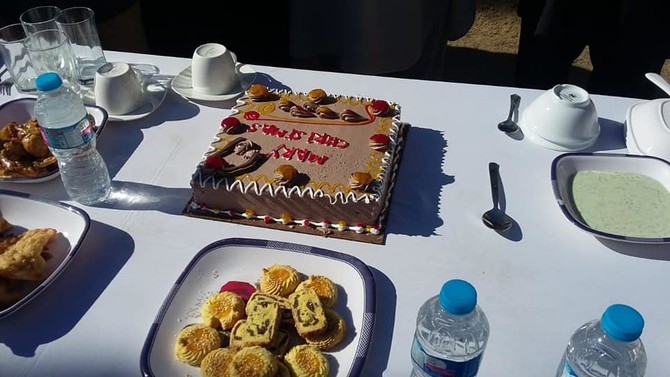
A Christmas cake is being baked ahead of celebrations in Wana, the headquarters of the South Waziristan tribal district. (AN photo)
5 / 8
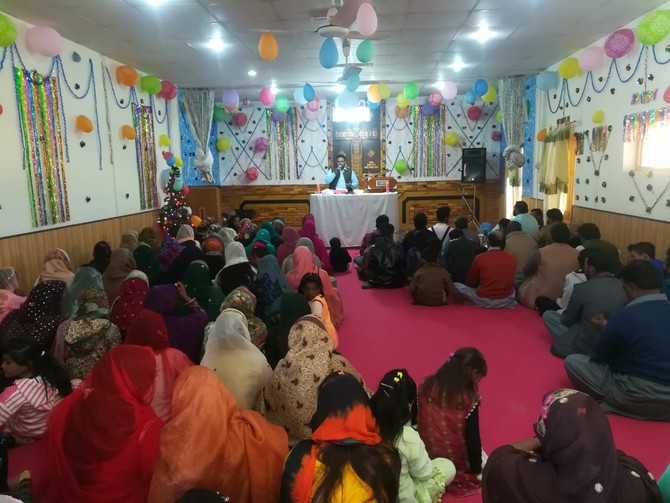
Pastor Zeeshan Alam leads the prayers while members of the Christian community attend the service at a church in Wana, the headquarters of the South Waziristan tribal district. (AN photo)
6 / 8
Members of a Christian community from a tribal district of Pakistan celebrate Christmas. Seen here are children from Wana, which is the headquarters of the South Waziristan tribal district. (AN photo)
7 / 8
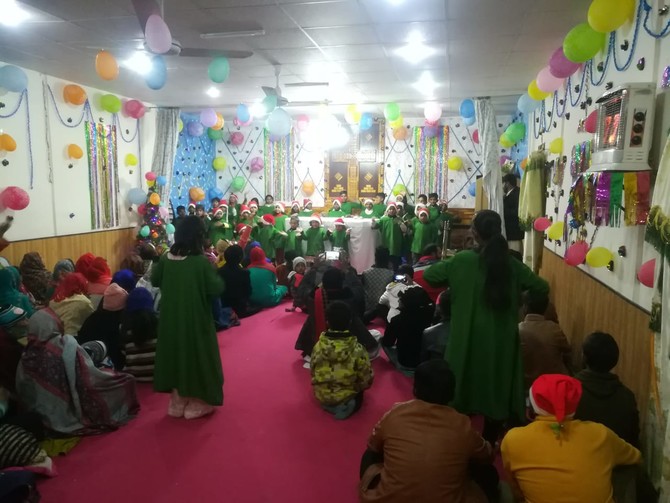
Wearing Santa Claus costumes, children and the elderly take part in Christmas celebrations at a church in Wana, the headquarters of the South Waziristan tribal district. (AN photo)
8 / 8
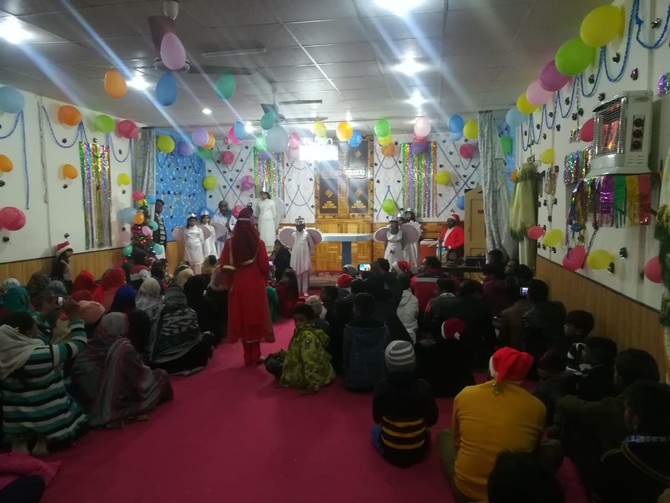
Zeeshan Alam, the pastor of the Wana Church in the South Waziristan tribal district, dresses up in red while children from the small Christian community wear Santa Claus outfits during Christmas celebrations in the tribal region. (AN photo)
Updated 26 December 2018
Follow

Pakistan’s tribal districts’ only church celebrates Christmas with great zeal

  • Christians from a tribal region of South Waziristan district celebrate Christmas
  • Community members from elsewhere in Pakistan said they were shocked to learn of their presence in volatile region

DERA ISMAIL KHAN: Once threatened by militant networks, members of a small Christian community in Pakistan’s South Waziristan tribal district celebrated Christmas with prayers for peace and prosperity of the country on Tuesday.
The event took place in their church, the only one of its kind, in Wana which is the district’s headquarters.
Surrounded by a mountainous terrain, the church’s building is located in the heart of Wana — a tribal region along the Pakistan-Afghanistan border — long considered as a terrorist sanctuary and one of the most dangerous places in the world.
“Christmas celebrations were held with enthusiasm with our community decorating their homes and the church, here in Wana, with colorful lights and posters. Around 500 members gathered at the church to offer prayers for the solidarity of the country,” Pastor Zeeshan Alam told Arab News by phone from Wana.
Walking through a small alleyway leads you to a few shops in the area where shopkeepers sell decorative items such as handmade figurines of Santa Claus, glass eggs, and other ornaments.
Until recently, the tribal belt was part of the Federally Administered Tribal Areas (FATA) of Pakistan. That was before South Waziristan, along with six other agencies, was merged with the Khyber Pakhtunkhwa (KP) province earlier this year.
Alam recalls a time when — following military operations in the region — security was a major issue, something which has improved with time, so much so that the tiny Christian community celebrates their religious festival without any fear.
When contacted by Arab News, KP Inspector General of Police Salahuddin Mehsud said that stringent security measures have been put in place to thwart any untoward incidents.
“Throughout KP, we have identified around 85 churches and up to 20 other sites where Christmas celebrations will be held. I have directed all district police officers to remain in close coordination with the Christian community to ensure heightened security,” the IGP added.
He said that 3,800 police personnel have been deployed across the region for this purpose with mobile patrolling and routine visits by supervisory officers also in place.
Alam said that they are satisfied with the security arrangements, adding that peace has been restored throughout the country in general, and in KP and other newly-merged districts in particular, due to the active role played by the police and the army.
The church’s foundation stone was laid in January 2000 in a ceremony that had seen several civil and military officials in attendance. This was done in response to several requests lodged by residents of the Christian community in the South Waziristan Scouts’ camp.
Talking to Arab News, Ali Wazir, a member of the National Assembly (MNA) from the South Waziristan tribal district said that though the Christian community in his area lives in a secure zone, plans were in place to hold regular meetings with them and the officials concerned in the next couple of weeks to resolve any problems, such as the provision of a separate land for their graveyard and a school for the children.
“I think locals have no problem with the Christian community in Wana and they have been living together with complete religious harmony for years now. I cannot remember a single incident of violence against members of the community for decades now,” Wazir said.
Fiaz Masih Nasir, a Christian who lives in Islamabad, said that he was shocked to learn that his community members live in Wana, one of the most volatile tribal regions.
“It gives me great pleasure to see religious harmony prevailing in our country and on this day we pray for greater peace,” Nasir said.
Pastor Alam added that Christmas celebrations were held in complete harmony in the tribal area. “The prayer sessions at the church have concluded amid prayers for religious harmony and solidarity of the country,” he said.


Pakistan joins regional talks on Afghanistan in Iran as Kabul stays away

Updated 15 December 2025
Follow

Pakistan joins regional talks on Afghanistan in Iran as Kabul stays away

  • China, Pakistan, Pakistan, Tajikistan, Uzbekistan, Turkmenistan all joined talks organized by Iran, as did Russia
  • Afghanistan was invited but decided not to attend, Taliban-led government was tight-lipped on the reasons

TEHRAN, Iran: Afghanistan’s neighbors met in Iran and agreed to deepen regional coordination to address political, economic and security challenges, as well as calling for sanctions on Afghanistan to be lifted. 

The only absent party? Afghanistan itself.

China, Pakistan, Pakistan, Tajikistan, Uzbekistan and Turkmenistan all joined the talks organized by Iran, as did Russia, according to a statement released after the meeting on Sunday.

Afghanistan was invited but decided not to attend. Its Taliban-led government was tight-lipped on the reasons, with the foreign ministry saying only that it would not participate because Afghanistan “currently maintains active engagement with regional countries through existing regional organizations and formats, and has made good progress in this regard.”

The statement from the talks in Iran stressed the importance of maintaining economic and trade ties with Afghanistan to improve living conditions and called for the country’s integration into regional political and economic processes.

The Taliban were isolated after they retook power in Afghanistan in August 2021, but in the past year, they have developed diplomatic ties. They now raise several billion dollars every year in tax revenues to keep the lights on.

However, Afghanistan is still struggling economically. Millions rely on aid for survival, and the struggling economy has been further impacted by the international community not recognizing the Taliban government’s seizure of power in the wake of the chaotic withdrawal of US-led troops in 2021. Natural disasters and the flow of Afghans fleeing Pakistan under pressure to return home have underlined Afghanistan’s reliance on foreign aid to meet essential needs.

The countries at the talks also voiced security concerns and pledged cooperation in combating terrorism, drug trafficking and human smuggling, while opposing any foreign military presence in Afghanistan. They underscored the responsibility of the international community to lift sanctions and release Afghanistan’s frozen assets, and urged international organizations to support the dignified return of Afghan refugees from neighboring countries.

The participants backed efforts to reduce tensions between Afghanistan and Pakistan, which have been particularly strained, with border clashes between the two sides killing dozens of civilians, soldiers and suspected militants and wounding hundreds more.

The violence followed explosions in Kabul on Oct. 9 that Afghan authorities blamed on Pakistan. A Qatar-mediated ceasefire has largely held since October, although there have been limited border clashes. The two sides failed to reach an overall agreement in November despite three rounds of peace talks.

Asif Durrani, Pakistan’s former special representative for Afghanistan, said the Taliban government’s decision to skip the meeting reflected a “lack of political maturity.” 

Writing on X, Durrani said the move reinforced concerns that the Taliban were unwilling to negotiate, instead adopting an “I don’t accept” stance that he said would do little to resolve serious regional problems.

Mohammad Sadiq, the current Pakistani special representative for Afghanistan who attended the talks, wrote on X that the Afghan people had already suffered enough and deserved better.

Only an Afghanistan that does not harbor militants would inspire confidence among neighboring and regional countries to engage meaningfully with Kabul and help unlock the country’s economic and connectivity potential, he wrote.

Participants agreed to hold the next meeting of foreign ministers of Afghanistan’s neighboring countries as soon as possible in Ashgabat, Turkmenistan, and welcomed Pakistan’s offer to host the next round of special envoys’ talks in Islamabad in March.

Iran’s foreign ministry spokesman, Esmail Baghaei, on Sunday said that the meeting had not been held for about two years and marked the first such gathering attended by special envoys on Afghanistan from neighboring countries as well as Russia. Russia and Uzbekistan sent the special envoys of their presidents, while Pakistan was represented by a delegate from the prime minister’s office.

Landlocked Afghanistan is sandwiched between the Middle East, Central Asia, and South Asia, making it strategically located for energy-rich and energy-hungry nations.