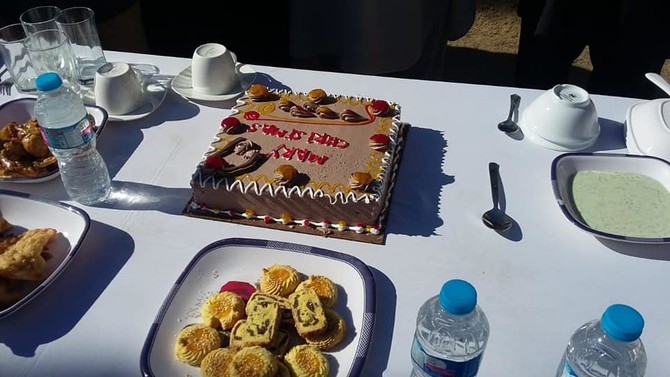
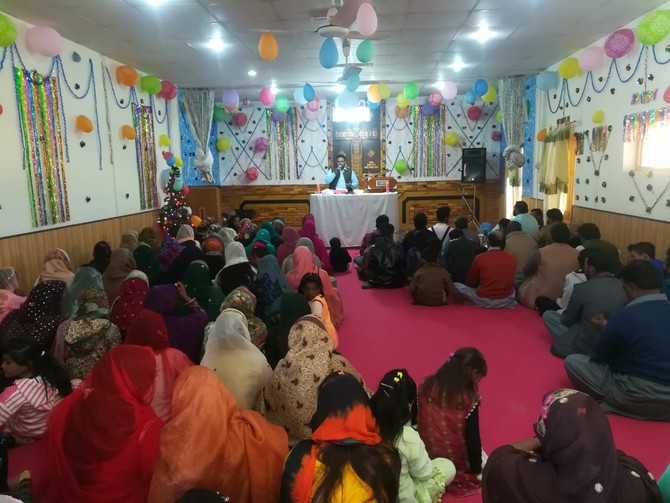
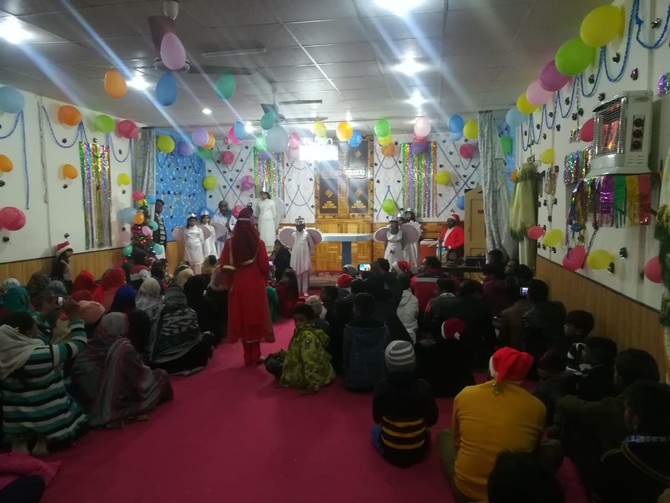
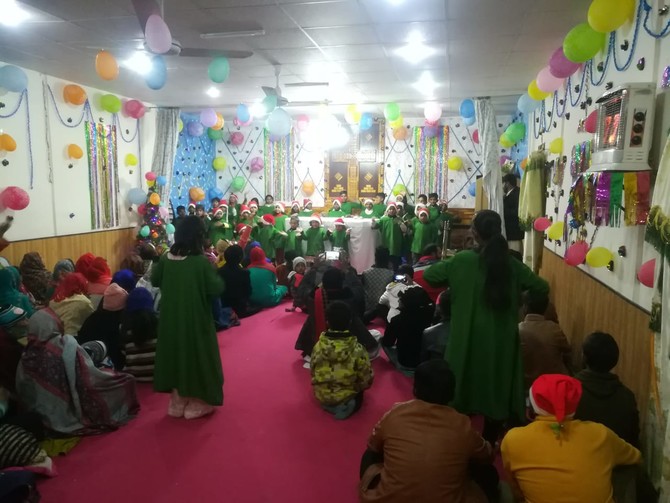
DERA ISMAIL KHAN: Once threatened by militant networks, members of a small Christian community in Pakistan’s South Waziristan tribal district celebrated Christmas with prayers for peace and prosperity of the country on Tuesday.
The event took place in their church, the only one of its kind, in Wana which is the district’s headquarters.
Surrounded by a mountainous terrain, the church’s building is located in the heart of Wana — a tribal region along the Pakistan-Afghanistan border — long considered as a terrorist sanctuary and one of the most dangerous places in the world.
“Christmas celebrations were held with enthusiasm with our community decorating their homes and the church, here in Wana, with colorful lights and posters. Around 500 members gathered at the church to offer prayers for the solidarity of the country,” Pastor Zeeshan Alam told Arab News by phone from Wana.
Walking through a small alleyway leads you to a few shops in the area where shopkeepers sell decorative items such as handmade figurines of Santa Claus, glass eggs, and other ornaments.
Until recently, the tribal belt was part of the Federally Administered Tribal Areas (FATA) of Pakistan. That was before South Waziristan, along with six other agencies, was merged with the Khyber Pakhtunkhwa (KP) province earlier this year.
Alam recalls a time when — following military operations in the region — security was a major issue, something which has improved with time, so much so that the tiny Christian community celebrates their religious festival without any fear.
When contacted by Arab News, KP Inspector General of Police Salahuddin Mehsud said that stringent security measures have been put in place to thwart any untoward incidents.
“Throughout KP, we have identified around 85 churches and up to 20 other sites where Christmas celebrations will be held. I have directed all district police officers to remain in close coordination with the Christian community to ensure heightened security,” the IGP added.
He said that 3,800 police personnel have been deployed across the region for this purpose with mobile patrolling and routine visits by supervisory officers also in place.
Alam said that they are satisfied with the security arrangements, adding that peace has been restored throughout the country in general, and in KP and other newly-merged districts in particular, due to the active role played by the police and the army.
The church’s foundation stone was laid in January 2000 in a ceremony that had seen several civil and military officials in attendance. This was done in response to several requests lodged by residents of the Christian community in the South Waziristan Scouts’ camp.
Talking to Arab News, Ali Wazir, a member of the National Assembly (MNA) from the South Waziristan tribal district said that though the Christian community in his area lives in a secure zone, plans were in place to hold regular meetings with them and the officials concerned in the next couple of weeks to resolve any problems, such as the provision of a separate land for their graveyard and a school for the children.
“I think locals have no problem with the Christian community in Wana and they have been living together with complete religious harmony for years now. I cannot remember a single incident of violence against members of the community for decades now,” Wazir said.
Fiaz Masih Nasir, a Christian who lives in Islamabad, said that he was shocked to learn that his community members live in Wana, one of the most volatile tribal regions.
“It gives me great pleasure to see religious harmony prevailing in our country and on this day we pray for greater peace,” Nasir said.
Pastor Alam added that Christmas celebrations were held in complete harmony in the tribal area. “The prayer sessions at the church have concluded amid prayers for religious harmony and solidarity of the country,” he said.


![]()
![]()
![]()
![]()
![]()
![]()
![]()
![]()

Pakistan’s tribal districts’ only church celebrates Christmas with great zeal



Pakistan’s tribal districts’ only church celebrates Christmas with great zeal
- Christians from a tribal region of South Waziristan district celebrate Christmas
- Community members from elsewhere in Pakistan said they were shocked to learn of their presence in volatile region
Latest updates


© 2026 SAUDI RESEARCH & PUBLISHING COMPANY, All Rights Reserved And subject to Terms of Use Agreement.