Pope hopes for peace in Yemen, Syria and other flashpoints

1 / 3
This handout picture released by the Vatican press office on December 25, 2018 at St Peter's square in Vatican shows Pope Francis waving from the balcony of St Peter's basilica during the traditional "Urbi et Orbi" Christmas message to the city and the world. (AFP / Vatican Press Office)
2 / 3
Pope Francis waves after delivering the “Urbi et Orbi” message from the main balcony of Saint Peter’s Basilica at the Vatican, December 25, 2018. (Reuters)
3 / 3
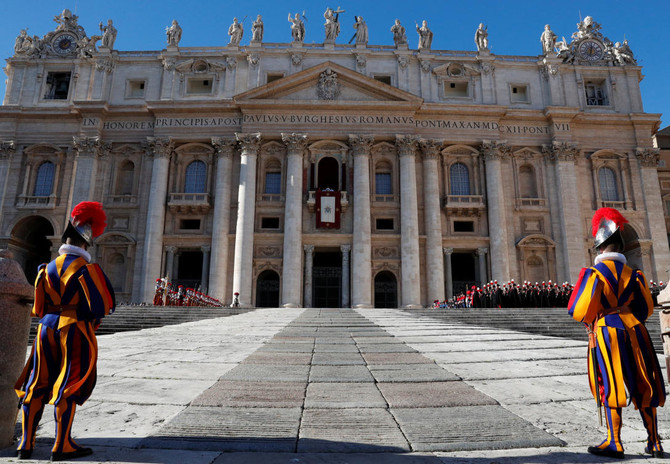
Members of Swiss Guard are seen as Pope Francis delivers the “Urbi et Orbi” message from the main balcony of Saint Peter’s Basilica at the Vatican, December 25, 2018. (Reuters)
Updated 25 December 2018
Follow

Pope hopes for peace in Yemen, Syria and other flashpoints

  • The pontiff said he hoped a truce in Yemen would end the war there
  • He also said he hoped for renewed peace talks between the Israelis and Palestinians

VATICAN CITY: Pope Francis offered a Christmas wish for fraternity among people of different nations, cultures, faiths, races or ideas, describing the world's differences as a richness, not a danger, and championing the rights of religious minorities.
His plea Tuesday for stronger bonds among peoples came as nationalism and a suspicion of migrants are gaining traction across much of the globe.
The long war in Syria, famine amid warfare in Yemen, social strife in Venezuela and Nicaragua, conflicts in Ukraine and tensions on the Korean Peninsula were among the pope's concerns in his Christmas Day message, which he read from the central balcony of St. Peter's Basilica.
Addressing some 50,000 tourists, pilgrims and Romans who flocked to St. Peter's Square on a mild, sunny day, Francis said the universal message of Christmas is that "God is a good Father and we are all brothers and sisters."
"This truth is the basis of the Christian vision of humanity," Francis said in the traditional papal "Urbi et Orbi" ("to the city and the world") message. Without fraternity, he said, "even our best plans and projects risk being soulless and empty." He called for that spirit among individuals of "every nation and culture" as well as among people "with different ideas, yet capable of respecting and listening to one another."
"Our differences, then, are not a detriment or a danger; they are a source of richness," Francis said.
Francis prayed that all minorities have their right to religious freedom respected, noting that some Christians were celebrating Christmas "in difficult, if not hostile, situations."
Communist China is witnessing a systematic suppression of religion, including some restrictions on Christmas celebrations this year. The government's suppression campaign includes re-education camps for Uighur Muslims and a crackdown on Christian churches.

Without specifying religions or countries, Francis prayed for "all those people who experience ideological, cultural and economic forms of colonization and see their freedom and identity compromised."
Francis urged the international community to find a political solution that "can put aside divisions and partisan interests" and end the war in Syria. He said he hoped that an internationally-brokered truce for Yemen would bring relief to that country's people, especially children, "exhausted by war and famine."
He encouraged dialogue among Israelis and Palestinians to end conflict "that for over 70 years has rent the land chosen by the Lord to show his face of love."
In Africa, Francis recalled the millions fleeing warfare or in need of food, and prayed for "a new dawn of fraternity to arise over the entire continent."
Francis urged Venezuelans to "work fraternally for the country's development and to aid the most vulnerable." Millions of Venezuelans are fleeing their country's economic and humanitarian crisis in what has become the largest exodus in modern Latin American history, according to the United Nations.
On Monday night, the 82-year-old pope celebrated Christmas Eve Mass in St. Peter's Basilica.


UK’s Starmer urges ‘sleeping giant’ Europe to curb dependence on US

Updated 2 sec ago
Follow

UK’s Starmer urges ‘sleeping giant’ Europe to curb dependence on US

MUNICH, Germany: British leader Keir Starmer will tell the Munich Security Conference that Europe is “a sleeping giant” and must rely less on the United States for its defense, his office said Friday.
In a speech on Saturday at the summit, the UK prime minister will argue that the continent must shift from overdependence on the United States toward a more European NATO.
“I’m talking about a vision of European security and greater European autonomy that does not herald US withdrawal but answers the call for more burden sharing in full and remakes the ties that have served us so well,” Starmer is expected to say.
The gathering comes as European leaders remain concerned that a United States led by President Donald Trump can no longer be relied upon to be the guarantor of their security.
Since returning to the White House last year, Trump has frequently criticized European countries for not sharing enough of the burden on common defense, and raised questions about the future of NATO.
European members of the transatlantic military alliance are rushing to build up their defenses in the face of an increasingly belligerent Moscow, whose war in Ukraine is set to enter its fifth year this month.
“As I see it — Europe is a sleeping giant. Our economies dwarf Russia’s, 10 times over,” Starmer will tell allies, according to excerpts released ahead of his address.
“We have huge defense capabilities. Yet, too often, all of this has added up to less than the sum of its parts,” he was to say, citing fragmented planning and procurement problems.
Late last year, talks on Britain joining the bloc’s new 150-billion-euro (£130 billion) rearmament fund broke down, reportedly because London baulked at the price for entry.
Downing Street said Starmer would use his speech to call for closer UK-EU defense cooperation.
“There is no British security without Europe, and no European security without Britain. That is the lesson of history — and it is today’s reality too,” Starmer was to say.
The UK government announced on Friday that Britain will spend more than £400 million this financial year on hypersonic and long-range weapons, including through joint projects with France, Germany and Italy.
Starmer, whose center-left Labour party is being squeezed on opposite ends of the political spectrum by the anti-immigrant Reform UK group and the more leftwing Greens, was to say leaders “must level with the public” about the defense costs they face.
He was due to hit out at “peddlers of easy answers on the extreme left and the extreme right,” according to the excerpts.
“The future they offer is one of division and then capitulation. The lamps would go out across Europe once again. But we will not let that happen,” Starmer was expected to say.