President Alvi lauds Christian community’s sacrifices for Pakistan

1 / 6
Children wearing Santa Claus costumes sing in a choir during a Christmas service at Saint Patrick’s Cathedral in Karachi on Dec. 22, 2018. (AFP/File)
2 / 6
Joseph Cardinal Coutts, Archbishop of Karachi, kisses the Bible during a Christmas Eve service at the St. Patrick Cathedral in Karachi, Pakistan on Dec. 25, 2018. (REUTERS)
3 / 6
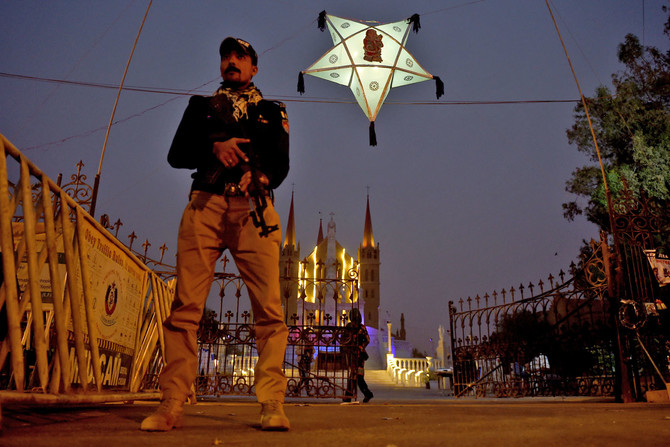
A Pakistani policeman stands guard in front of Saint Patrick’s Cathedral in Karachi on Dec. 23, 2018. (AFP/File)
4 / 6
Pakistani Christian devotees attend a special service ahead of Christmas at the St. John’s Church in Peshawar on Dec. 23, 2018. (AFP/File)
5 / 6
Pakistani Christian devotees attend a special service ahead of Christmas at the St. John’s Church in Peshawar on Dec. 23, 2018. (AFP/File)
6 / 6
Pakistani Christians attend a Christmas Day service at the Holy Trinity Cathedral in Karachi on Dec. 25, 2018. (AFP/File)
Updated 25 December 2018
Follow

President Alvi lauds Christian community’s sacrifices for Pakistan

  • Vows to build a society that respects differences and celebrates diversity
  • Authorities deploy additional law enforcement personnel for tighter security around Christmas

ISLAMABAD: As Christians celebrated Christmas on Tuesday in Pakistan with zeal and zest, the country’s top political leadership extended their good wishes to the community and vowed to provide equal rights and opportunities to all citizens.
Authorities, on their part, deployed additional law enforcement personnel to ensure tighter security for the occasion.
President Arif Alvi in his message extended his “warmest greetings” to the community in a statement released by his office. “Much more than festivity and celebration, the spirit of Christmas is to share, to reach out, and to love all humanity,” it read.
He commended the sincere efforts of the Christian community toward the socio-economic development of the country. “I also take this opportunity to pay a rich tribute to the sacrifices made by our Christian brethren in Pakistan’s fight against terrorism,” he said.
In his message, President Alvi added that the government of Pakistan upholds the principle of equal rights and freedom for all its citizens irrespective of caste, creed, or religion.
“We are committed to building a society that respects differences and finds strength in diversity; a nation that is tolerant and cohesive; and a state that provides equal rights and opportunities to all citizens,” he said, adding that “our Christian brethren are an integral part of our multicultural polity; and together we are building a strong and prosperous Pakistan, for ourselves and our children.”


Pakistan urges concessional finance for developing nations to boost clean energy security

Updated 11 January 2026
Follow

Pakistan urges concessional finance for developing nations to boost clean energy security

  • Pakistan has emerged as one of world’s fastest growing solar markets, with 12GWs of off-grid and 6GWs of net-metered capacity in 2025
  • PM’s aide says Islamabad remains committed to Paris Agreement, looks for continued support in building a resilient and low-carbon future

ISLAMABAD: Pakistan has urged international partners to scale up concessional financing for developing countries, the country’s Press Information Department (PID) said on Sunday, citing an aide to Prime Minister Shehbaz Sharif.

The call was made by Sharif’s coordinator on climate change, Romina Khurshid Alam, while delivering Pakistan’s national statement at the 16th International Renewable Energy Agency (IRENA) Assembly in Abu Dhabi.

Pakistan has emerged as one of the world’s fastest growing solar markets, with 12 gigawatts (GWs) of off-grid and over 6GWs of net-metered solar capacity by the end of 2025. Last fiscal year, renewables accounted for a historic 53 percent of total electricity generation, according to Alam.

The prime minister’s aide stressed that affordable funding for developing nations is critical to accelerating their transition to clean energy and strengthening energy security amid rising climate and economic challenges.

“Alam reaffirmed Pakistan’s target of achieving 60 percent renewables in the power mix by 2030,” the PID said in a statement.

“In her call to action, she urged IRENA and Member States to increase concessional finance for developing nations, treat technologies such as energy storage and green hydrogen as global public goods, and strengthen regional cooperation for shared energy security.”

IRENA is a global intergovernmental agency for energy transformation that serves as the principal platform for international cooperation, supports countries in their energy transition, and provides state of the art data and analyzes on technology, innovation, policy, finance and investment. Its membership comprises 170 countries and the European Union (EU).

The 16th session of the IRENA Assembly is taking place on Jan. 10-12 in Abu Dhabi and focuses on the theme of “Powering Humanity: Renewable Energy for Shared Prosperity.” The session has gathered global leaders and energy decision-makers to discuss strategies and underline necessary actions for the acceleration of renewable energy across countries, regions, and the world, driving economic inclusion, equity, and human well-being.

Alam shared that Pakistan is taking action against energy poverty through initiatives like the Punjab Solar Panel Scheme 2026, which provides free or subsidized systems to low-income households.

She highlighted how distributed solar kits have restored power and livelihoods in flood-affected communities and offer a replicable model for climate-resilient recovery.

“Pakistan remains fully committed to the Paris Agreement and looks to IRENA for continued technical and financial support in building a resilient, inclusive, and low-carbon future,” Alam said.

Adopted in 2015 to combat climate change, the Paris Agreement binds nations to hold “the increase in the global average temperature to well below 2°C above pre-industrial levels” and pursue efforts “to limit the temperature increase to 1.5°C above pre-industrial levels.”