

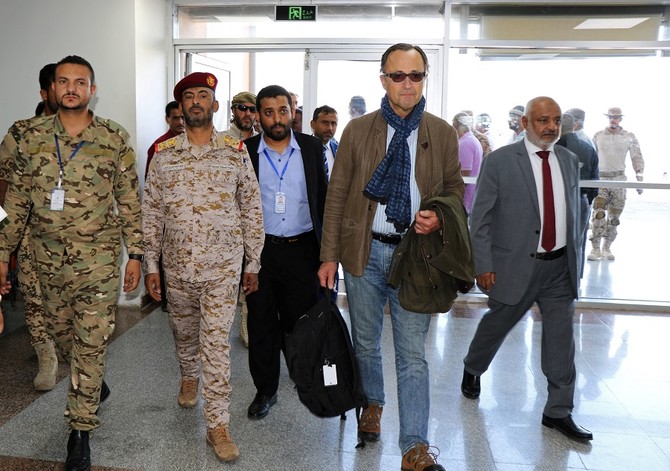
Advance UN truce monitors arrive in Yemen’s Hodeidah

Retired Dutch general Patrick Cammaert in Aden. (File/AFP)
Updated 24 December 2018
Follow

Advance UN truce monitors arrive in Yemen’s Hodeidah

  • Retired Dutch general Patrick Cammaert is heading a joint committee including members of the government and the Houthi rebels
  • He stopped in Sanaa before he arrived in Hodeidah

UNITED NATIONS: A UN advance team arrived in Yemen’s port city of Hodeidah on Sunday to start monitoring a cease-fire and withdrawal of forces agreed by the Iranian-aligned Houthi group and Saudi-backed government forces, the United Nations said.

The warring parties in Yemen’s nearly four-year war reached the deal at UN-sponsored peace talks in Sweden earlier this month. The truce began on Tuesday but skirmishes continued on the outskirts of the city.

The UN Security Council on Friday unanimously approved the deployment — for an initial 30 days — of an advance monitoring team led by retired Dutch General Patrick Cammaert. He is chair of a Redeployment Coordination Committee (RCC) that includes representatives from both sides of the conflict.

“General Cammaert is encouraged by the general enthusiasm of both sides to get to work, immediately. One of the priorities in the coming days will be the organization of the first joint RCC meeting, which is projected for 26 December,” UN spokesman Stephane Dujarric said in a statement.

Cammaert’s team, which the United Nations has said will not be uniformed or armed, will oversee the truce and troop withdrawal from Hodeidah city and three ports.

The United Nations will also provide support for the management of and inspections at the ports of Hodeidah, Salif and Ras Issa; and strengthen its presence in the war-torn region.

Hodeidah, the main port used to feed Yemen’s 30 million people, has been the focus of fighting this year, raising fears abroad that a full-scale assault could cut off supplies to nearly 16 million people suffering from severe hunger.

The deal reached in Sweden is meant to pave the way for a wider cease-fire in the impoverished country and a second round of talks in January on a framework for political negotiations.

A Sunni Muslim Arab alliance led by Saudi Arabia and the United Arab Emirates entered the war in 2015 against the Houthis to restore the internationally recognized government of Abd-Rabbu Mansour Hadi, which was ousted from the capital Sanaa.

The Houthis control most urban centers, including Sanaa, while Hadi’s government is based in the southern port of Aden.


Pakistan flags funding strain, host state cooperation gaps in UN peacekeeping

Updated 07 February 2026
Follow

Pakistan flags funding strain, host state cooperation gaps in UN peacekeeping

  • Pakistan says blue helmets remain the most visible symbol of UN commitment to peace
  • The country urges member states to pay contributions on time to sustain UN missions

ISLAMABAD: Pakistan on Friday raised concerns over mounting financial pressures on United Nations peacekeeping operations along with a lack of cooperation from some host countries, warning that the challenges risk undermining the effectiveness and safety of missions worldwide.

Pakistan’s top diplomat at the UN flagged the issues while speaking at a UN Security Council briefing on peacekeeping police components.

Pakistan is one of the world’s top troop-contributing countries and has deployed more than 235,000 peacekeepers to 48 UN missions across four continents over the past eight decades.

A total of 182 of its peacekeepers have also lost their lives while serving under the UN flag.

“We are concerned at the current challenges faced by the United Nations peacekeeping, both financial as well as those arising from lack of host state cooperation,” Ambassador Asim Iftikhar Ahmad told the council. “Pakistan underscores the importance of full cooperation by host States to enable timely deployment of peacekeepers including police components where authorized by the Security Council.”

He noted that UN missions were operating under acute financial stress, leading to capacity reductions that directly affected mandate delivery and the safety of peacekeepers, while UN police units continued to face gaps between authorized strength and actual deployments.

Ahmad urged UN member states to pay their assessed contributions in full and on time to ensure peacekeeping missions remain operationally capable.

“Blue helmets are the most visible symbol of the United Nations commitment to peace and stability,” he said. “Peacekeeping brings relevance and legitimacy to this organization by making a tangible difference in people’s lives.”

Pakistan has contributed both military and police personnel to UN operations, deploying more than 50 formed police units to missions including Haiti, Darfur, Timor-Leste and Côte d’Ivoire, according to Pakistan’s UN mission.