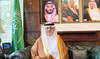
TheFace: Enji A. Al-Ghazzawi, Executive Vice President of Operations, Riyadh Bank

AN photo by Ziyad Alarfaj
Updated 23 December 2018
Follow

TheFace: Enji A. Al-Ghazzawi, Executive Vice President of Operations, Riyadh Bank

  • The first lesson we were taught was to never prioritize anything over family; work was important, indeed essential, but family must always precede it

Enji A. Al-Ghazzawi: Quality time spent with family is sacred. This is a lesson my parents taught me from an early age. I was an only daughter, sandwiched between two brothers; my father is an employee of the Ministry of Energy and Mineral Resources, and my mother, a strong woman, strived to complete her education and degree with three children in tow.
The first lesson we were taught was to never prioritize anything over family; work was important, indeed essential, but family must always precede it.
I was raised as an equal to my brothers, and our parents believed we could accomplish anything we set our hearts to. What mattered, in order to achieve, was a readiness to learn. Growth, they taught us, required us to grab opportunities and not compromise our ethics. It was a life lesson I have clung to in my 20-year career at Riyadh Bank.
Starting off as a translator, I rotated around various departments, gradually gaining more experience. I was hooked, and it gave me the inspiration to drive my way up the company.
I jotted down four words on a note, “Executive Vice President of Operations” (EVP), the visual representation of the role I wanted to achieve, and kept it with me.
Without the drive instilled by my parents, my family’s support and the opportunities afforded to me by Riyadh Bank, I would never have reached it. For 12 years I worked in the operations department, before moving to corporate services, and eventually becoming the EVP of operations four years ago.
My own success is not my only motivation, though. Throughout my career, I made a point of supporting and mentoring fellow Riyadh Bank employees on their own career journeys. Pushing them to gain the right skills and to grow in the organization was a personal goal of mine; I wanted them to achieve their dreams too. To see a young generation reach their potential, to see their happiness and to know I had played a part, was as satisfying to me as seeing the joy of my own children reach theirs.
Despite this, my parents’ mantra, that work is important but family comes first, has stuck with me. Just before my marriage, my mother advised me to always prioritize my family over anything else. “You will be accountable before God for your family,” she said. “Always strive to temper your ambition; happiness will strike the right balance between both.”
My children are my best friends and my pride and joy. My eldest son Faisal is a medical student, and my daughter Lana, though only in 10th grade, is a pillar of support, alongside my husband. We both believe in leading by example, and while raising our children, we hope to install in them the same work and moral ethics our parents gave us.


Minzal brings Saudi traditions to life in Diriyah

Updated 07 January 2026
Follow

Minzal brings Saudi traditions to life in Diriyah

  • From leather crafts and archery to Saudi coffee, Minzal offers a lesson in ‘Sloum Al-Arab’

RIYADH: This season of Minzal places social norms and traditional etiquette at its center, with tents set up to teach what is locally known as “Sloum Al-Arab” alongside gatherings for coffee, dinner and stargazing around campfires.

“Sloum Al-Arab” refers to the unwritten customers and values that have shaped Arab and Bedouin society for centuries, including generosity, coffee preparation, courage and archery. 

In Saudi Arabia, these traditions are closely ties to cultural identity and religious belief. 

Leather products and the making of leather goods is one of the crafts featured at Minzal this year and is one of the oldest crafts still practiced in the kingdom.

“The most difficult thing I faced to work on was camel leather because it is a little tough,” Nada Samman, a leather trainer and craftsman at Minzal, told Arab News. 

Minzal continues to evolve with each season, offering activities that highlight Bedouin values, traditional skills and sports. (AN photo by Haifa Alshammari)

“The work on leather is wonderful whether it is goat leather, cow leather, Sawakni sheep, and of course, camel leather. At Minzal, we are offering multiple handicraft workshops, most specifically the leather handicrafts. We want visitors to spend time at something useful and fun."

Samman explained the workshops allowed participants to preserve heritage while engaging in meaning, hands on activities. 

Faisal Al-Khaled, a visual artist and craftsman specializing in Saudi designs at Minzal, shared a similar goal: “I want people to have, by the end of this experience, a unique and traditional art piece created by them, and that I know I helped them to preserve this craft.”

Minzal, which has been organized for several years now, continues to evolve with each season, offering activities that highlight Bedouin values, traditional skills and sports. Archery is a key feature, reflecting its deep roots in Arab and Islamic history.

Mohammed Al-Sharif, a certified archery player and coach with the Saudi Archery Federation since 2028, said the sport was closely connected to Saudi culture. It was encouraged by the Prophet Muhammad, which led people to learn and teach it through generations.

“Our traditional bow is considered one of the most important and widely used bows in Arab culture,” Al-Sharif said. “We have several styles, and professional archers specializing in traditional bow shooting … There are various types of archery, such as horseback archery and standing archery, where bow sizes vary according to specific needs, such as types used for hunting and others used during warfare.”

He explained that archery was historically part of daily life, used for protection and hunting. 

Saudi coffee also plays a significant role in the Minzal experience, with live demonstrations. One of the most frequently consumed beverages in the Kingdom, it is a symbol of hospitality and generosity.

Ahmed Al-Shuaibi explained how it was prepared at the Sloum tent, first by roasting the beans and then allowing them to cool. The beans are ground with spices in a Nigr.

“Coffee is passed from our grandparents,” he added. “In significant majlis, you see them offering our local coffee and not other types of coffee. We organized this corner so that young generations can visit and learn this.”