ISLAMABAD: ISLAMABAD: Ruing that issues inherited from the previous governments were slowing down the performance of Prime Minister Imran Khan’s administration, Ministers quoted the premier in saying that Pakistan is going through an extraordinary phase.
While talking exclusively to Arab News about the details of a cabinet meeting — described as the longest to be held in the history of Pakistan – Finance Minister Asad Umar said that PM Khan has “literally tried to reach for the stars and that’s the benchmark he wants to set”.
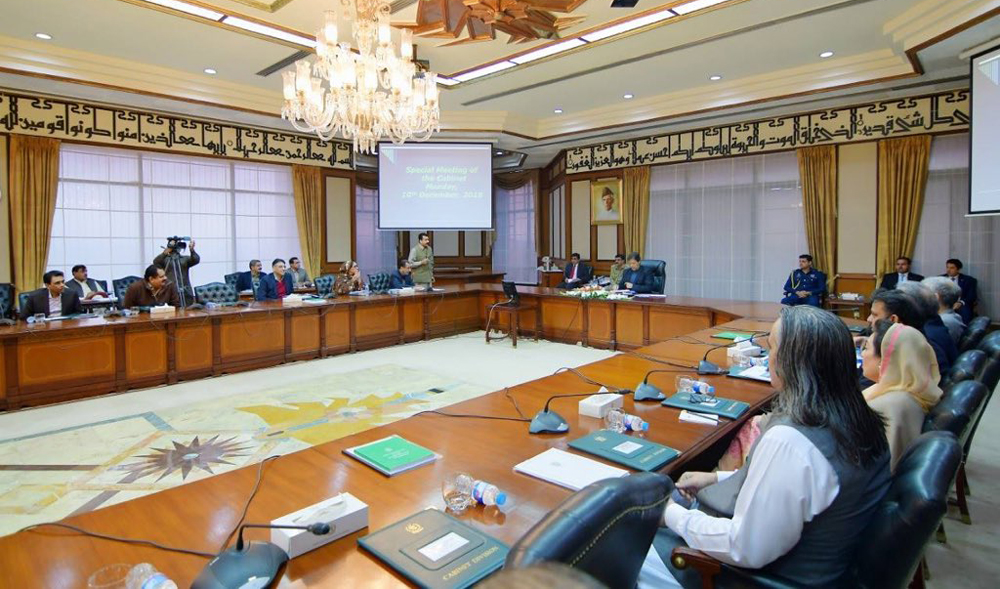
On Monday, the premier chaired the nine-hour cabinet meeting to evaluate the performance of 26 out of 34 ministries. (Photo courtesy: @pid_gov/Twitter)
PM Khan told his cabinet: “The circumstances are not normal. We are passing through an extraordinary situation and I expect all the ministers to show extraordinary performance.”
“But I mean it,” he added, reminding his administration not to backtrack on the promises made during the election campaign just like their predecessors. “We have to take every step for the betterment of the people. People are at the center of our government policies.”
Though Khan didn’t express displeasure over the performance of any specific ministries and lauded a few, but it cannot be assumed he was satisfied acknowledged Umar.
Among the several issues discussed during the meeting, the government announced plans to hold quarterly assessments to review ministerial accomplishments said the PM office in a statement adding that the move was to ensure that the “government is on track.”
However, analysts are skeptical about whether or not PM Khan can actually implement his party’s reforms agenda.
The PM’s selected cabinet is comprised of politicians from allied parties which helped form his government, therefore “he can’t be tough on his ministers”, political analyst Qamar Cheema told Arab News.
Assessing the newly-installed government’s performance, Cheema said that PM Khan and his cabinet “failed to give time to parliament” and hear the representatives of the people.
“There has been virtually no legislation since PTI [Pakistan Tehreek-e-Insaf party] assumed power. Khan hasn’t fulfilled his promise of question hour where he was to answer questions by parliamentarians,” Cheema said, highlighting the premier’s poor attendance to National Assembly sessions.
Blowing the trumpet on the self-assessed achievements by fulfilling milestones set during the 100-day agenda in November, PM Khan is cognizant that his administration’s honeymoon period of planning and plotting a course to tackle multifaceted issues is over and its time for action. His promise of a new Pakistan requires deliverables looking past the formation of task forces and on paper reforms to pursue his vision of a progressive and ideal welfare state.
Gallup Pakistan (GP), the country’s leading research institution since the 1980s, informed Arab News that the party’s popularity graph is heading south.
“Since the elections, the graph has been on a downward (trajectory). In the beginning there was hope and the morale of the people (was) quite high in terms of their expectations and (PTI) promises but there has been a shift toward the negative side due to (certain) blunders and inexperienced (administration) of Khan,” Mohsina Ahmed, a GP research executive, said.
Umar, dispelled the notion, that the PTI has shown less than stellar performance, and that it laid much of its woes on the outgoing embattled Pakistan Muslim League – Nawaz party for the slowdown in the economy and the ongoing financial crisis.
While the ruling party says that it has prioritized uprooting corruption, equal accountability, recovery of stolen national wealth, and implement austerity measures amid inflation, depreciating currency and a crippled economy, an atmosphere of economic uncertainty is gradually generating hysteria with in the business and merchant communities according to experts.
“How do we know there is uncertainty in the country,” Umar asked. “What are the metrics other than people saying it repeatedly”, he added, pointing to the fall of the stock market and the devaluation of the currency prior to the July elections.
“I lived with the two to three months of uncertainty” mulling whether to approach the International Monetary Fund first “which was the easiest thing for me to do” he said. “I’d much rather have long-term success, what’s good for the people of Pakistan and if in the meantime the media wants to blame me for being confused, I’ll bare that cost,” he said.