PARIS: A shooting in the French city of Strasbourg killed three people and wounded 11 others near a world-famous Christmas market Tuesday, sparking a broad lockdown and a search for the suspected gunman, who remained at large.
French prosecutors said a terrorism investigation was opened, though authorities did not announce a motive for the bloodshed. The city is home to the European Parliament, which was locked down after the shooting.
It was unclear if the market — which was the nucleus of an Al-Qaeda-linked plot in 2000 — was targeted. The prefect of the Strasbourg region said the suspect was previously flagged as a possible extremist.
The gunman has been identified and has a criminal record, according to Interior Minister Christophe Castaner.
The death toll, first reported as one, rose to three by late Tuesday, according to two police union officials. One official, Stephane Morisse of union FGP, told The Associated Press the alleged shooter was wounded by soldiers guarding the market.
Gendarmes went to the suspect’s home to arrest him earlier Tuesday, before the attack, but he wasn’t there, Morisse said. They found explosive materials, he said.
French military spokesman Col. Patrik Steiger said the shooter did not aim for the soldiers patrolling in and around the Christmas market, but targeted civilians instead.
Several of the people wounded were in critical condition, the interior minister said.
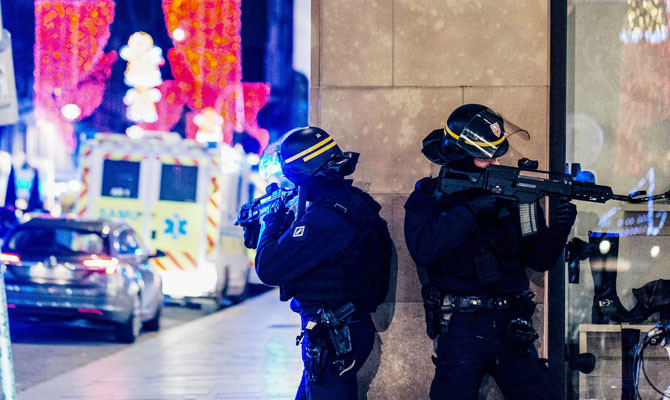
Witnesses described to the AP hearing gunshots, screams and the shouts of police officers ordering people to stay indoors before the area fell silent and the officers fanned out.
“I heard two or three shots at around 7:55 p.m. (1855 GMT), then I heard screams. I got close to the window. I saw people running. After that I closed the shutters. Then I heard more shots, closer this time,” Yoann Bazard, 27, who lives in central Strasbourg.
“I thought maybe it’s firecrackers,” he said, speaking by phone. “And then, as it got close, it was really shocking. There were a lot of screams. ... There were police or soldiers shouting ‘Get inside!’ and ‘Put your hands on your head.’“
Freelance journalist Camille Belsoeur was at a friend’s apartment when they heard the gunfire, at first mistaking it for firecrackers.
“We opened the window. I saw a soldier firing shots, about 12 to 15 shots,” Belsoeur said,
Other soldiers yelled for people to stay indoors and shouted ‘Go home! Go home!’” to those outside, he said. .
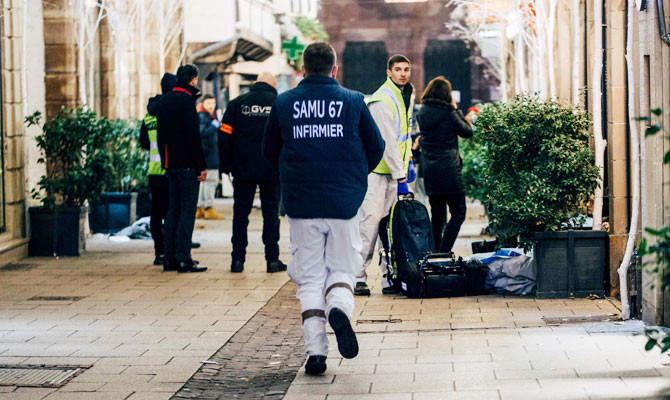
Another witness, Peter Fritz, told the BBC one of the people killed was a Thai tourist who was shot in the head and didn’t respond to lengthy attempts to revive him.
“We tried our best to resuscitate him. We applied CPR. We dragged him into a restaurant close by,” Fritz said.
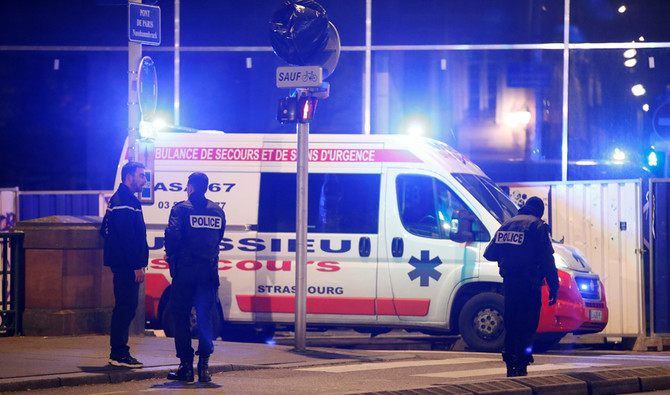
He said it took more than 45 minutes for an ambulance to arrive, during which time an emergency doctor advised by telephone “that any further efforts would be futile.”
The victim “is still here in this restaurant but we have abandoned all hope for him,” Fritz said.
France previously endured several high-profile extremist attacks, including the coordinated attacks at multiple Paris locations that killed 130 people and wounded hundreds in November 2015. A 2016 truck attack in Nice killed dozens.
President Emmanuel Macron adjourned a meeting at the presidential palace Tuesday night to monitor the emergency, his office said, indicating the gravity of the attack.
Castaner and the Paris prosecutor, who is in charge of anti-terror probes in France, headed to Strasbourg. The prosecutor’s office said the investigation was being conducted on suspicion of murder and attempted murder in relation with a terrorist enterprise charges, suggesting officials think the alleged shooter may have links to extremists.
In multiple neighborhoods of Strasbourg, the French Interior Ministry urged the public to remain indoors. Local authorities tweeted for the public to “avoid the area of the police station,” which is close to the city’s Christmas market.
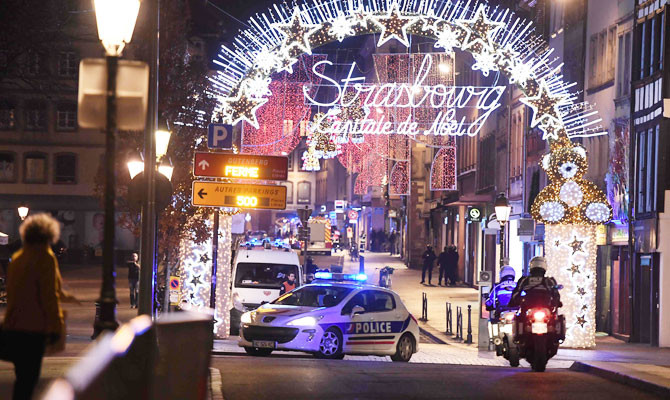
Strasbourg’s well-known market is set up around the city’s cathedral during the Christmas season and is a popular gathering place.
French soldiers were on patrol after the shooting. At the scene, police officers, police vehicles and barricades surrounded the sparkling lights of the market.
“Our security and rescue services are mobilized,” Castaner said.
European Parliament spokesman Jaume Duch said that “the European Parliament has been closed and no one can leave until further notice.” It wasn’t immediately clear how many people were inside.
The attack revived memories of a new millennium terror plot targeting Strasbourg’s Christmas market. Ten suspected Islamic militants were convicted and sentenced to prison in December 2004 for their role in a plot to blow up the market on the New Year’s Eve ushering in 2000..
The Algerian and French-Algerian suspects — including an alleged associate of Al-Qaeda leader Osama bin Laden — went on trial in October on charges they were involved in the foiled plot for the attack.
They were sentenced to prison terms ranging from one to nine years.


![]()
![]()
![]()
![]()

France shooting: 3 dead, several wounded in Strasbourg
France shooting: 3 dead, several wounded in Strasbourg
- The shooter was believed to be a 29-year-old from the city who was set to be arrested on Tuesday morning


Latest updates


© 2026 SAUDI RESEARCH & PUBLISHING COMPANY, All Rights Reserved And subject to Terms of Use Agreement.