

NAB arrests PML-N leader in Paragon Housing scam

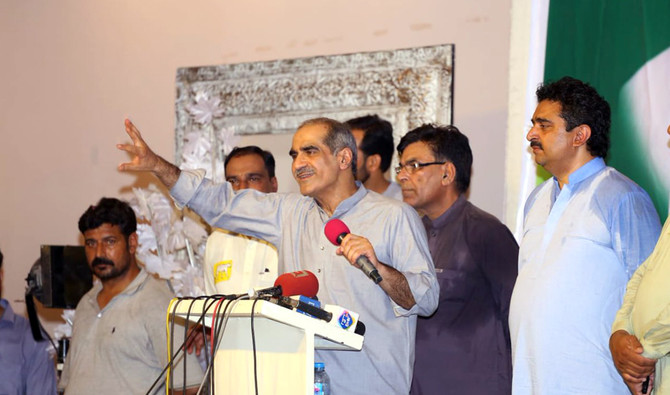
Khawaja Saad Rafique, Member of National Assembly from Lahore, is considered a close aide of PML-N leadership (Photo courtesy: Khawaja Saad Rafique's Twitter account)
Updated 11 December 2018
Follow

NAB arrests PML-N leader in Paragon Housing scam

  • Former federal minister Khawaja Saad Rafique and his younger brother are senior members of the party
  • Lahore High Court rejects bail applications filed by the two

ISLAMABAD: Pakistan's anti-graft body on Tuesday arrested opposition leader Khawaja Saad Rafique and his younger brother, Salman Rafique, for their alleged involvement in a multi-million dollar housing scam in Lahore.

Both the brothers are senior members of the Pakistan Muslim League-Nawaz (PML-N) party.

The Lahore High Court, on Tuesday, rejected the bail application filed by the two in the “Paragon Housing Scam”, following which officials from the National Accountability Bureau (NAB) arrested them from outside the court. 

The two are accused of receiving an overestimated contract for a housing society project which was allegedly approved by the former Chief Minister of Punjab and PML-N president, Shehbaz Sharif.  

The Khawaja brothers rejected the charges, adding that they were politically motivated, even as the Ashiana Housing Scheme case is one of the key charges against Sharif who is currently lodged in Rawalpindi's Kot Lakhpat Jail after being arrested by NAB.  

Saad Rafique served as the railways minister under former-PM Nawaz Sharif, who was removed from office in July last year following the Supreme Court's decision in the Panama Papers' case.

PML-N spokesperson, Marriyum Aurangzeb, while talking to reporters on Tuesday said that the arrest of the Khawaja brothers was nothing but “political vendetta."

Rafique is the member of the National Assembly from Lahore and is considered as a close aide of PML-N leadership. 

Nawaz, the supreme leader of the PML-N and thrice former prime minister, is accused of being involved in two corruption cases, too.


Putin calls Russia’s ties with Pakistan ‘mutually beneficial’

Updated 4 sec ago
Follow

Putin calls Russia’s ties with Pakistan ‘mutually beneficial’

  • The Russian President mentions the ties as Pakistan’s new envoy presents his credentials in Moscow
  • Pakistan and Russia have strengthened relations in recent years, expanding cooperation in key sectors

ISLAMABAD: Russian President Vladimir Putin has described relations with Pakistan as “mutually beneficial,” according to a social media post by his country’s embassy in Pakistan on Friday, as he met newly appointed Pakistani ambassador Faisal Niaz Tirmizi during a credentials ceremony in Moscow.

Pakistan and Russia have steadily strengthened bilateral ties in recent years while working to further expand cooperation in trade, investment, energy and connectivity.

“We maintain close cooperation with Pakistan, a full member of the Shanghai Cooperation Organization, the largest regional organization in terms of economic, technological, and human potential,” Putin was quoted as saying in a post on X. “Russia

Pakistan relations are genuinely mutually beneficial.”

In recent years, Pakistan and Russia have pledged to deepen economic ties, explore barter trade and energy deals, and boost people-to-people contacts. High-level visits have also taken place between officials of both countries, highlighting interest in expanding cooperation in technology, agriculture and transport.

Last December, Pakistan Finance Minister Muhammad Aurangzeb said Russia and Pakistan were in talks on a potential oil-sector agreement.

Earlier, in May, Pakistan and Russia agreed to establish a steel mill in Karachi, aiming to boost bilateral ties and expand industrial collaboration.

The two countries are also working on the Pakistan Stream Gas Pipeline, a major infrastructure project aimed at transporting imported gas from Karachi to Punjab to help meet Pakistan’s energy needs.

In 2023, Pakistan and Russia also discussed a deal for the delivery of Russian crude to Pakistan, and talks have continued on broader energy partnerships.