President Alvi underlines strong Pak-Saudi ties during visit to Madinah

1 / 5
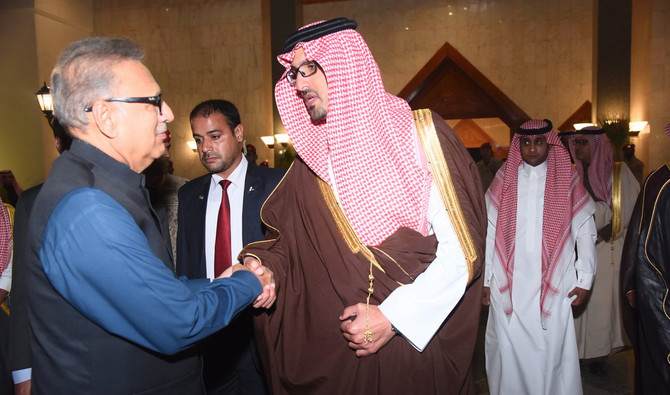
Pakistan’s President Arif Alvi with the deputy governor of Madina, Prince Saud bin Khalid bin Faisal, at the Madinah airport. (Photo courtesy: Pakistan Embassy in Riyadh)
2 / 5
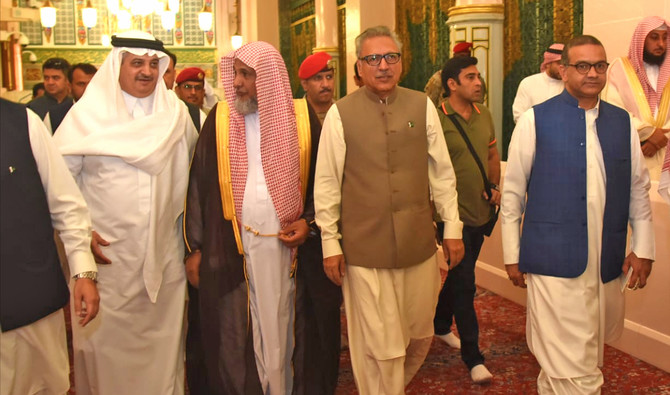
Pakistan’s President Arif Alvi offers prayers at the Prophet’s Mosque in Madinah. (Photo courtesy: Pakistan Embassy in Riyadh)
3 / 5
President Alvi was received by the deputy governor of Madina, Prince Saud bin Khalid bin Faisal at the airport. (Photo courtesy: Pakistan Embassy in Riyadh)
4 / 5
Pakistan’s President Arif Alvi offered prayers for the prosperity and development of Pakistan and for Muslims around the world. (Photo courtesy: Pakistan Embassy in Riyadh)
5 / 5
Pakistan’s President Arif Alvi during his visit to the Prophet’s Mosque in Madinah. (Photo courtesy: Pakistan Embassy in Riyadh)
Updated 11 December 2018
Follow

President Alvi underlines strong Pak-Saudi ties during visit to Madinah

  • Marks first visit to the Kingdom after assuming office in September
  • Pakistan and Saudi Arabia enjoy close bilateral relations

ISLAMABAD: Pakistan’s President Arif Alvi visited the Prophet’s Mosque in Madinah on Monday after performing Umrah, marking his first visit to the Kingdom since assuming office in September this year.
He was received by Saudi officials, with Saudi ambassador to Pakistan, Nawaf bin Saeed Al-Malki accompanying the president on his journey.
“He offered prayers for the prosperity and development of Pakistan and also for the Muslim Ummah,” a statement released by his office on Tuesday read.
Earlier on Sunday, President Alvi was received at the Prince Mohammad Bin Abdulaziz International Airport by an entourage of top officials which included Prince Saud Bin Khalid Bin Faisal, deputy governor of Madinah, and Pakistan’s consul-general, Sheheryar Akbar Khan.
Pakistan and Saudi Arabia enjoy close bilateral relations, with historic trade ties and religious affinity providing a strong basis of trust between the two countries. The Kingdom has always extended support for Pakistani nationals to perform Umrah and Hajj. This week, on Monday, both Pakistan and Saudi Arabia signed an agreement to increase the annual Hajj quota for Pakistan in 2019.
Targeting an increase of 5,000 pilgrims next year, authorities said nearly 184,210 Pakistanis will be able to perform Hajj.
Earlier this month, the government said it has reduced the visa fee for Saudi nationals who wish to travel to the country, with an aim to increase people-to-people contact between the two countries.
In October this year, Saudi Crown Prince Mohammad bin Salman accepted Prime Minister Imran Khan’s proposal to reduce the visa fee for Pakistani workers which Pakistan considers as a significant step toward supporting its workforce in Saudi Arabia, as well as facilitating the travel of people between both the countries.


Pakistan sends vessels to Saudi, UAE ports to secure crude supplies amid regional crisis

Updated 07 March 2026
Follow

Pakistan sends vessels to Saudi, UAE ports to secure crude supplies amid regional crisis

  • The development comes as countries scramble to secure energy supplies amid US-Israeli strikes on Iran and Tehran’s counterattacks
  • If Islamabad arranges, Aramco has assured a large crude carrier can be loaded at Yanbu and stationed near Pakistan, minister says

ISLAMABAD: Pakistan has sent vessels to ports in Saudi Arabia and the United Arab Emirates to secure crude oil supplies, the Pakistani petroleum minister said late Friday, as tensions in the Middle East continue to threaten global energy flows.

Global oil markets have been rattled since the United States and Israeli began pounding Iran last week, prompting retaliatory strikes from Tehran across the region. The conflict has raised fears of disruptions in energy supplies, particularly through the Strait of Hormuz, and pushed petroleum prices.

Pakistani Petroleum Minister Ali Pervaiz Malik and others said Islamabad was monitoring international energy markets and domestic supply conditions as they announced a hike of Rs55 ($0.20) per liter in petrol and diesel prices, promising to bring down the prices as soon as the conflict is resolved.

Describing the situation as “extraordinary,” Malik said they did not know how long the Middle East crisis would last and it was important to stretch Pakistan’s available petroleum reserves as much as they could to ensure a steady supply to consumers during the crisis.

“At the regional and global level, you can clearly see that countries are scrambling to secure energy supplies. Pakistan is also part of this effort because a significant portion of our energy supplies comes through the Strait of Hormuz,” he said, adding that Prime Minister Shehbaz Sharif has engaged the Saudi government to secure alternative sources.

“With the help of the Foreign Office, two Pakistan National Shipping Corporation (PNSC) vessels are currently on their way, one toward Yanbu port and the other toward Fujairah port, to bring crude oil from outside the Hormuz region in order to meet Pakistan’s energy needs.”

In addition, he said, Aramco had assured that if Pakistan arranged, a Very Large Crude Carrier (VLCC) can be loaded at Yanbu and stationed near the Pakistani waters.

“From there, PNSC (Pakistan National Shipping Corporation) feeder vessels will ensure a continuous supply of crude oil to our refineries, so that even during this difficult phase Pakistan’s energy requirements continue to be met,” Malik shared.

The statement came as long queues of vehicles were seen outside petrol stations nationwide as Islamabad moved to raise petroleum prices to keep the supplies in check.

Pakistan, which relies heavily on imported fuel to meet its energy needs, is particularly vulnerable to global oil price shocks that can quickly feed into inflation and pressure the country’s external accounts.

Officials at Friday’s presser said Pakistan, which reviews petroleum prices fortnightly, will be considering them more frequently, potentially on a weekly basis, and any reduction in global oil prices would be passed on to consumers.

Finance Minister Aurangzeb said a high-level government committee formed by PM Sharif had been meeting daily to review developments in global petroleum markets and their potential impact on Pakistan’s economy.

“Pakistan currently maintains adequate energy stocks and macroeconomic stability,” Aurangzeb said, adding that the government’s response was based on preparedness rather than panic.