
JEDDAH: Wedding celebrations across the world include traditions such as henna decoration, perfuming the bride’s dress with incense and placing garlands around the groom’s neck.
These are the subtle traditions. Then there are the not-so-subtle wedding traditions, such as the practice across the Arab world of celebratory gunfire, which has become the target of increasing safety concerns.
In a recent video that went viral across social media — at one point reaching more than 2 million views — a young Arab man shoots live bullets upwards but slightly haphazardly, and barely misses a man standing nearby, the bullet hitting the wall instead. The video is merely one of hundreds that have gone viral over the years.
Societies across the Arab world — and India, Pakistan, the Balkans and the Americas too — find this practice culturally acceptable, disregarding the danger.
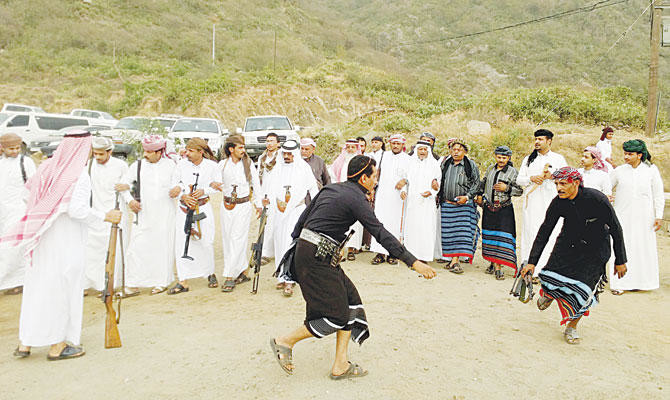
In Saudi Arabia, gun ownership is a custom held dear by many tribal families, who have traditionally believed that by carrying hunting rifles they projected power, protected their territories, and intimidated and kept rival tribes away. It is unclear how the tradition of celebratory gunfire began but it is most common in the north and southwest regions of the Kingdom, mostly in areas remote from large cities.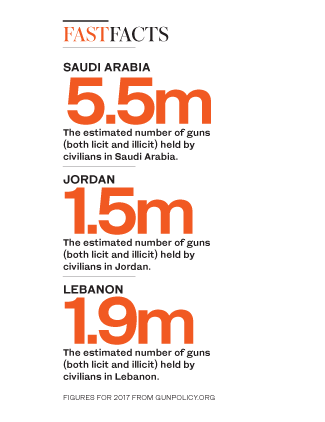
Many wedding halls prohibit firearms on their premises, often reporting incidents to the police. “It’s a dangerous nuisance and ruins the festive mood,” said 67-year-old Abdullah Fahad, a retired teacher. “People come to enjoy weddings, not to be deafened by the loud gunfire. These old traditions must stop.”
Gunfire is no longer tolerated at weddings and is considered a criminal offense. The Interior Ministry confirmed that strict laws are in place for obtaining a firearm license, saying guns are dangerous and put citizens in harm’s way.
Carrying firearms is a traditional pastime that displays a tribe’s pride, power, wealth and fighting ability. Many tribesmen still feel that it is their duty to dress in their everyday clothes and put their small firearm in its holder, said Waleed A.R., a private business owner in Al-Jouf.
“It’s mostly about tradition, the older members of our tribe still see it as important and a sign of pride for a member to carry his arms, but times have changed,” he said.
“I didn’t allow gunfire at my wedding night. I strictly told anyone who wanted to come with their firearm that they needed to have it locked on the safety without any ammunition or not to bother showing up. I was adamant. There’s no point in celebrating with a gunfire show if someone somewhere could get hurt — I don’t want to carry that weight on my conscience.”
In the Wadi Al-Dawaser governorate of southern Saudi Arabia, it is uncommon to see firearms in men’s holsters nowadays. Many keep their firearms secured and locked after too many incidences of stray bullets hitting innocent bystanders were reported.
“It’s not only tradition, we were given lessons as children on how to hold a gun — more specifically a rifle and a semi-automatic — we held our heads high and guns higher,” said Sultan M. Al-Qahtani, a 23-year-old college student.
“My grandfather told us that as head of a family branch, we as his grandchildren must hold the family name high. In perfecting the use of the rifle, we make
him proud.
“As he grew older, he realized that many young men are reckless and bring shame to the family name. The only difference between now and then is that he understands the consequences of stray bullets; he won’t allow it anymore,” he said.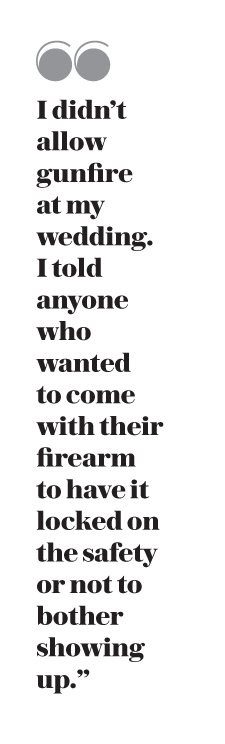
“We’d still shoot our guns in the air during Eid festivities and weddings but with lots of regulations; it’s either done in an open area away from the public or just one or two bullets shot minimum. Laws are very strict nowadays and although it is a proud tradition in the family, it’s not worth hurting anyone.”
Firearms in Saudi Arabia are strictly regulated. According to article 36 of Saudi Arabia’s Public Prosecutor’s Law of Weapons and Ammunition, any individual proven to be carrying a war weapon such as a machine gun or ammunition — or the acquiring of these — is considered a crime. The offender shall be sentenced to a maximum of 15 years of prison and will be fined SR150,000 ($40,000).
A 17-year-old female relative of a groom died in Jazan in July this year after a stray bullet hit her in the chest. In the city of Abqaiq, 25 people were killed and 35 injured at a celebration in 2012 when a stray bullet from a wedding party, fired from a semi-automatic, hit a power line and caused a fire. In the small town of Samtah, a young boy was hit by a stray bullet from a nearby wedding party while he was playing in his backyard.
Yet there are still many celebratory gun fire videos out there showing not just one or two firearms shooting bullets in the air. Some have grown bolder and mass firearms’ shows are still seen, lighting the skies with hundreds of bullets to resemble shooting stars.
In Lebanon, it is considered illegal to bear arms in public and shoot bullets in the air and yet this still occurs on occasions such as during or after a speech given by a political leader or za’eem, at weddings, funerals and, at times, randomly, just for the sake of it.
There have been many instances of deaths due to stray bullets, known as “rasa tayshe,” across Lebanon, with groups such as the Permanent Peace Movement, who are against gunfire at celebrations, campaigning for change.
According to the US Library of Congress, the firearms-control legislation and policy for Lebanon states: “There is no legal right under Lebanese law for anyone on Lebanese territory to bear arms.” No one is permitted to acquire, possess or transport weapons or ammunition except in case of security.
Yet it is estimated that there are more than 1.9 million illicit guns held by Lebanese civilians in 2017, more than double the number since 2007, according to GunPolicy.org, a web source on armed violence, firearm law and gun control which supports global efforts to prevent gun injury.
As of 2015, Jordanians were banned from possessing automatic weapons, licenses were restricted to security companies and private guards. The penalty for breaking the law is imprisonment and hard labor of between three months to three years, or a fine of 1,000 Jordanian dinars ($1,410).
Gunfire during public jubilation at weddings, parties, the end of high school exams and graduations is common. King Abdullah of Jordan has condemned the practice, saying: “There will be a zero-tolerance policy in dealing with celebratory gunfire.”
“Even if it is my own son, I will ask the appropriate authorities to deal with him,” he said.
In 2015, a man was sentenced to 10 years in jail with labor for killing a 15-year-old boy after hitting him with three bullets from an illegal Kalashnikov rifle, penetrating his chest and abdomen and killing him instantly.
But traditions die hard. Many videos have surfaced in Jordan of accidental shootings, a problem that continues even with the current laws that are in place.
So whatever happened to dancing at weddings? It must be time to change the tune when it comes to guns and celebrations before even more people get hurt.