

Holy smoke! Pakistan Twitter on fire over ‘sin tax’ on cigarettes

Electronic cries of rage and amusement are ringing across Pakistan’s Twitter community after the government announced on Wednesday its plans to impose a ‘sin tax’ on tobacco products ostensibly to make cigarettes more expensive. (REUTERS/file)
Updated 05 December 2018
Follow

Holy smoke! Pakistan Twitter on fire over ‘sin tax’ on cigarettes

  • Pakistan’s government plans to impose a sin tax on tobacco and sugary beverages
  • The fund collected from sin tax will be allocated to health budget, says Minister for National Health Services

ISLAMABAD: Electronic cries of rage and amusement are ringing across Pakistan’s Twitter community after the government announced on Wednesday its plans to impose a ‘sin tax’ on tobacco products ostensibly to make cigarettes more expensive and reduce the number of youngsters who take to smoking each year.

While sin tax is a commonly used term to mean excise or sales tax on products deemed harmful to society, the translation by Urdu-language media of the word sin as ‘gunnah,’ used to refer to activities that go against the commands of Allah, did not go down too well among Pakistan’s puff-chested, rambunctious Twitter users.

Journalists, cultural critics and members of the ruling Pakistan Tehreek-e-Insaaf party alike took to Twitter to blow off smoke.

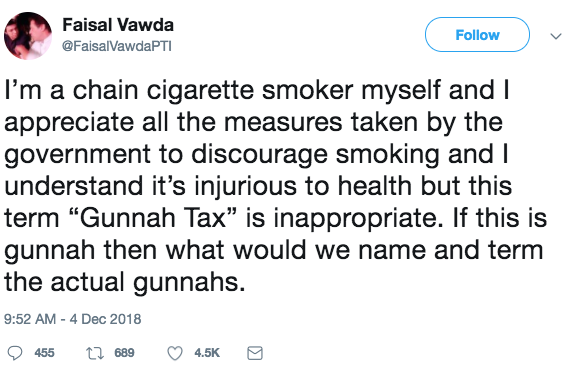
The gunslinging, motorbike-riding parliamentarian Faisal Vawda wouldn’t have any of it.   

‘I’m a chain cigarette smoker myself and I appreciate all the measures taken by the government to discourage smoking and I understand it’s injurious to health but this term “Gunnah Tax” is inappropriate,” he tweeted. “If this is gunnah then what would we name and term the actual gunnahs.”
Journalist Zarrar Khuhro, known for his sharp wit and merciless trolling, who is generally never on the same page as Vawda, responded that he was ‘with [Vawda] on this.’
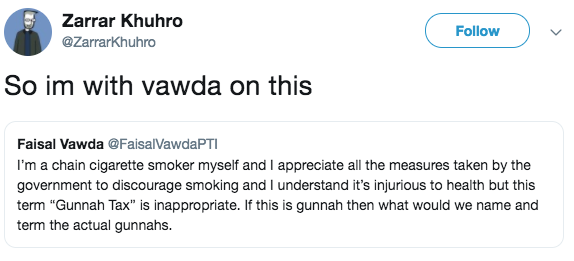
“It is a common term used internationally and is just a literal translation, not a big deal,” Khuhro told Arab News, adding that the outcry was “just another storm in a teacup.”

But Khuhro’s response to Vawda had already unleashed an army of economists (read: people adept at using google search) who proceeded to educate him about what sin tax actually meant and that the use of the word gunnah was merely a translation error. Indeed, the sheer number of people who suddenly emerged as experts on the origins and use of the sin tax since the beginning of time proved beyond a doubt that Pakistanis are capable of google searching a wide variety of topics other than just raunchy content. Ahem.

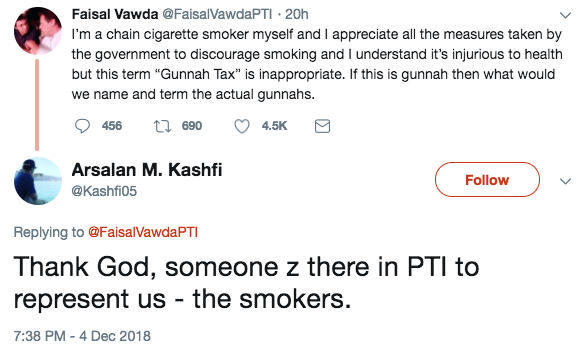
There were also those who welcomed Vawda’s stand.

“Thank God, someone z there in PTI to represent us - the smokers,” Twitter user Arsalan M Kashif said in response to Vawda’s post.
 

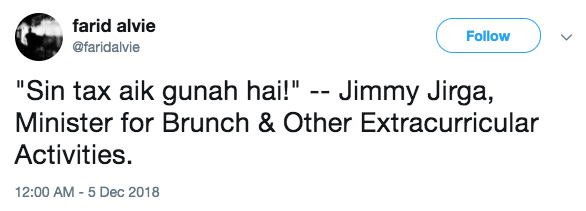
The searingly funny Farid Alvie ascribed the quote “sin tax is a sin” to a make-belief ministry:

"Sin tax aik gunah hai!’ -- Jimmy Jirga, Minister for Brunch & Other Extracurricular Activities,” Alvie posted.

One Twitter user directly addressed the prime minister for raining on his fun:

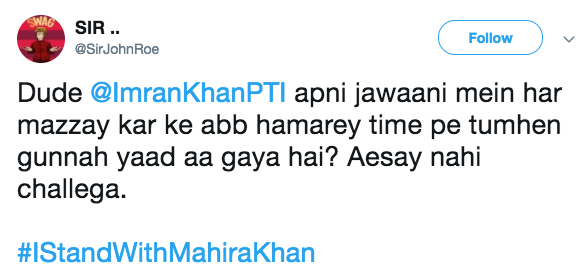
“Dude @ImranKhanPTI apni jawaani mein har mazzay kar ke abb hamarey time pe tumhen gunnah yaad aa gaya hai? Aesay nahi challega. #IStandWithMahiraKhan.’ (Oh Imran Khan, after having all the fun in your youth, now when it’s our turn you’ve remembered this is a sin? It’s not going to work like this.”

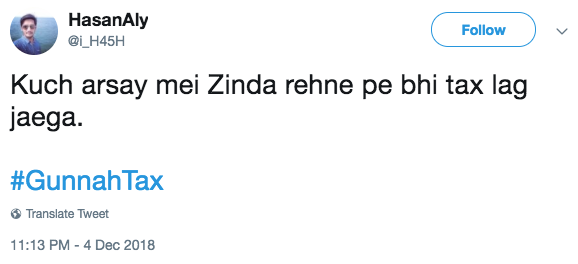
Others took an ever more dramatic approach. Hasan Aly tweeted that soon the government would tax citizens simply for being alive.
Many even revived the #IStandWithMahiraKhan hashtag from last year which was created to express solidarity with Pakistan actress Mahira Khan after she was shamed on social media over leaked photos that showed her smoking in a backless dress with Indian actor Ranbir Kapoor.

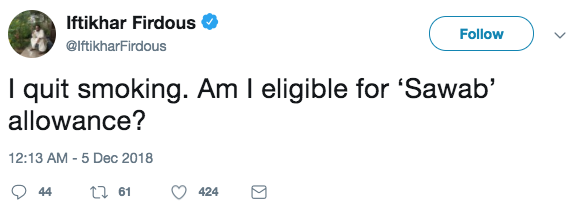
Then there was also those enterprising few who wondered if they could be rewarded for giving up smoking:

“I quit smoking. Am I eligible for ‘Sawab’ (reward) allowance?” Iftikhar Firdous, an editor at Samaa TV, said in a tongue-in-cheek post.
Author, columnist and cultural critic Nadeem Farooq Paracha had his own ideas.  

“I sure wish they could have called it something else,” Paracha told Arab News. “Like Indulgence Tax or Fun Tax Or Minor Sin tax or Chota Gunnah (small sin) Tax.” 


Showtime: The best television of 2025 

Updated 26 December 2025
Follow

Showtime: The best television of 2025 

  • From belly laughs to gut punches, here are the must-watch shows of the year 

‘Adolescence’ 

This harrowing drama consisted of four episodes, all shot in a single take. It told the story of 13-year-old Jamie Miller (the debut role for Owen Cooper, who deservedly won an Emmy for his faultless performance), who is accused of murdering a schoolmate, and the aftermath of that accusation for his family. “Adolescence” was the perfect blend of style and substance; you could marvel at the “balletic production processes that must have been involved,” as our reviewer noted, even while squirming in your seat at the painfully raw performances of the excellent ensemble cast. “It may be one of the most upsetting shows released this year,” our review concluded, “but it is also a remarkable work of art.” 

‘Severance’ S2 

Apple’s absorbing sci-fi comedy-drama expanded its universe in season two, as Mark S (Adam Scott) and his team of data refiners dealt with the fallout from their successful, if brief, escape from their ‘severed’ floor — where work and out-of-work memories and personalities are controlled and delineated by a chip embedded in their brains — at Lumon, during which they tried to alert the outside world to the cruelties of their working conditions. “Creator Dan Erickson and director Ben Stiller waste no time in rediscovering the subtle blend of tangible oddness and sinister dystopian creepiness that made the first season such an uncomfortable joy,” our reviewer wrote.  

‘Stranger Things’ S5 Vol. 1 

At the time of writing, we don’t know whether volume two of the final season of this epic Eighties-set sci-fi horror drama — out Dec. 26 — will be able to maintain the quality of this first volume, but all signs are good. As our reviewer wrote of volume one: “The Duffer Brothers lay down a compelling claim to be the current best-in-class when it comes to making thrilling mainstream TV. Is there anyone better at consistently building tension, releasing it a little through comedy, action, or both, then applying the pressure once again? The four episodes fly by.” There was edge-of-the-seat action and high-stakes jeopardy aplenty, but tempered by the moments of emotional interaction that have been crucial to the show’s success. 

‘Mo’ S2 

In Mo Amer’s semi-autobiographical comedy drama, he plays Mo Najjar, a Kuwait-born Palestinian refugee living in Houston, Texas, with his mother Yusra (the superb Farah Bsieso), and his older brother Sameer (Omar Elba), who’ve been waiting more than two decades to have their asylum case heard. In season two, our reviewer said, Amer continued to explore “incredibly complex and divisive topics — family, religion, imbalance of power, exile, mental health, parenthood, multiculturalism and much more — with an artful lightness of touch, without ever taking them lightly.”  

‘Andor’ S2 

The best of the multitude of TV spinoffs from “Star Wars,” “Andor” was only two seasons long, and the majority of viewers would already have known what was coming (spoiler: the events of “Rogue One” were coming). But its story of a population rising up against the erosion of their rights was both convincing and timely. “With ‘Andor,’ (creator Tony) Gilroy and (star Diego) Luna have truly set the gold standard for what future ‘Star Wars’ can be,” our reviewer wrote. “Not just a space opera, but real stories of transformation and beauty.” 

‘The Studio’ 

With “The Studio,” Seth Rogen and his co-creators manage both to skewer Hollywood and remind us why it’s still (sometimes) great (because it can still produce shows like ‘The Studio’). The star-studded comedy about a newly appointed Hollywood studio head, Matt Remick (Grogan), who believes himself to be a supporter of great art, but quickly discovers that he’ll have to park his principles and chase the money, was as sharp a satire as you could wish to see, confronting the inherent silliness of showbusiness but remaining entertaining throughout. 

‘Slow Horses’ S5 

The fifth season of this excellent, darkly humorous espionage drama wasn’t its strongest, but even so, it trumped most of the competition. British super-spy Jackson Lamb and his crew of misfit agents at Slough House were once again embroiled in high-level conspiracies when their resident tech nerd Roddy gets a glamorous new girlfriend who everyone — or, at least, everyone except for Roddy — can see is well out of his league. That led us into a plot covering Islamic extremism, the British far-right, and much more, all held together by Gary Oldman’s scene-stealing turn as Lamb. 

‘Last One Laughing’ 

Putting a group of 10 comedians in a room for six hours and telling them not to laugh isn’t the greatest premise on paper, but this UK adaptation of the Japanese show “Documental,” featuring a stellar lineup of some of Britain’s funniest people — and host Jimmy Carr — was an absolute joy. From Joe Wilkinson being eliminated by Lou Sanders’ whispered “Naughty tortie” to eventual winner Bob Mortimer’s whimsical flights of fancy, there was so much to love about this endearingly silly show. And credit to the casting directors — the mix of comics was central to its success.