

Iraq’s ancient pottery struggles to outlive modern plastic

1 / 3
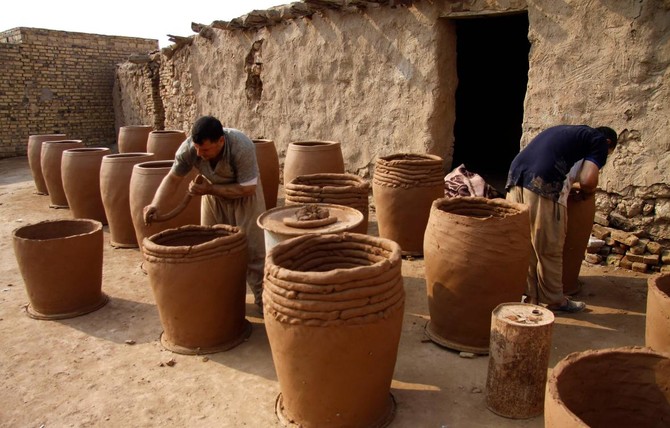
Iraqis making clay pots in Najaf on November 11, 2018. Pottery has deep roots in Iraq, where ancient civilizations turned to clay to build their homes, shape their cooking utensils, and even make their ovens. (AFP)
2 / 3
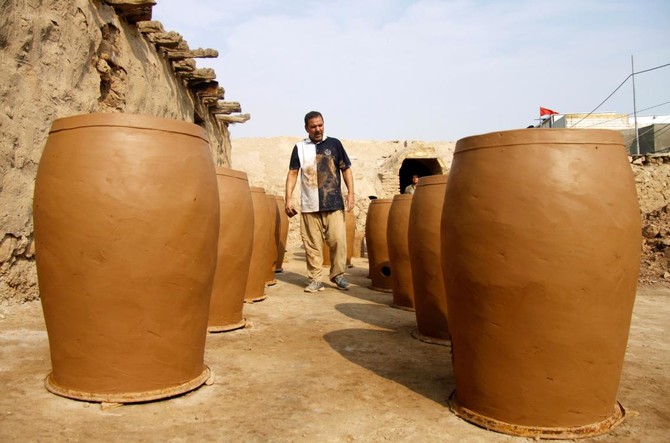
Iraqis making clay pots in Najaf on November 11, 2018. Pottery has deep roots in Iraq, where ancient civilizations turned to clay to build their homes, shape their cooking utensils, and even make their ovens. (AFP)
3 / 3
Iraqis making clay pots in Najaf on November 11, 2018. Pottery has deep roots in Iraq, where ancient civilizations turned to clay to build their homes, shape their cooking utensils, and even make their ovens. (AFP)
Updated 03 December 2018
Follow

Iraq’s ancient pottery struggles to outlive modern plastic

  • Pottery has deep roots in Iraq, where ancient civilizations turned to clay to build their homes, shape their cooking utensils, and even make their ovens
  • They were surprisingly handy during the era of Saddam Hussein, when many families struggled financially, as well as in the 1990s, when international sanctions hit Iraq

NAJAF, Iraq: Adel Al-Kawwaz expertly spins the potter’s wheel, shaping the wet clay into a smooth jug. His family is famous for this millennia-old Iraqi craft, but Kawwaz is struggling to keep it alive.
For thousands of years, clay utensils for storing food and cooking were found in virtually every home in Sumer, the earliest known civilization in modern-day southern Iraq.
Kawwaz’s own family drew their name from the jug, or “kawz” in Arabic, which they have produced for more than 200 years from clay found at a lake by Najaf, a holy Shiite Muslim city.
“Making clay vases is a craft that my family had become famous for,” says 45-year-old Kawwaz wistfully.
Pottery has deep roots in Iraq, where ancient civilizations turned to clay to build their homes, shape their cooking utensils, and even make their ovens.
Cuneiform, one of the earliest forms of writing invented by the Sumerians, was also carved into clay tablets.
But now, with a flood of more modern products, demand for the handmade clay items has dried up, says Kawwaz.
His family’s jugs were shaped from Najaf mud, dried in the shade, then baked at high temperatures for no less than 15 hours.
In Iraq, one of the hottest countries on earth, they were indispensable.
“These vases were used to keep water cool or preserve food. They were placed in the shade or hung in another high location,” he says.
Some Iraqis even used them to store jewelry.
“Those that practiced pottery would make a lot of money because they were common items in ancient Iraqi households,” says Kawwaz.
They were surprisingly handy during the era of Saddam Hussein, when many families struggled financially, as well as in the 1990s, when international sanctions hit Iraq.
With household appliances extremely rare or unaffordable for most of the population, Iraqis once again relied on clay.
“The income of most families did not allow them to buy a refrigerator or freezer to keep their water cold, so most used clay cauldrons,” he says.
Back then, his family sold their large jugs in bulk — sometimes thousands per week across every Iraqi province.
But times have changed.

“We sell very few now — the numbers in an entire year don’t hit 100 or 200 jugs,” says Kawwaz.
Farmers who once used the large containers are opting for cheaper goods, made either elsewhere in Iraq or imported.
“They buy plastic bags imported from China, so now we rarely sell clay pots,” says Kawwaz in his studio, itself made of mud and covered in palm leaves.
He makes the vases by special request only, but admits it’s hardly worth it.
Small jugs cost just 2,500 dinars or around $2, while the larger cauldrons that hold several dozen liters (gallons) are sold at 15,000 dinars.
Despite the prevalence of electric and gas cookers, Um Haydar prefers her trusty clay oven.
On her rooftop terrace in Old Najaf, she uses it to bake her own traditional bread every morning.
“The taste of bread made in a traditional oven is so different from bread baked in an electric or gas oven,” says Um Haydar, as the searing oven near her radiates an enticing smell.
Well into her sixties, the Iraqi woman is dressed in a traditional black robe that covers her from head to toe.
Like her mother and grandmother before her, she has stuck to tradition when it comes to the clay oven, with one exception — she didn’t build it herself.
But some Iraqis, like Haydar Al-Kaabi, insist on the full Sumerian experience.
On the edge of the Najaf Sea, Kaabi begins mixing together ingredients to make his own oven.
“To the clay, you have to add reeds, red sand, and synthetic wool fibers. You let the mixture rest for two days so the clay becomes compact,” he explains to AFP.
Despite the drop in sales, this potter is upbeat.
“Even if we sell less, even if the craftsmen are fewer and fewer, we’re fighting to keep the artisanal heritage of our fathers and grandfathers alive,” he says.
“And of course, there are still Iraqis who only eat good bread,” he says with a wink.


Ilia Malinin hints at ‘inevitable crash’ amid Olympic pressure and online hate in social media post

Updated 16 February 2026
Follow

Ilia Malinin hints at ‘inevitable crash’ amid Olympic pressure and online hate in social media post

  • He says Olympic pressure and online hate have weighed on him. He described negative thoughts and past trauma flooding in during his skate
  • He later congratulated the surprise champion, Mikhail Shaidorov of Kazakhstan

MILAN: Ilia Malinin posted a video on social media Monday juxtaposing images of his many triumphs with a black-and-white image of the US figure skater with his head buried in his hands, and a caption hinting at an “inevitable crash” amid the pressure of the Olympics while teasing that a “version of the story” is coming on Saturday.
That is when Malinin is expected to skate in the traditional exhibition gala to wrap up the Olympic figure skating program.
Malinin, who helped the US clinch the team gold medal early in the Winter Games, was the heavy favorite to add another gold in the individual event. But he fell twice and struggled throughout his free skate on Friday, ending up in eighth.
He acknowledged afterward that the pressure of the Olympics had worn him down, saying: “I didn’t really know how to handle it.”
Malinin alluded again to the weight he felt while competing in Milan in the caption to his social media video.
“On the world’s biggest stage, those who appear the strongest may still be fighting invisible battles on the inside,” wrote the 21-year-old Malinin. “Even your happiest memories can end up tainted by the noise. Vile online hatred attacks the mind and fear lures it into the darkness, no matter how hard you try to stay sane through the endless insurmountable pressure. It all builds up as these moments flash before your eyes, resulting in an inevitable crash.”
Malinin, who is expected to chase a third consecutive world title next month in Prague, had been unbeaten in 14 events over more than two years. Yet while Malinin always seemed to exude a preternatural calm that belied his age, the son of Olympic skaters Tatiana Malinina and Roman Skorniakov had admitted early in the Winter Games that he was feeling the pressure.
The first time came after an uneven short program in the team event, when he finished behind Yuma Kagiyama of Japan — the eventual individual silver medalist. Malinin referenced the strain of the Olympics again after the Americans had won the team gold medal.
But he seemed to be the loose, confident Malinin that his fans had come to know after winning the individual short program. He even playfully faked that he was about to do a risky backflip on the carpeted runway during his free skate introduction.
The program got off to a good start with a quad lutz, but the problems began when he bailed out of his quad axel. He ended up falling twice later in the program, and the resulting score was his worst since the US International Classic in September 2022.
Malinin was magnanimous afterward, hugging and congratulating surprise gold medalist Mikhail Shaidorov of Kazakhstan. He then answered a barrage of questions from reporters with poise and maturity that few would have had in such a situation.
“The nerves just went, so overwhelming,” he said, “and especially going into that starting pose, I just felt like all the traumatic moments of my life really just started flooding my head. So many negative thoughts that flooded into there and I could not handle it.”
“All I know is that it wasn’t my best skate,” Malinin added later, “and it was definitely something I wasn’t expecting. And it’s done, so I can’t go back and change it, even though I would love to.”