

G20 Summit declaration: multilateral trading system ‘falling short’ and needs fixing

1 / 3
Argentina's President Mauricio Macri and the G20 leaders attend the plenary session at the G20 leaders summit in Buenos Aires, Argentina, on December 1, 2018. (REUTERS /G20 handout)
2 / 3
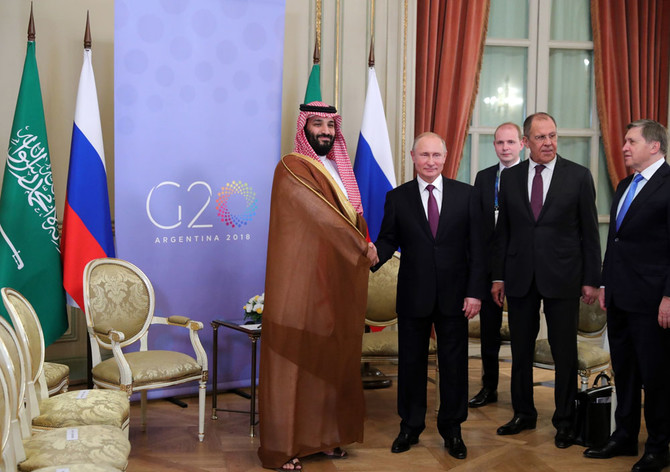
Saudi Arabia's Crown Prince Mohammed bin Salman, left, and Russian President Vladimir Putin shake hands prior their talks at the G20 summit in Buenos Aires on Dec. 1, 2018. (Mikhail Klimentyev, Sputnik, Kremlin Pool Photo via AP)
3 / 3
German Chancellor Angela Merkel and US President Donald Trump attend the plenary session at the G20 leaders summit in Buenos Aires on Dec. 1, 2018. (G20 Argentina/Handout via REUTERS)
Updated 02 December 2018
Follow

G20 Summit declaration: multilateral trading system ‘falling short’ and needs fixing

  • Summit declaration stopped short of agreement on the two biggest challenges facing the G20: The future of world trade and climate change
  • US President Donald Trump has taken a stance not shared by most of the other leaders

BUENOS AIRES: The G20 Summit of leaders of the world’s most powerful nations ended in Buenos Aires, the capital of Argentina, with a consensus for “fair and sustainable development through an agenda that is people-centred, inclusive and forward-looking.”

The official leaders’ declaration stressed their common goals in the future of work, infrastructure for development, a sustainable food future and a gender-mainstreaming strategy.

“We have addressed our agenda promoting dialogue and the search for common ground. Building consensus requires the commitment of the society as a whole,” the declaration read.

But it stopped short of agreement on the two biggest challenges facing the G20: The future of world trade and climate change. 

On these issues, US President Donald Trump has taken a stance not shared by most of the other leaders.

The declaration struck a neutral formula on trade, reading: “We welcome the strong global economic growth while recognizing it has been increasingly less synchronized between countries and some of the key risks, including financial vulnerabilities and geopolitical concerns, have partially materialized. We also note current trade issues.”

The declaration sought to reconcile the US position with the majority opinion. “International trade and investment are important engines of growth, productivity, innovation, job creation and development,” it said. “We recognize the contribution that the multilateral trading system has made to that end. The system is currently falling short of its objectives and there is room for improvement,” the declaration added, calling for further reform of the World Trade Organization (WTO).

On climate, the leaders said: “A strong economy and a healthy planet are mutually reinforcing… We recognize the importance of comprehensive adaptation strategies, including investment in infrastructure that is resilient to extreme weather events and disasters.”

They declared the Paris Agreement on Climate Change, which most countries in the world have signed, to be “irreversible.” 

The declaration thanked Argentina for hosting the G20, and the leaders said they look forward to the next scheduled meetings, in Japan next year and Saudi Arabia in 2020.

The Kingdom played a full role in the Buenos Aires summit, with Crown Prince Mohammed bin Salman meeting world leaders of the UK, China, Indonesia and South Africa, among others. 

Saudi Finance Minister Mohammed Al-Jaadan took part in the G20 Investor Forum, organized by the World Bank and held on the sidelines of the main event with a view to promoting long-term sustainable investments.


US says it seized another tanker that tried to break Venezuela blockade

Updated 09 January 2026
Follow

US says it seized another tanker that tried to break Venezuela blockade

  • The latest vessel seized was the Olina, which US Homeland Security Secretary Kristi Noem said was “another ‘ghost fleet’ tanker ship”
  • “The ghost fleets will not outrun justice,” Noem wrote on X

WASHINGTON: The United States said Friday it seized another tanker that tried to break an American naval blockade aimed at preventing sanctioned vessels from going to or departing Venezuela, the fifth ship apprehended in recent weeks.
Washington has deployed a huge naval force in the Caribbean, striking boats it says were used for drug trafficking, seizing tankers and carrying out a stunning operation to seize Venezuela’s leftist leader.
The latest vessel seized was the Olina, which US Homeland Security Secretary Kristi Noem said was “another ‘ghost fleet’ tanker ship suspected of carrying embargoed oil” that “departed Venezuela attempting to evade US forces.”


“The ghost fleets will not outrun justice. They will not hide under false claims of nationality,” Noem wrote on X, saying the Coast Guard carried out the seizure.
US Southern Command (Southcom), which is responsible for the country’s forces in the region, said US Marines and Navy personnel also took part in the operation, launching from the USS Gerald R. Ford, the world’s largest aircraft carrier.
“Once again, our joint interagency forces sent a clear message this morning: ‘There is no safe haven for criminals,’” Southcom said in a post on X that included a video clip showing US forces roping down from a helicopter and taking control of the ship.
President Donald Trump later said the seizure was carried out in coordination with interim authorities in Venezuela after the ship departed the country without US approval.
“This tanker is now on its way back to Venezuela, and the oil will be sold,” he said in a post on his Truth Social platform.
Trump said last month that he had ordered a “blockade” of sanctioned oil vessels heading to and from Venezuela, and American forces have taken control of five ships since then, including three this week.
Among them was a Russia-linked vessel that was seized in the North Atlantic on Wednesday in an operation condemned by Moscow, after being pursued by the United States from off the coast of Venezuela.
Trump told Fox News on Thursday that the tanker seized the previous day was being escorted by a Russian submarine and a destroyer.
“They both left very quickly when we arrived and we took over the ship,” the US president said, declining to specify if his Russian counterpart Vladimir Putin called him after the seizure.