Student entrepreneurs ‘will transform Saudi economy’
Al-Saraj says that Saudi Vision 2030 was motivating students, encouraging them to create their own businesses
Updated 28 November 2018
MOHAMMED AL-KINANI
Entrepreneurship in Saudi Arabia is flourishing, with specialist university centers helping students to make their dreams of setting up their own businesses a reality.
However, according to education and entrepreneurship mentor Dr. Taghreed Al-Saraj, Saudi entrepreneurs need more training if they are to develop their entrepreneurial skills and produce something worthwhile.
“Being interested is not enough,” she told Arab News.
Al-Saraj said that Saudi Vision 2030 was motivating students, encouraging them to create their own businesses. “Countries rely on entrepreneurs to create jobs for themselves and their fellow citizens,” she said.
“Everyone here is interested in being an entrepreneur, but since they do not know the basics, our academic institutes have a role to play. They don’t know what to do and what it takes to become entrepreneurs. So they need more training.
“We have a lot of interest and the buzzword in Saudi Arabia now is ‘entrepreneurship.’ However, our entrepreneurs lack sufficient knowledge of how to do that. They think that the first time they fail, they are not good entrepreneurs, but all entrepreneurs fail two times, or even more, before they produce projects worthy of acclaim,” Al-Saraj said.
Universities play a major role in exposing students to entrepreneurship. However, Al-Saraj believes that students should become entrepreneurs before leaving university.
“Once students graduate, they will be looking for jobs. That way, they increase the unemployment rate. But when they are business founders, they help to create jobs and, therefore, reduce the (jobless) rate,” she said.
Al-Saraj said that Saudi Arabia’s focus on reducing unemployment should be looked at in depth without the need for quick results.
“We need to go deeper and look at university-level students before they graduate. Teaching entrepreneurship at university is good, but it should be given through elective courses,” she said. “That way, universities can effectively contribute in tackling unemployment.”
King Abdul Aziz University’s Center of Creativity and Entrepreneurship held a forum on Monday to celebrate Global Entrepreneurship Week (GEW).
The main speaker, Abdulaziz Al-Adwani, founder and CEO of Manafa Capital, a recently authorized crowdfunding platform in Saudi Arabia, told the forum that a World Bank report had estimated crowdfunding in the Kingdom would soon rise to SR4 billion ($1.07 billion). “Individual investors in Saudi Arabia have the capability and desire to invest in small businesses,” he said.
Al-Adwani highlighted the Alibaba Group’s growth from its entrepreneurial beginnings to a giant e-commerce company.
“At first, 200 investors refused to invest in Alibaba. If those investors knew what it would become, they would not have hesitated to fund it,” he said.
Earlier this month, professor Abdullah Bafail, president of Umm Al-Qura University (UQU), launched the Future Entrepreneurs Forum at the university’s King Abdul Aziz Historical Hall in Al-Abidiyah. The forum was organized by the Institute of Innovation and Entrepreneurship as part of GEW.
Dr. Muafaq Oraijah, dean of the Innovation and Entrepreneurship Institute, told the forum that UQU provided quality programs in entrepreneurship.
“This forum is held in conjunction with GEW to embrace students’ graduation projects and provide guidance and training for them under the supervision of a highly experienced academic team in the field of innovation and entrepreneurship,” he said.
He added that they are looking forward to seeing the university entrepreneur achievements serving the community and nation.
Bafail said that the university hoped to strengthen the culture of innovation and entrepreneurship to help students become “the sources and founders of startups.”
“The university has all the capabilities that innovators and entrepreneurs need to set out in the world of innovation and creativity,” he said.
Promoting entrepreneurship among youth was the main factor in realizing Saudi Arabia’s Vision 2030, he said.
New SR 1.3 billion package targets salaries, liquidity shortages and state stability at pivotal moment for Aden government
Economic backing reinforces reform momentum and positions security as a foundation for Yemen’s long-term recovery
Updated 25 min 44 sec ago
Arab News
LONDON: When Riyadh announced on Wednesday a new SR 1.3 billion ($346.6 million) package to support Yemen’s government budget, salaries, and operational costs, it underscored more than a financial gesture. It reaffirmed a steady doctrine: diplomacy through economic stabilization.
Saudi Arabia’s military and humanitarian engagement in Yemen has long drawn global attention. Yet its economic role — through direct budgetary support, deposits, and large development projects — has been equally central to shaping the country’s fragile path toward recovery.
The latest aid signals Riyadh’s conviction that fiscal stability underpins enduring political and security progress.
The Kingdom has rolled out numerous economic and humanitarian initiatives in recent years.
Government soldiers ride on the back of a pick-up truck in the Arabian Sea port city of Mukalla. (Reuters/File)
Project Masam, a Saudi-funded demining program launched in June 2018 under KSrelief and in partnership with Yemen’s Executive Mine Action Center, has cleared more than 450,000 explosive devices.
In September 2025, KSrelief and the UN migration agency, IOM, launched two $4.45 million projects: one replacing costly water trucking in Ma’rib with permanent water systems and the other rehabilitating education facilities in Aden, Lahj, and Taiz for conflict-affected communities.
This builds on the Saudi Program for Development and Reconstruction of Yemen’s portfolio of hundreds of infrastructure projects spanning education, health, water, energy, transport, agriculture, fisheries, and governance capacity-building, offering a lifeline to millions amid what the UN has often called the world’s worst humanitarian crisis.
Yet this directive, guided by the Saudi leadership and channeled through the SDRPY, comes at a turning point for Yemen’s governance.
Fresh from recent leadership changes, the country faces acute economic strain. Public institutions grapple with severe liquidity shortages and salary arrears that threaten to erode what little trust remains in the state.
People walk at the traditional market in Mukalla in Hadramout, Yemen. (Reuters/File)
The SDRPY package is intended to strengthen economic, financial and monetary stability, enhance government capacity, improve governance and transparency, and empower the private sector to drive sustainable growth.
With a gross domestic product of just $19-20 billion, ranking roughly 125th in the world, the package is designed to kickstart Yemen’s derelict economy and break the vicious cycle whereby collapse fuels aid dependency, rendering the state all but ungovernable.
“There is no doubt that the recent Saudi support to the Yemeni government comes at an important time, following the formation of the new government headed by Dr. Shaea Al‑Zandani and its return to the interim capital Aden to manage affairs from within the country,” Gulf analyst Abdulhadi Al-Habtoor told Arab News.
“As Saudi Defense Minister Prince Khalid bin Salman announced, the support is meant to cover operational expenses and salaries, responding to the urgent needs of the Yemeni government.
A displaced Yemeni man poses for a portrait with his daughters at their shelter inside a camp in Marib, Yemen. (Reuters/File)
“In my view, this assistance will also help the government continue the economic reforms it began in the past period, with a focus on transparency, combating corruption, and unifying state revenues under the Yemeni central bank.”
Yemen’s public payroll — the lifeline of any society — has nearly collapsed. Teachers, soldiers, medical staff, and administrative workers in government-controlled areas have gone months without pay.
Even when salaries do arrive, rampant depreciation of the Yemeni rial has eroded their value, forcing families to borrow money, sell belongings, or skip meals to survive.
Economically, the package targets Yemen’s gravest structural challenge: the inability to pay around half a million civil servants regularly.
Saudi officials said the funds will bolster the salary component of Yemen’s budget, ensure consistent disbursements, and lay the foundations for long-term financial stability.
“Yemen remains Saudi Arabia’s top regional priority,” Salman Al-Ansari, a Saudi geopolitical researcher, told Arab News. “Saudi Arabia is the world’s largest humanitarian and development partner to Yemen, providing more than $20 billion in support over the past decade.
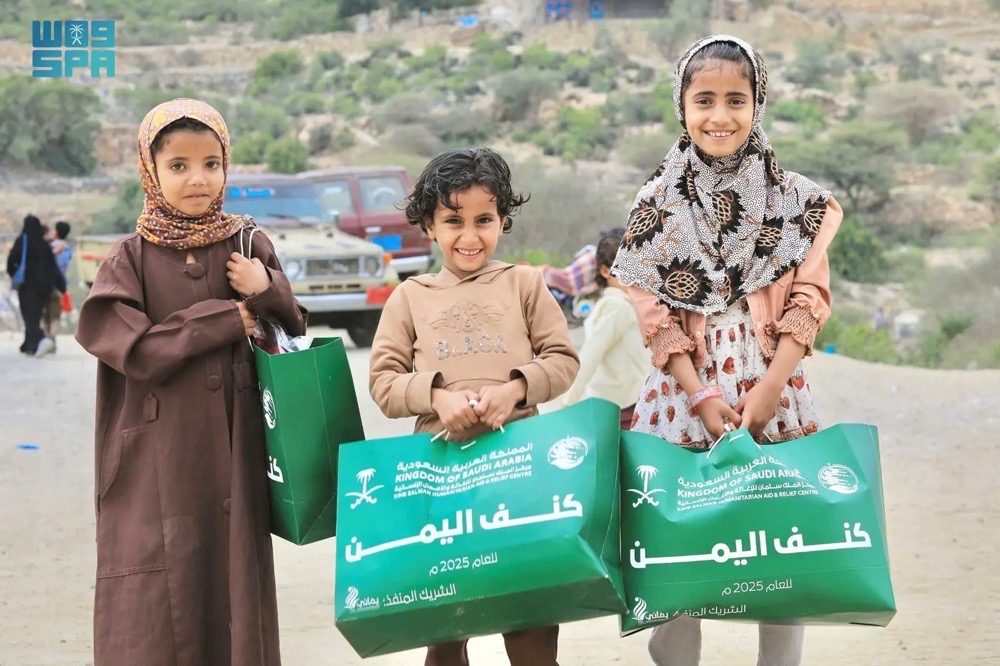
KSrelief Distributes 390 Clothing Vouchers in Yemen's Lahj. (KSrelief)
“More than two million Yemenis live and work in the Kingdom, reflecting the deep human ties between our peoples. Paying salaries to our brothers and sisters in Yemen is only one part of a broader Saudi commitment to help Yemenis rebuild their lives and restore stability.”
The implications stretch beyond payroll. By circulating liquidity across Yemen’s regions, the package aims to restore purchasing power, stabilize household incomes, and revive confidence in local markets.
Over time, this could reactivate small businesses, strengthen supply chains, and weaken parallel economies run by militias and informal networks — bringing a semblance of normalcy to a country where despair once seemed all-consuming.
“We should also not forget that this Saudi support came after the recent events in eastern Yemen (Hadramout and Al‑Mahra) and the unrest caused there by the Southern Transitional Council before its dissolution — developments that negatively affected the living conditions of residents,” said Al-Habtoor.
“This latest support is expected to restore normalcy across the liberated provinces, reinforce the unity of the legitimate government’s ranks, and strengthen efforts to confront the Houthi terrorist group, which still controls the Yemeni capital, Sana’a.”
Smoke rises in the aftermath of a Saudi-led coalition airstrike in Yemen's southern port of Mukalla. (SABAA/Reuters)
Riyadh’s approach stands out for its continuity.
Since 2012, Saudi Arabia has injected an estimated $12.6 billion in economic assistance to Yemen — through deposits at the central bank, monetary transfers, and direct grants — to avert fiscal collapse and curb the inflationary spiral that has undermined local governance.
The aid aligns with the Kingdom’s core regional narrative: security and development are inseparable.
Saudi Defense Minister Prince Khalid bin Salman recently emphasized that Riyadh’s support “embodies the Kingdom’s commitment to strengthening security and stability and contributing to building a better future for Yemen and its people.”
This logic has shaped much of Saudi Arabia’s current strategy in Yemen: prioritizing gradual economic rehabilitation — through liquidity support and targeted projects — over grand reconstruction pledges.
The Defense Ministry’s statement in January that Saudi Arabia had launched 28 developmental projects worth SR 1.9 billion across key sectors including health, energy, and education solidified this integrated approach: stabilizing essential services while re‑energizing public infrastructure.
A project by the Saudi Program for Development and Reconstruction of Yemen. (SDRPY)
In Yemen, such measures carry profound social and political weight. Regular salaries and operational funding signal legitimacy, keeping public employees connected to the state apparatus and preventing the hollowing out of governance.
In a landscape long defined by fractured authority, financial continuity becomes a simple act of state‑building.
Critics, however, note that the scale of need dwarfs the amount of aid. Yemen’s economy — operating at a fraction of pre-conflict capacity amid oil export blockades, inflation spikes, and declining donor support — is projected to have shrunk 1.5 percent in real GDP in 2025 and remains institutionally divided.
Yet, from Riyadh’s perspective, short‑term stabilization must precede structural change, a philosophy that echoes its domestic economic doctrines alike, where fiscal buffers unlock diversification.
KSrelief Mobile Medical Clinic in Hajjah, Yemen. (KSrelief)
The $346 million support, then, functions on two intertwined fronts: a humanitarian lifeline for millions facing wage insecurity, and a geopolitical anchor preserving Yemen’s sovereignty against further collapse.
Analysts view it as calibrated diplomacy: less transactional relief, more sustained leadership in a volatile neighborhood vital to Saudi interests.
As Yemen navigates yet another uncertain year, Saudi Arabia’s latest support may not solve the crisis, but it reiterates a principle increasingly central to Riyadh’s foreign policy: that economic endurance is the cornerstone of security.