



BEIRUT: A local official in Raqqa says more than 500 bodies have so far been exhumed from one of the largest mass graves discovered near the Syrian city, once the capital of the Daesh group’s self-styled caliphate.
Raqqa was liberated in a US-backed campaign that ended more than a year ago, but rescuers and recovery teams continue to locate mass graves around the northern city.
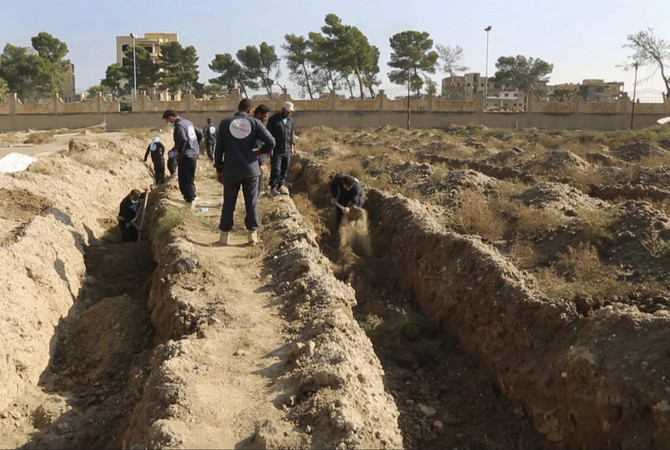
More than a month after digging began in the Panorama mass grave, forensic teams continue to lift bodies believed to have been buried there during the four-month campaign to liberate Raqqa.
Estimates put the number of bodies buried there at around 1,500. Hammoud Al-Shawakh, a local official involved in the work, said Tuesday that 516 bodies have been exhumed.
Syrian workers have exhumed more than 500 bodies from one of the largest mass graves near the northern city of Raqqa, once the capital of Daesh’s self-styled caliphate, and are still uncovering remains, a local official said Tuesday.
The exhumation of mass graves in and around Raqqa is being undertaken by local groups and first responders amid concerns about the preservation of bodies and evidence for possible war crimes trials.
“We’re in a race against time. These bodies are decomposing at an exponential rate,” said Sara Kayyali of Human Rights Watch.
A devastating US-backed air and ground campaign drove Daesh from Raqqa more than a year ago, but rescuers and recovery teams continue to discover mass graves in and around the city. At least nine graves have been found in the area, and the bodies that have been recovered are a mix of victims of US-led coalition airstrikes, Daesh fighters and civilians.
The Panorama mass grave, named after the neighborhood where it was found, is one of the largest of nine burial sites discovered so far, and is believed to contain about 1,500 bodies. Hammoud Al-Shawakh, a local official involved in the work, said 516 bodies, believed to be of Daesh terrorists and civilians, have been exhumed so far.
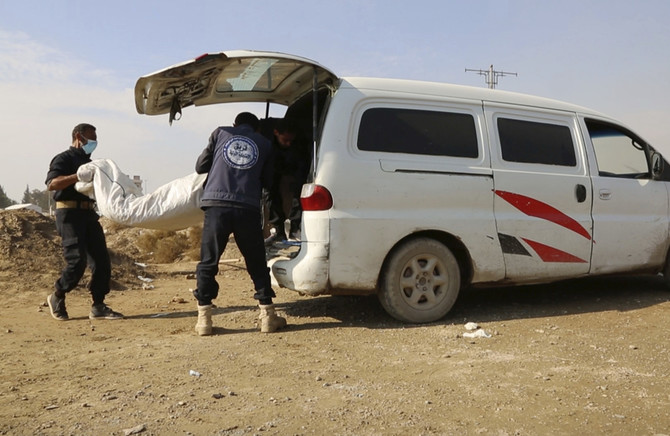
The work is painstaking and the task is huge. A team of Raqqa-based first responders and forensic doctors carefully shovel dirt to search for the bodies, which are believed to have been buried there in the last days of the four-month campaign to liberate the city.
Abdul Raouf Al-Ahmad, the deputy forensic doctor, said local teams start their work at 8 a.m. and continue for more than seven hours straight each day, digging through neatly formed trenches in the grave.
“After we extract the bodies from this grave... we document whether it belongs to a fighter, child, baby, an adolescent or woman or an ordinary person,” he said. “We document clothing, ornaments, height, type of injury, cause of death and how it was covered, what the person was wearing, with what it was wrapped and its position in the grave.”
Kayyali said: “If these bodies are not preserved in the correct way, in the way that’s been established, then it does mean that much of this evidence might be lost when we’re seeking accountability for crimes committed either in the context of the battle or before it.”


