CAPE CANAVERAL, Florida: A NASA spacecraft designed to burrow beneath the surface of Mars landed on the red planet Monday after a six-month, 300 million-mile (482 million-kilometer) journey and a perilous, six-minute descent through the rose-hued atmosphere.
Flight controllers at NASA’s Jet Propulsion Laboratory in Pasadena, California, leaped out of their seats and erupted in screams, applause and laughter as the news came in. People hugged, shook hands, exchanged high-fives, pumped their fists, wiped away tears and danced in the aisles.
“Flawless,” declared JPL’s chief engineer, Rob Manning.
“This is what we really hoped and imagined in our mind’s eye,” he said. “Sometimes things work out in your favor.”
A pair of mini satellites trailing InSight since their May liftoff provided practically real-time updates of the spacecraft’s supersonic descent through the reddish skies. The satellite also shot back a quick photo from Mars’ surface.
The image was marred by specks of debris on the camera cover. But the quick look at the vista showed a flat surface with few if any rocks — just what scientists were hoping for. Much better pictures will arrive in the hours and days ahead.
“What a relief,” Manning said. “This is really fantastic.” He added: “Wow! This never gets old.”
The three-legged InSight spacecraft reached the surface after going from 12,300 mph (19,800 kph) to zero in six minutes flat, using a parachute and braking engines to slow down. Radio signals confirming the landing took more than eight minutes to cross the nearly 100 million miles (160 million kilometers) between Mars and Earth.
It was NASA’s ninth attempt to land at Mars since the 1976 Viking probes. All but one of the previous US touchdowns were successful.
NASA last landed on Mars in 2012 with the Curiosity rover.
Viewings were held coast to coast at museums, planetariums and libraries, as well as New York’s Times Square.
“Landing on Mars is one of the hardest single jobs that people have to do in planetary exploration,” InSight’s lead scientist, Bruce Banerdt, said before the landing. “It’s such a difficult thing, it’s such a dangerous thing that there’s always a fairly uncomfortably large chance that something could go wrong.”
Mars has been the graveyard for a multitude of space missions. Up to now, the success rate at the red planet was only 40 percent, counting every attempted flyby, orbital flight and landing by the US, Russia and other countries since 1960.
The US, however, has pulled off seven successful Mars landings in the past four decades, not counting InSight, with only one failed touchdown. No other country has managed to set and operate a spacecraft on the dusty red surface.
InSight was shooting for Elysium Planitia, a plain near the Martian equator that the InSight team hopes is as flat as a parking lot in Kansas with few, if any, rocks.
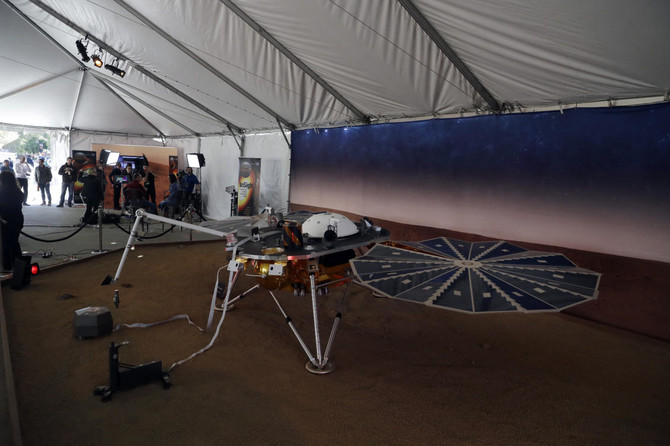
This is no rock-collecting expedition. Instead, the stationary 800-pound (360-kilogram) lander will use its 6-foot (1.8-meter) robotic arm to place a mechanical mole and seismometer on the ground. The self-hammering mole will burrow 16 feet (5 meters) down to measure the planet’s internal heat, while the seismometer listens for possible quakes.
Nothing like this has been attempted before at our next-door neighbor, nearly 100 million miles (160 million kilometers) away. No lander has dug deeper than several inches, and no seismometer has ever worked on Mars.
By examining the interior of Mars, scientists hope to understand how our solar system’s rocky planets formed 4.5 billion years ago and why they turned out so different — Mars cold and dry, Venus and Mercury burning hot, and Earth hospitable to life.
InSight has no life-detecting capability, however. That will be left to future rovers. NASA’s Mars 2020 mission, for instance, will collect rocks that will eventually be brought back to Earth and analyzed for evidence of ancient life.

NASA spacecraft lands on red planet after six-month journey
OPINION: Saudi Arabia’s cultural continuum: from heritage to contemporary AlUla
- The director of arts & creative industries at the Royal Commission for AlUla writes about the Kingdom’s cultural growth
AlUla: Saudi Arabia’s relationship with culture isa long and rich. It doesn’t begin with modern museums or contemporary installations, but in the woven textiles of nomadic encampments, traditional jewellery and ceramics, and of course palm‑frond weaving traditions. For centuries, Saudi artisans have worked with materials drawn directly from their environment creating objects that are functional, but also expressions of identity and artistry.
Many of these traditions have been recognised internationally, with crafts such as Al-Sadu weaving inscribed on UNESCO’s Intangible Cultural Heritage list.
This grounding in landscapes, resources, and collective history means Saudi Arabia’s current cultural momentum is not sudden, but the natural result of decades — even centuries — of groundwork. From the preservation of heritage sites and, areas, some of which have been transformed into world-renowned art districts, to, the creation of institutions devoted to craft, the stage has been set for a moment where contemporary creativity can move forward with confidence, because it is deeply rooted.
AlUla, with its 7,000 years of human history, offers one of the clearest views into this continuum. Millennia-old inscriptions at Dadan and Jabal Ikmah stand alongside restored mudbrick homes in Old Town and UNESCO-listed Hegra. In the present, initiatives like Madrasat Addeera carry forward AlUla’s craft traditions through design residencies and material research. And, each winter, the AlUla Arts Festival knots these threads together, creating a season in which heritage and contemporary practice meet.
This year, that dialogue began in the open desert with Desert X AlUla 2026. Now in its fourth edition, the exhibition feels like the pinnacle of the current moment where contemporary art, heritage, and forward-thinking meet without boundaries. The theme of Desert X AlUla 2026 was “Space Without Measure,” inspired by the work of Lebanese-American artist and writer Kahlil Gibran[HA1] [MJ2] . The theme invited artists to respond to the horizons of AlUla’s landscape and interpret its wonder through their perspective.
Works by Saudi and international figures converse directly with nature: Mohammed Al-Saleem’s modernist sculptures bring in celestial-inspired geometry; Maria Magdalena Campos-Pons translates the colour of AlUla’s sunsets; Agnes Denes “Living Pyramid” turns the oasis into a vertical landscape of indigenous plants, . The 11 artists of this year’s edition were able to capture AlUla’s essence while creating monumental works that speak directly to our relationship with the environment.
In AlJadidah Arts District, “Material Witness: Celebrating Design From Within,” features heritage craft and material research from Madrasat Addeera alongside work by regional and international designers, showing how they translate heritage materials into contemporary forms.[HA3] [MJ4]
Music adds another element of vitality, filling the streets of AlJadidah Arts District, with performances supported by AlUla Music Hub, featuring local musicians.
The opening of “Arduna,” the first exhibition presented byof the AlUla Contemporary Art Museum, co-curated with France’s Centre Pompidou, adds another layer to this conversation. Featuring Saudi, regional, and international artists, from Picasso and Kandinsky to Etel Adnan, Ayman Zedani and Manal AlDowayan, the [HA5] [MJ6] exhibition signals the emergence of a global institution rooted in the heritage and environment of AlUla, placing local voices in context with world masters.
Each activation in this year’s AlUla Arts Festival is part of the same Saudi cultural continuum, . This is why the Kingdom’s cultural rise feels different from rapid developments elsewhere. The scale of cultural infrastructure investment is extraordinary, but its deeper strength lies in how that investment connects to living traditions and landscapes.
The journey is only accelerating. Rooted in heritage yet open to the world, the Kingdom’s cultural future is being shaped not by sudden inspiration, but by our traditions and history meeting the imagination and creative voices of our present.