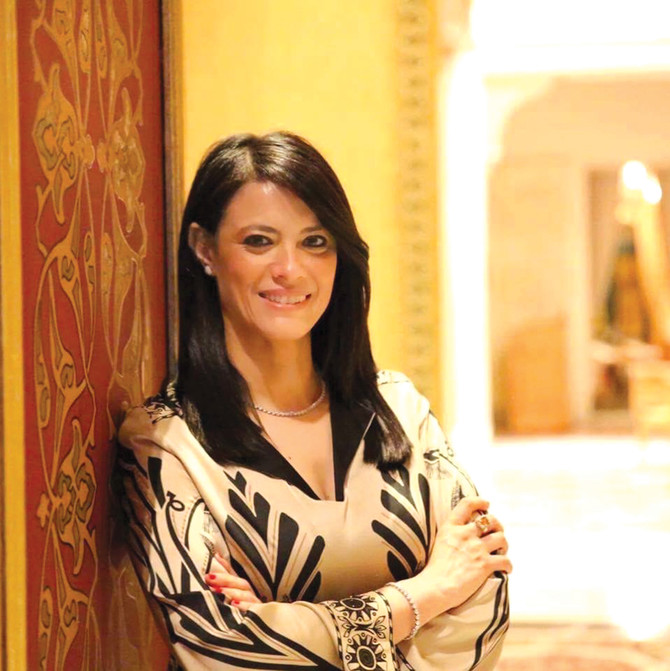

CAIRO: On the eve of Saudi Crown Prince Mohammed bin Salman’s visit to Cairo, Egypt’s first female tourism minister sat down with Arab News to talk about one of the country’s most important portfolios.
Dr. Rania Al-Mashat said she was at first a little surprised at her appointment in January this year, given her background in economics, but then it made sense.
“What was described to me at that moment was that the president wanted the (tourism) sector to be handled from an economic perspective,” she told Arab News.
“Tourism is one of the most important sectors for Egypt. It represents between 15 and 20 percent of GDP (gross domestic product). It’s a very important employment generator. There was a lot of confidence put in myself and my background.”
On Monday, Al-Mashat will launch the Egypt Tourism Reform Program, which will include a private equity fund that will upgrade hotel infrastructure.
She speaks of plans that are underway to restore several historic landmarks as Egypt expands its tourism sector, something that is vital to the country’s economy.
“Tourism feeds into 70 other sectors in Egypt… For each direct job that’s generated, at least three or four indirect jobs are generated,” she said.
“The global economy is coming out of the global financial crisis. There’s a recovery worldwide, and people are spending more on places to go. The idea is to capture as much as we can from that increase.”
The crown prince is expected to meet with Egypt’s President Abdel Fattah El-Sisi and many senior officials to further strengthen bilateral ties, as part of his tour of Arab states.
On the crown prince’s last visit to Egypt in March, the two countries signed a $10 billion joint investment fund related to Neom.
The high-tech economic megacity, a pillar of his Vision 2030 reform plan, will span the borders of Saudi Arabia, Egypt and Jordan.
Saudi Arabia and Egypt are also working together on the Red Sea project, a sustainable development that will span an island ecosystem.
“Several islands were off the map for foreign and private investments. Now the president is keen on investing in these islands for the very first time, but with a different concept in mind,” Al-Mashat said.
“Taking into consideration the nature of these islands’ ecosystems… the hotels that will be constructed on these islands will be very ecofriendly, like the ones seen in the Maldives and so on.”
Europeans make up of more than 50 percent of Egypt’s tourists. Arabs come second at 25 percent, with Saudis making up the bulk.
Some 600,000 Saudis visited Egypt in 2017, while many Egyptians visit the Kingdom for the Umrah and Hajj pilgrimages.
“Given that the Egyptian people are very religious, whether they’re Muslim or Christian, Egyptians can’t get enough of visiting Saudi to perform Hajj or Umrah as much as they can,” Al-Mashat said.
She first performed Umrah in 1997, and has observed firsthand the level of development Saudi Arabia has gone through to accommodate and ease the flow of pilgrims in terms of logistics, visas and transportation.
“We have a very good relationship with Saudi Arabia. We’re very impressed with the speed of modernizing the IT systems, which makes it very easy in terms of issuing visas and monitoring our people on the ground,” she said.
“The magnitude of the effort taken on the Saudi side to arrange for such a trip is very impressive.”