

UAE reviewing clemency request in Briton spy case

1 / 2
Matthew Hedges, right, with his wife Daniela Tejada are shown in this photo released by Detain in Dubai. (Detained in Dubai/AFP)
2 / 2
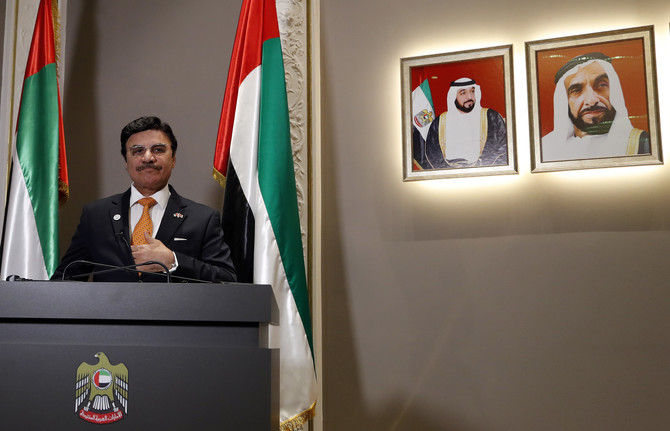
Ambassador Sulaiman Hamid Al-Mazroui delivers a statement about the espionage case against 31-year old academic Matthew Hedges at the UAE embassy in London on Friday, November 23. (AP)
Updated 23 November 2018
Follow

UAE reviewing clemency request in Briton spy case

  • Espionage case against the 31-year-old Hedges ‘was an extremely serious case’
  • Hedges is a Ph.D. student who was arrested May 5 at Dubai Airport after a research trip to the UAE

LONDON: The United Arab Emirates is reviewing a request for clemency from the family of a British researcher sentenced to life in prison on espionage charges this week, the country’s ambassador to London said on Friday.

Matthew Hedges’s family “have made a request for clemency and the government is studying that request,” Ambassador Sulaiman Hamid Al-Mazroui said in a televised statement shown on BBC and Sky News in which he also defended the UAE’s judiciary.

“The government does not dictate verdicts to the courts,” Al-Mazroui said, dismissing criticism of the judicial process in the UAE from Hedges’s family and insisting that genuine researchers were able to visit his country “freely.”

“Matthew Hedges was not convicted after a five-minute trial as some have reported. This was an extremely serious case. We live in a dangerous neighborhood and national security must be our top priority,” he said.

A UAE court on Wednesday sentenced 31-year-old Hedges, who was studying for a doctorate on the UAE’s foreign and security policies at Durham University in northern England.

He had been arrested at Dubai airport on May 5.

British Prime Minister Theresa May said earlier she was “deeply disappointed and concerned” at the verdict in what is a key ally for Britain in the Gulf region.

The UAE foreign ministry also responded saying it hoped for “amicable solution to the Matthew Hedges case.”

Hedges’s wife Daniela Tejada has criticized British officials for their handling of the case, saying they had refused to defend her husband for fear of upsetting Dubai.


Tunisian police arrest member of parliament who mocked president

Updated 05 February 2026
Follow

Tunisian police arrest member of parliament who mocked president

  • Ahmed Saidani mocked the president in a Facebook post, describing him as the “supreme commander of sewage and rainwater drainage”

TUNIS: Tunisian police arrested lawmaker Ahmed Saidani on Wednesday, two of his colleagues ​said, in what appeared to be part of an escalating crackdown on critics of President Kais Saied.
Saidani has recently become known for his fierce criticism of Saied. On Tuesday, he mocked the president in a Facebook post, describing him as the “supreme commander of sewage and rainwater drainage,” blasting what he said ‌was the absence ‌of any achievements by Saied.
Saidani ‌was ⁠elected ​as ‌a lawmaker at the end of 2022 in a parliamentary election with very low voter turnout, following Saied’s dissolution of the previous parliament and dismissal of the government in 2021.
Saied has since ruled by decree, moves the opposition has described as a coup.
Most opposition leaders, ⁠some journalists and critics of Saied, have been imprisoned since he ‌seized control of most powers in 2021.
Activists ‍and human rights groups ‍say Saied has cemented his one-man rule and ‍turned Tunisia into an “open-air prison” in an effort to suppress his opponents. Saied denies being a dictator, saying he is enforcing the law and seeking to “cleanse” the country.
Once a supporter ​of Saied’s policies against political opponents, Saidani has become a vocal critic in recent months, accusing ⁠the president of seeking to monopolize all decision-making while avoiding responsibility, leaving others to bear the blame for problems.
Last week, Saidani also mocked the president for “taking up the hobby of taking photos with the poor and destitute,” sarcastically adding that Saied not only has solutions for Tunisia but claims to have global approaches capable of saving humanity.
Under Tunisian law, lawmakers enjoy parliamentary immunity and cannot be arrested for carrying out their ‌duties, although detention is allowed if they are caught committing a crime.