

Pakistan, UAE agree to strengthen long-term economic partnership

1 / 6
Prime Minister Imran Khan being presented the Guard of Honor at the Presidential Palace in Abu Dhabi on Sunday. (Photo courtesy: Press Information Department – PID)
2 / 6
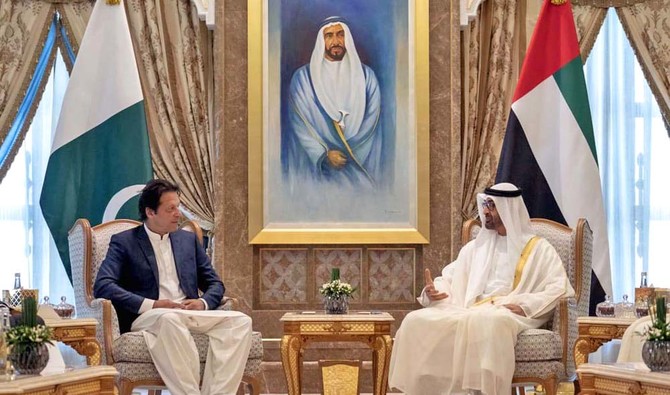
Pakistan’s Prime Minister Imran Khan met with Sheikh Muhammad bin Zayed Al Nahyan, the Crown Prince of Abu Dhabi and Deputy Supreme Commander of the UAE Armed Forces at the Presidential Palace in Abu Dhabi, UAE, on Sunday.. (Photo courtesy: Press Information Department – PID)
3 / 6
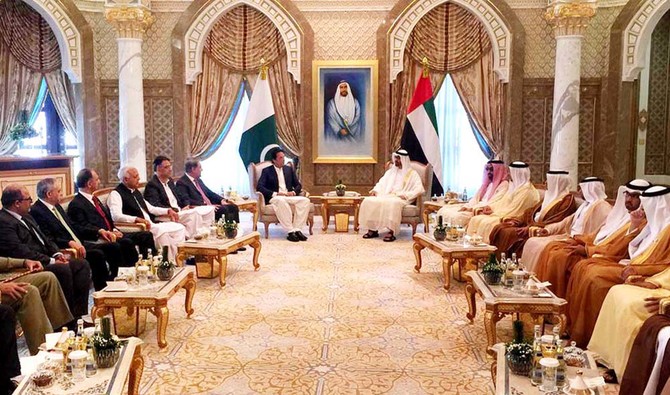
Prime Minister Imran Khan and his delegation in a meeting with Sheikh Muhammad bin Zayed Al Nahyan, the Crown Prince of Abu Dhabi and Deputy Supreme Commander of UAE Armed Forces at the Presidential Palace in Abu Dhabi on Sunday. (Photo courtesy: Press Information Department – PID)
4 / 6
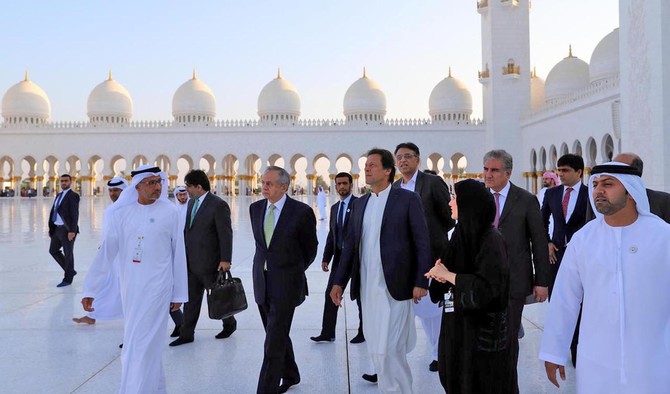
Prime Minister Imran Khan visited the Sheikh Zayed Mosque in in Abu Dhabi during his day-long visit on Sunday. (Photo courtesy: Press Information Department – PID)
5 / 6
Prime Minister Imran Khan also met with Sheikh Muhammad bin Rashid Al Maktoum, the Vice President and Prime Minister of the UAE and Ruler of Dubai in Dubai. (Photo courtesy: Press Information Department – PID)
6 / 6
High-level talks between Pakistan’s Prime Minister Imran Khan and Sheikh Muhammad bin Rashid Al Maktoum, the Vice President and Prime Minister of the UAE and Ruler of Dubai in Dubai took place on Sunday. (Photo courtesy: Press Information Department – PID)
Updated 19 November 2018
Follow

Pakistan, UAE agree to strengthen long-term economic partnership

  • Next high-level meeting to be held in February 2019
  • Islamabad offers services of IT professionals and skilled labor for Expo 2020

ISLAMABAD: Pakistan and the United Arab Emirates (UAE) have reiterated their resolve to transform the existing special relations shared by the two countries into a Strategic Long-Term Economic Partnership by adopting a direct, transparent and time-bound approach, Prime Minister Imran Khan’s office said in a statement on Monday.
It followed Khan’s day-long visit to the UAE on Sunday night on the invitation of Sheikh Muhammad bin Zayed Al Nahyan, the Crown Prince of Abu Dhabi and Deputy Supreme Commander of the UAE Armed Forces.

During the meeting, the two leaders expressed satisfaction at the positive trajectory of relations and agreed to take immediate measures to further elevate their historic partnership, the statement said. “The two sides agreed to chalk out a comprehensive roadmap to accelerate cooperation and partnership in areas encompassing trade, investment, economic development, energy, infrastructure, and agriculture, with a view to accrue early dividends from the economic partnership,” it added.
The next Pakistan-UAE Joint Ministerial Commission — to be co-chaired by the respective Foreign Ministers in Abu Dhabi – is scheduled to be held in February next year. “The two sides also agreed to further strengthen their cooperation to deal with transnational organized crime, including drug trafficking, money laundering, and human trafficking,” the statement said.
The two leaders also expressed satisfaction at the on-going defense and security cooperation and resolved to explore further collaboration in the areas of training, joint exercises and defense production.
Later in Dubai, PM Khan was received by Sheikh Muhammad bin Rashid Al Maktoum, the Vice President and Prime Minister of the UAE and Ruler of Dubai. PM Khan briefed the UAE leadership about his government’s people-centric reform agenda including the steps being taken to eliminate corruption and promote transparency and accountability at all levels of his administration.

He also reiterated Pakistan’s readiness to actively participate in the Expo 2020 and extend its full support to the UAE in making the mega event a great success. “Pakistan offered UAE the services of its IT professionals and skilled labor, in preparing for Expo 2020,” the statement read.
This was PM Khan’s second visit to the UAE in the past two months where he was accompanied by a high-level delegation comprising Chief of Army Staff General Qamar Javed Bajwa, Foreign Minister Makhdoom Shah Mahmood Qureshi, Finance Minister Asad Umar, Minister for Petroleum Ghulam Sarwar Khan, Minister for Power Omar Ayub Khan, and the Adviser on Commerce Abdul Razak Dawood. PM Khan also visited the Sheikh Zayed Mosque in Abu Dhabi and the Martyrs’ Memorial in Dubai where he paid homage to Emirati heroes who had sacrificed their lives in the service of the nation.


Pakistan says $50 million meat export deal with Tajikistan nearing finalization

Updated 09 December 2025
Follow

Pakistan says $50 million meat export deal with Tajikistan nearing finalization

  • Islamabad expects to finalize agreement soon after Dushanbe signals demand for 100,000 tons
  • Pakistan is seeking to expand agricultural trade beyond rice, citrus and mango exports

ISLAMABAD: Tajikistan has expressed interest in importing 100,000 tons of Pakistani meat worth more than $50 million, with both governments expected to finalize a supply agreement soon, Pakistan’s food security ministry said on Tuesday.

Pakistan is trying to grow agriculture-based exports as it seeks regional markets for livestock and food commodities, while Tajikistan, a landlocked Central Asian state, has been expanding food imports to support domestic demand. Pakistan currently exports rice, citrus and mangoes to Dushanbe, though volumes remain small compared to national production, according to official figures.

The development came during a meeting in Islamabad between Pakistan’s Federal Minister for National Food Security and Research Rana Tanveer Hussain and Ambassador of Tajikistan Yusuf Sharifzoda, where agricultural trade, livestock supply and food-security cooperation were discussed.

“Tajikistan intends to purchase 100,000 tons of meat from Pakistan, an import valued at over USD 50 million,” the ambassador said, according to the ministry’s statement, assuring full facilitation and that Islamabad was prepared to meet the demand.

The statement said the two sides agreed to expand cooperation in meat and livestock, fresh fruit, vegetables, staple crops, agricultural research, pest management and standards compliance. Pakistan also proposed strengthening coordination on phytosanitary rules and establishing pest-free production zones to support long-term exports.

Pakistan and Tajikistan have long maintained political ties but bilateral food trade remains below potential: Pakistan produces 1.8 million tons of mangoes annually but exported just 0.7 metric tons to Tajikistan in 2024, while rice exports amounted to only 240 metric tons in 2022 out of national output of 9.3 million tons. Pakistan imports mainly ginned cotton from Tajikistan.