

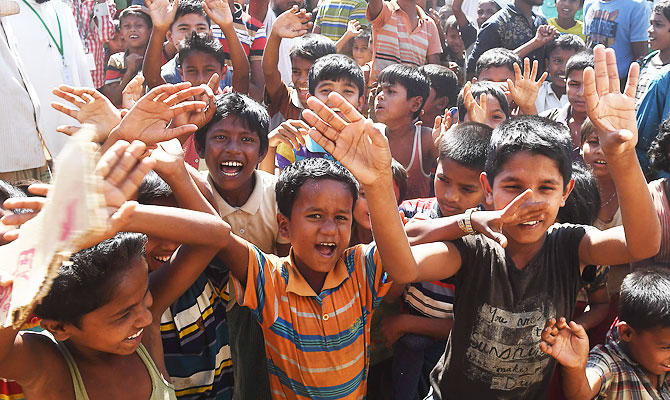

COX'S BAZAR: Authorities in Bangladesh have postponed the Rohingya repatriation indefinitely after the refugees voiced their unwillingness to return to Myanmar.
The authorities overturned the recommendations of the Joint Working Group (JWG), a high-powered body set up to plan the repatriation process.
In line with the JWG schedule, the Bangladesh government had gathered about 150 Rohingya from 27 families at the Ghumdhum border crossing point in Bandarban district for repatriation, the Refugee, Relief and Repatriation Commissioner of Bangladesh, Abul Kalam, said.
Kalam, who is also the technical head looking after the repatriation process on the ground, told Arab News that the authorities had been trying to encourage the Rohingya from Unchiprang camp in Teknaf subdistrict to leave with the assembled refugees, but none were willing to return to Myanmar.
“We waited to get the willingness for repatriation from the Rohingya until 4 p.m. But when they were not willing to return at this moment, we could not start the process,” said Kalam.
“The Rohingya will remain here until the next repatriation date is announced,” he said.
Kalam confirmed that no Rohingya would be repatriated against their will. The next repatriation date will be announced after a review of the situation, he said.
As the Bangladesh government prepared to repatriate the first group of 150 Rohingya, hundreds of refugees protested in Unchiprang camp, denouncing any repatriation without their seven-point demand agenda being accepted. Their demands include citizenship rights, freedom of movement, and recognition as Rohingyas in line with the rights given to other ethnic groups in Myanmar.
Protesting refugees chanted slogans: “We won’t go back” and “We want justice.”
Abdus Shukkur, 55, one of the protesting refugees, told Arab News: “I lost three sons and two younger brothers during the military crackdown last year. Now if I go back, the soldiers will kill me. I don’t find any reason to go back at the moment.”
Mohammad Solaiman, 39, another protester, said: “There is no chance of a livelihood in Rakhine. They have destroyed all our assets. What will I do going back there — live in another camp?”
Situation
The UNHCR acknowledged that “the circumstances are not conducive at the moment for (the Rohingya) repatriation.”
Fairas Al-Khateeb, UNHCR spokesperson in Cox’s Bazar, said that according to an understanding with the Bangladesh government, the UN body had been asked to assess the “willingness for repatriation” of all 485 families selected in the first group.
“The assessment is not complete yet. Once concluded, we will share it with the Bangladesh government.”
Assessing the situation regarding refugee repatriation, he said: “We hope things will get better. But I can’t anticipate when this will happen.”
“We always stress willingness and dignity in going back home,” Al-Khateeb said.
Experts and activists monitoring the situation believe future repatriation depends on the Myanmar government’s willingness to create a conducive environment for the refugees.
Amena Mohsin, professor of international relations at Dhaka University, told Arab News: “Myanmar didn’t make any sincere efforts to offer the Rohingya confidence or to create comfort among the distraught refugees. I think without the proper resolution of citizenship issues, Rohingya repatriation will not be possible.”


