

Hezbollah ‘blocking formation of Lebanon government’

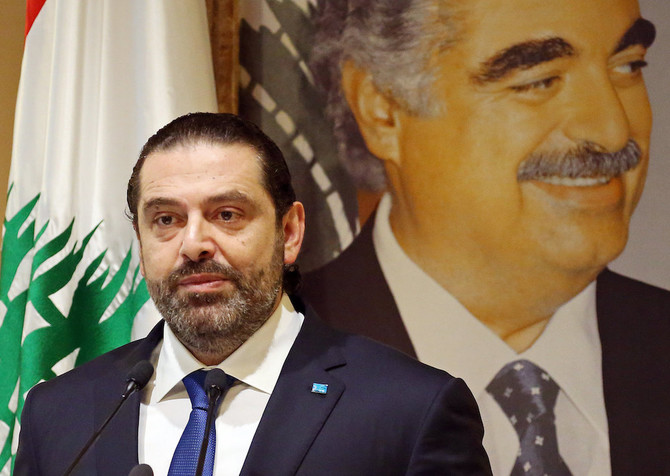
Lebanese Prime Minister-designate Saad Hariri speaks during a news conference in Beirut on Nov. 13. (Reuters)
Updated 14 November 2018
Follow

Hezbollah ‘blocking formation of Lebanon government’

BEIRUT: Lebanon’s Prime Minister Saad Hariri accused Hezbollah on Tuesday of blocking the formation of a government after nearly six months of wrangling.

“It’s very regrettable that Hezbollah has put itself in the position of bearing responsibility for hindering the government,” Hariri said.
“I’ve done my job and the government is ready” otherwise, he said.

Hezbollah has pushed for Sunni politicians allied to the militia but opposed to Hariri to be represented in the Cabinet. Hariri has refused to give up a portfolio that would otherwise go to his own party.

Hezbollah leader Hassan Nasrallah said on Saturday no government would be formed if his Sunni allies were not represented. “The lawmakers have demanded their right to be represented,” he said.

Hezbollah is the only political party not to have disarmed after Lebanon’s 1975-1990 civil war, and has backed the Assad regime in the civil war in Syria.

On May 24, after parliamentary elections, President Michel Aoun nominated Hariri for his third term as prime minister and asked him to form a Cabinet. But disputes have dragged out the process, starting with a now resolved argument over Christian representation.

Meanwhile the US State Department on Tuesday declared Nasrallah’s son Jawad Nasrallah a “global terrorist.” It said he was a “rising leader” of the group who had recruited people “to carry out terrorist attacks against Israel.”

The US also maintained its 21-year “foreign terrorist organization” designation of Hezbollah. 


Iran FM criticizes Israel for ‘doctrine of domination’

Updated 58 min 7 sec ago
Follow

Iran FM criticizes Israel for ‘doctrine of domination’

  • Doctrine allows Israel to expand its military arsenal while pressuring other countries in the region to disarm
  • His remarks came a day after renewed nuclear talks with Washington in Oman

DOHA: Iran’s Foreign Minister Abbas Araghchi on Saturday criticized what he said was a “doctrine of domination” that allows Israel to expand its military arsenal while pressuring other countries in the region to disarm.
His remarks came a day after renewed nuclear talks with Washington, with previous talks collapsing when Israel launched an unprecedented bombing campaign against Iran last June that triggered a 12-day war.
Araghchi was speaking at the Al Jazeera Forum conference in Qatar but made no reference to Friday’s talks with the United States.
“Israel’s expansionist project requires that neighboring countries be weakened: militarily, technologically, economically and socially,” Araghchi said.
“Under this project Israel is free to expand its military arsenal without limits ... Yet other countries are demanded to disarm. Others are pressured to reduce defensive capacity. Others are punished for scientific progress,” he added.
“This is a doctrine of domination.”
During the 12-day war Israel targeted senior Iranian military officials, nuclear scientists and sites as well as residential areas, with the US later launching its own attacks on key nuclear facilities.
Iran responded at the time with drone and missile attacks on Israel, as well as by targeting the largest US military base in the Middle East, located in Qatar.
On Friday, Araghchi led the Iranian delegation in indirect nuclear talks with US Middle East envoy Steve Witkoff in Muscat.
The top Iranian diplomat later described the atmosphere as having been “very positive,” while US President Donald Trump said the talks were “very good,” with both sides agreeing to proceed with further negotiations.
The talks followed threats from Washington and its recent deployment of an aircraft carrier group to the region following Iran’s deadly crackdown on anti-government protests last month.
The United States has sought to address Iran’s ballistic missile program and its support for militant groups in the region — issues which Israel has pushed to include in the talks, according to media reports.
Tehran has repeatedly rejected expanding the scope of negotiations beyond the nuclear issue.