One killed several injured in Melbourne gas attack and stabbing rampage

1 / 3
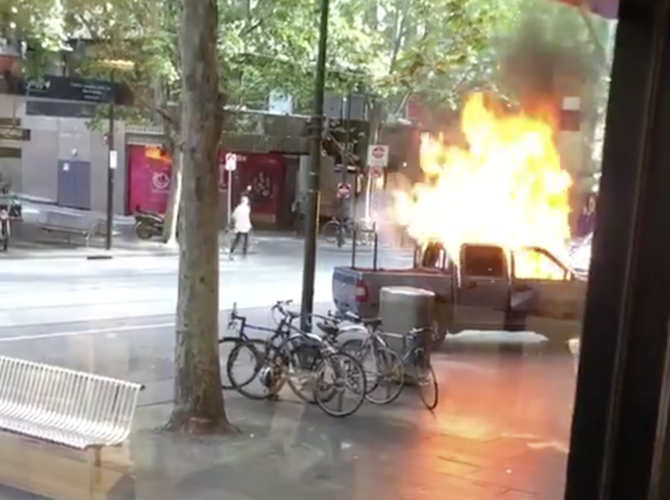
The attacker set fire to a vehicle laden with gas bottles. (Twitter video screengrab)
2 / 3
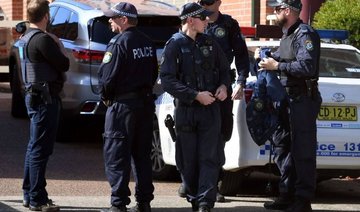
Police work at the crime scene following a stabbing incident in Melbourne on Friday, November 9. (AFP)
3 / 3
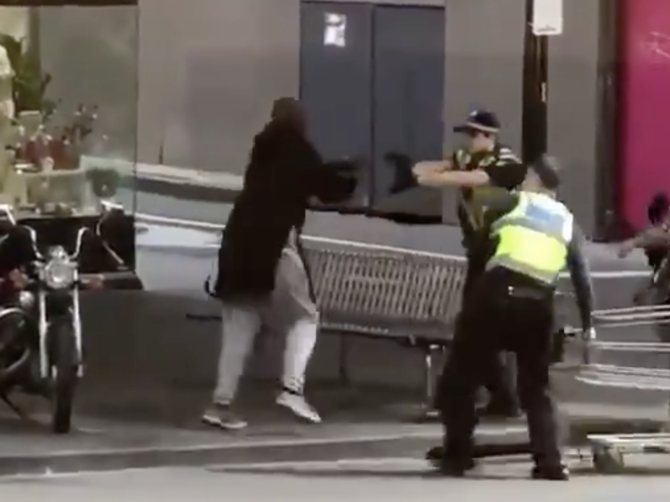
Police confront the attacker shortly before he is shot dead in a busy Melbourne street. (Twitter video screengrab)
Updated 09 November 2018
Follow

One killed several injured in Melbourne gas attack and stabbing rampage

  • The attack during the afternoon rush hour brought central Melbourne to a standstill
  • Prime Minister Scott Morrison condemned the ‘evil and cowardly attack’

MELBOURNE:  A Somali-born man set fire to a pickup truck laden with gas cylinders in the centre of the Australian city of Melbourne on Friday and stabbed three people, killing one, before he was shot by police in a rampage they called an act of terrorism.

The utility truck carrying barbecue gas cylinders burned on busy Bourke Street just before the evening rush hour as the driver stabbed bystanders and attacked police.
The cylinders did not explode and the fire was put out in 10 minutes, by which point the attack was over.

"We are still trying to piece together whether the vehicle was lit then he got out the car or whether he got out the car and then the vehicle took flame," Victoria Police Commissioner Graham Ashton told reporters.
Video posted to Twitter and broadcast on television showed the man swinging a knife at two police officers, while his truck burned in the background.
One of the officers shot the man and he collapsed to the ground clutching his chest, the video showed. Other footage showed two stab victims lying on the ground nearby.
The attacker died in hospital, as did one of the victims, Ashton said. "From what we know of that individual, we are treating this as a terrorism incident," he said of the attacker.

Daesh said it carried out the attack, without providing any evidence. The militant group also claimed responsibility for a deadly siege in the city in 2017 when a Somali man was killed by police after taking a woman hostage.
Police gave no information identifying the Melbourne attacker but Ashton said the man was known to them and intelligence authorities because of family associations.
All of the victims were men, Ashton said. He declined to release their names because police were still in the process of contacting families.
Asked if the man had recently travelled to Syria he said: "That is something we might be able to talk more about tomorrow."
Australia has been on alert for such violence after a Sydney cafe siege in 2014, and its intelligence agencies have stepped up scrutiny, though there was no warning of the latest attack.
Authorities say Australia's vigilance has helped to foil at least a dozen plots, including a plan to attack downtown Melbourne at Christmas in 2016.
Prime Minister Scott Morrison said in a statement released on Twitter: "Australia will never be intimidated by these appalling attacks."
Ashton said there was no longer a threat to the public, but that security would be boosted at horse races and Remembrance Day memorials over the weekend.
Video posted to social media showed chaotic scenes as bystanders scattered while the attacker fought with police and his victims lay bleeding on the footpath.
One man charged at the tall attacker, wearing a long black shirt, with a shopping trolley just before police drew their weapons.
A witness, Markel Villasin, told Australian Broadcasting Corporation radio: "Bystanders were yelling out 'just shoot him, just shoot him'." They did.
Victorian Premier Daniel Andrews said the attack was "an evil, terrifying thing that's happened in our city".
Warning text messages were sent after the attack and police sealed off the downtown area, usually busy with shoppers and diners on a Friday evening. Some cordons were lifted later, though the immediate crime scene would be sealed until Saturday, police said.
Memories remain fresh of a fatal but not terror-related attack on the same street last year, in which a man drove his car at pedestrians at high speed, killing six people and wounding about 30. That prompted the city to install hundreds of security bollards. The driver is currently on trial.
In December 2014, two hostages were killed during a 17-hour siege by a "lone wolf" gunman, inspired by Daesh militants, in a cafe in Sydney.


Bangladesh shuts universities, turns off air conditioners as global fuel crunch hits

Updated 8 sec ago
Follow

Bangladesh shuts universities, turns off air conditioners as global fuel crunch hits

  • Bangladesh relies on oil and gas imports for 95 percent of its energy needs
  • Gas stations ration fuel, government offices ordered to halve electricity use

DHAKA: Bangladesh has closed educational institutions and slashed the use of air conditioning and lighting at government offices in a worsening energy crisis linked to the US-Israeli war with Iran and the closure of vital oil and gas routes from the Middle East.

A country of 170 million people, which relies on imports for 95 percent of its energy needs, Bangladesh has for years been vulnerable to disruptions in global energy markets.

Oil and natural gas prices have been soaring since the beginning of the US-Israeli attack on Iran last week, which triggered Iranian retaliatory strikes on American-linked assets across the Gulf region and the closure of the Strait of Hormuz.

Bangladeshi authorities almost immediately started implementing austerity measures, including fuel rationing at gas stations, ordering educational institutions to begin their Eid Al-Fitr holidays ahead of schedule, and government offices to minimize power consumption.

“The prime minister has already started using half of the lights at his office. He does not turn on air conditioning unless it’s urgent. This austerity is being practiced at all offices across the country,” Saleh Shibly, press secretary to Prime Minister Tarique Rahman, told Arab News on Tuesday.

“The move has been undertaken as a preventive measure in case the global energy situation deteriorates further due to the ongoing war in the Middle East.”

The measures might offer some immediate relief if they can be enforced nationwide, as during summertime — from March to June — the use of air conditioning consumes more than 2,000 megawatts of electricity.

“The government needs to build consensus so that people realize that each and every one can contribute to this energy conservation,” said Prof. Abdul Hasib Chowdhury from the Bangladesh University of Engineering and Technology.

But energy conservation could help only immediately, he said, as the Iran war brought to the spotlight the fact that Bangladesh has no strategic energy reserves — an issue that the prime minister and government, who only took office last month, will have to address during their term.

“Bangladesh needs to build a strategic reserve of energy — primary fuel for the power plants, and also for the industry. Between three and six months of energy reserves have to be here,” Chowdhury said. “This will take years of planning and work to build these reserves. Nevertheless, Bangladesh should do that.”

Oil prices have surged by about 50 percent since the US and Israel launched joint strikes on Iran on Feb. 28, with Brent crude, the international benchmark, topping $119 a barrel on Sunday.

For Bangladesh, every $10 increase in global fuel prices raises the monthly import bill by roughly $80 million, according to BRAC EPL, one of the country’s leading stockbrokers.

While the effect will not be felt immediately, especially as the government announced on Tuesday it had no plans to increase the prices of fuel or electricity, Bangladeshis are likely to experience a crisis in the longer term.

“It’s more like a looming crisis because any shortfall in supply takes a little bit of time to show. So, the agriculture will be affected, but it will be realized only after a few months,” Chowdhury said.

“It will affect transportation and, because of that, the primary food supply, which would add to inflation ... It is not a crisis as such at this moment, but it will be.”