





DUBAI: Regional observers will watch the midterm elections in the US on Tuesday with added interest because of two separate, but pivotal, issues: Republican losses could alter the country’s hard-line foreign policy, especially toward Iran, while two Democratic candidates are expected to make history as the first female Muslims elected to Congress.
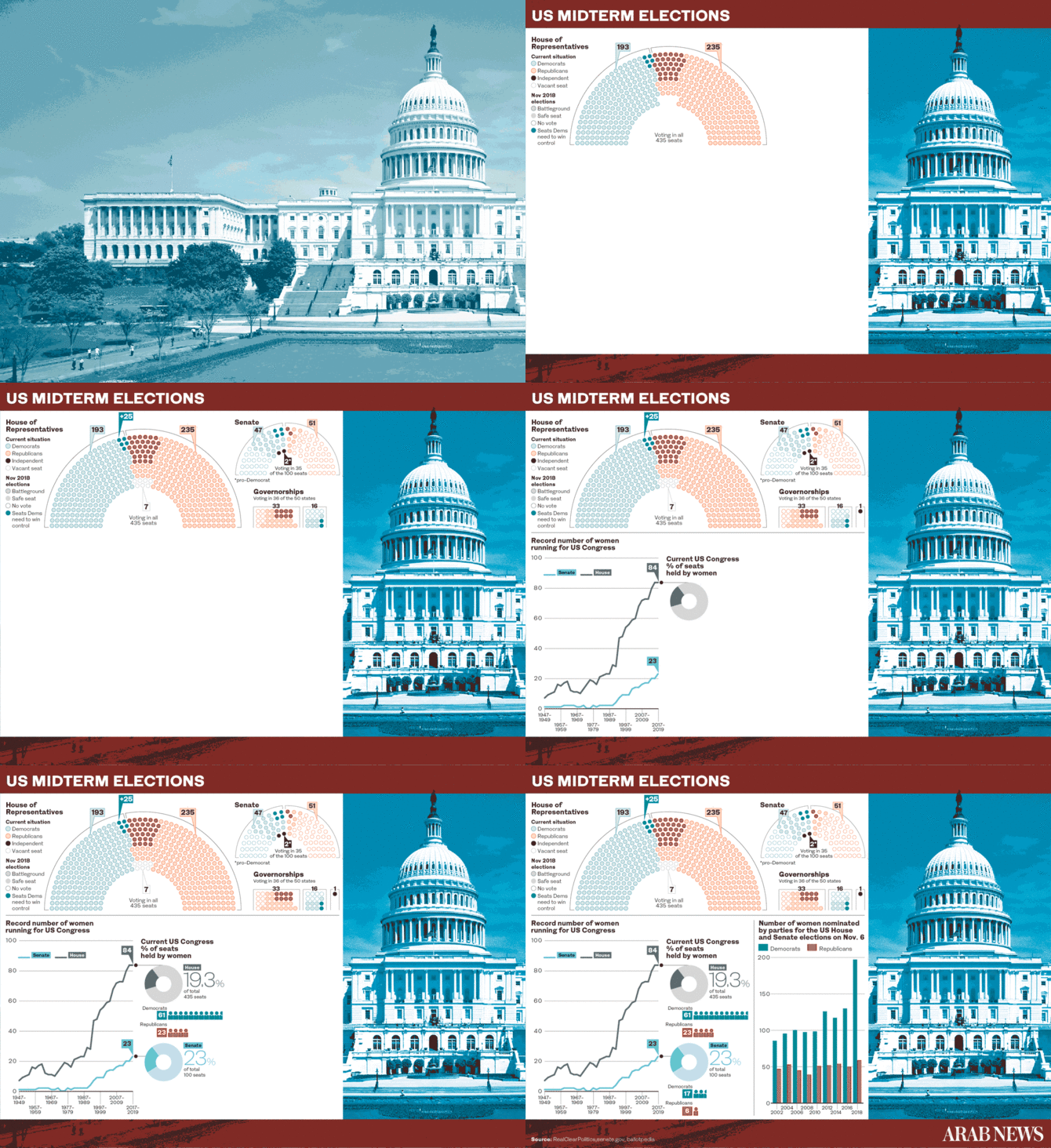
The midterm elections mark two years since Donald Trump took power, the midpoint in the US president’s four-year term. Republicans currently control the House of Representatives and the Senate, the two chambers that make up the US Congress.
“The question is, of course, how well the Democrats do, if they succeed in taking the House and less likely the Senate,” said Dr. Charles Freilich, a senior fellow at the Belfer Center of the Harvard Kennedy School and adjunct associate professor of political science at the Middle East Institute at Columbia University in New York.
“If the Republicans do well, this will merely reinforce the hard-line foreign policy, especially toward Iran. If the Democrats do well, they will push for a somewhat more moderate approach toward Iran, though the nuclear deal has already been abrogated.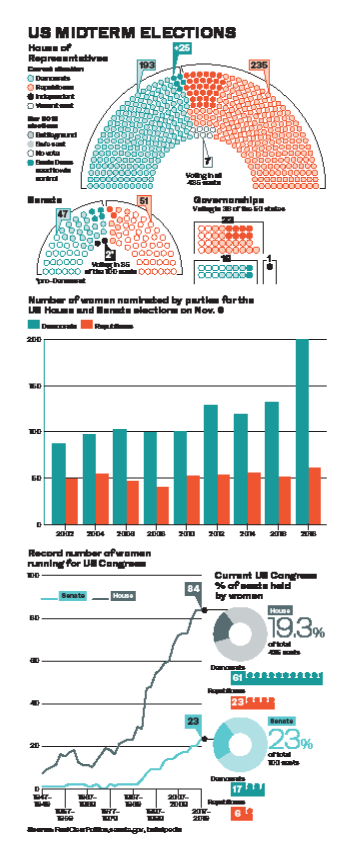
“Another question is whether Trump intends to try to push his peace plan forward, in which case he will also have to provide the Palestinians with some inducements to get them to re-engage, whether bilateral US-Palestinian, or pressure on Israel, to change some of its policies,” Freilich said. “Midterm elections tend to have a limited impact on policy, unless there is a dramatic change.”
Some are predicting that the Democrats could gain control of the House of Representatives, while Republicans will retain control of the Senate. Among the Democrats in the House, it is expected there will be two Muslim-American newcomers: Palestinian-American Rashida Tlaib, who is running unopposed in her Detroit-area riding; and Somali-American Ilhan Omar, a former refugee who won the Democratic primary in her Minnesota district.
“These women being elected could be the start of a trend,” said Mark Katz, professor of government and politics at the Schar School of Policy and Government at George Mason University. “There are places in the US where there are significant Muslim-American populations and they’re voting. I have a feeling these won’t be the only two women that, in future, we’ll see more of.”
Katz said that US support for Israel has been partly a function of domestic politics, but there are growing constituencies that favor the Palestinian side. “I don’t see the US ever turning against Israel, but what I do see — and I think many in Israel fear, including Israeli Prime Minister Benjamin Netanyahu — is that the changes in US demographics are going to mean that it won’t be unconditional American support, and that is already one big step.”
The women are viewed as being able to raise Palestinian and Muslim issues to a high level. “No more will pro-Israeli representatives and Islamophobes have the House floor to themselves,” said Dr. Albadr Alshateri, politics professor at the National Defense College in Abu Dhabi. “Both women are fighters, and very fierce at that.”
However, beyond the halls of Congress, he said, the newly minted representatives will have little impact. “Freshman congresspersons are not known to carry huge sway in legislation. They tend to feel their way in the contours of power. Seniority is very important, and the new members have to find mentors to guide and support them.”
In this midterm election, there are 435 seats available in the House of Representatives and 35 Senate seats up for election, including two special elections in Minnesota and Mississippi. In these elections, the incumbent president is on the ballot as much as the individual candidate.
“Trump is a controversial figure, and maybe a radioactive one in these elections,” Alshateri said. “It looks like the Democrats have a very good chance to capture the House of the Representatives. All the same, the Senate map election looks like an uphill battle. The Democrats have to defend almost twice the number of seats in the Senate as the Republicans, and the Democrats need to keep their seats and pick up only two Senate seats to win back the upper house, but it is not going to be smooth sailing.”
Should the expectation hold on Tuesday, he said, we can expect a divided government in a highly polarized society.
“I do not expect much to be done in terms of new legislation,” he said. “The new Congress starting in January 2019 will start investigating Trump for a motley of legal violations, and he will be a lame duck president until the 2020 presidential elections. In that case, Trump will be fighting for his political life and will have precious little time for dueling with the Iranian ayatollahs or searching for an Israeli-Palestinian peace.”


