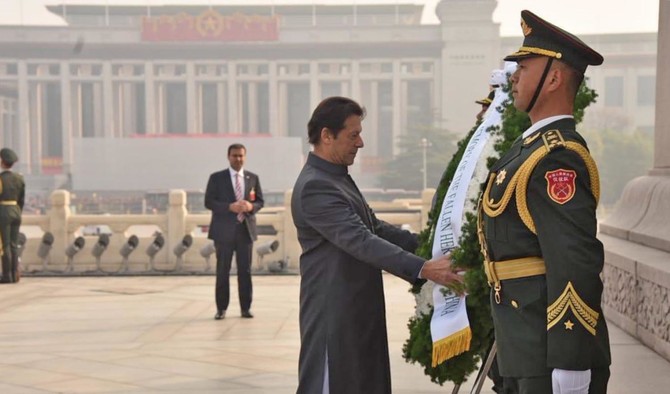
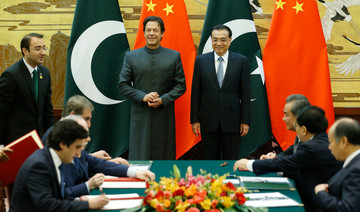
KARACHI: With an aim to consolidate their strategic partnership and all-weather friendship, Pakistan and China signed 15 agreements on Sunday covering a range of bilateral issues, as part of Prime Minister Imran Khan’s first visit to the country, a joint statement said.
The statement added that building a closer China-Pakistan community in the new era was the pillar of the continued relationship between the “iron brothers”.
Pakistan, on its part, reaffirmed its support in safeguarding China’s sovereignty and security, while enhancing cooperation against the “three evils” of extremism, terrorism and separatism, the statement said.
Dismissing the growing propaganda against the China Pakistan Economic Corridor (CPEC) project, both Beijing and Islamabad expressed their determination to protect the initiative against all threats, while agreeing to speed up progress along the Gwadar port. “Both sides reviewed the early phase of the CPEC and reaffirmed their complete consensus on the future trajectory of CPEC, timely completion of on-going projects and joint efforts for realization of its full potential…,” the statement added.
They also agreed to task the CPEC’s Joint Cooperation Committee (JCC) with formulating ideas to explore new areas of cooperation. “It was decided that the eighth session of the JCC will be held in Beijing before the end of the year. The two sides announced the setting up of a working group on socio-economic development, to assist with livelihood projects in Pakistan,” the statement added.
The two sides discussed ways to boost Pakistan’s industrial capacity through joint ventures, including steps to take concrete measures in addressing the trade imbalance. “These would include an exchange of trade missions, broadening market access for agricultural and ICT products, and simplifying customs, quarantine and phytosanitary procedures,” the statement said.
Pakistan and China acknowledged the need to conclude the second phase of the China-Pakistan Free Trade Agreement as early as possible and further enhance defense cooperation, maintain high-level visits and exchanges between relevant departments of the two countries' armed forces; while making full use of the China-Pakistan Defense and Security Consultation mechanism to deepen cooperation in military exercises and technology.
Islamabad applauded Beijing’s efforts in combating corruption with successful results, while expressing an interest to imbibe and apply similar practices in Pakistan as well. Acknowledging the fact that China was a popular choice for Pakistanis -- with more than 25,000 students enrolled across universities in the country -- China, on its part, said that it would offer additional scholarships for students from the neighboring country. To facilitate this process, the two countries discussed methods to establish a committee to encourage youth exchange programs and ensure cooperation in the area.
Additionally, they reaffirmed their commitment to uphold the purpose and principles of the UN Charter, in terms of promoting international peace and security and safeguarding the contemporary world order.
Khan is visiting China on the invitation of Prime Minister Li Keqiang. During his visit, he also called on President Xi Jinping and a coterie of other officials.


![]()
Pakistan, China sign 15 agreements on a range of bilateral issues
Pakistan, China sign 15 agreements on a range of bilateral issues
- Islamabad reaffirms its support in combating terrorism
- Both countries dismiss growing propaganda against CPEC

Latest updates


© 2026 SAUDI RESEARCH & PUBLISHING COMPANY, All Rights Reserved And subject to Terms of Use Agreement.