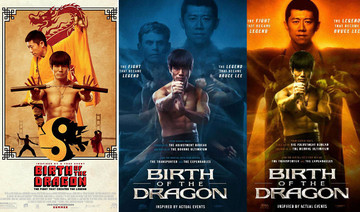
HONG KONG: Legendary Hong Kong film producer Raymond Chow, who introduced the world to Bruce Lee and Jackie Chan and even brought the Teenage Mutant Ninja Turtles to the big screen, has died at age 91.
Hong Kong’ secretary for commerce and economic development, Edward Yau, said in a statement Friday that Chow “helped nurture a pool of Hong Kong talents and brought them to the international stage.”
Chow was a journalist who became a publicist for Shaw Brothers Studios, which churned out hundreds of films and popularized the kung fu genre. Studio founder Run Run Shaw soon moved Chow to the production side of the business after Chow complained that the movies — made on low budgets and short schedules — weren’t good enough.
“I said I did not think I could keep my job because the pictures were so bad,” Chow told Asiaweek magazine in 1983. Frustrated with Shaw Brothers’ assembly-line ethic, he created his own production company, Golden Harvest, in 1970.
He soon outmaneuvered his gigantic old employer to grab the actor who would become synonymous with kung fu movies. Chow signed Bruce Lee in 1971 after seeing him on a Hong Kong television variety show.
“Facing you on the screen, you feel his presence is very strong, very powerful,” Chow told The Associated Press in 2005.
Golden Harvest signed Lee to a three-picture deal, with each breaking all Hong Kong box office records.
Those movies were followed by “Enter the Dragon,” the first Chinese martial arts film to be produced by a major Hollywood studio, Warner Bros. It cost $500,000 and earned $40 million at the box office. Tragically, Lee died days before the film’s release in 1973.
Lee’s death left a void for kung fu heroes in Hong Kong’s film industry that young performers were eager to fill. Chow signed one of them, a former stuntman named Jackie Chan, in 1979.
Chan’s first taste of success in Hong Kong had come the year before with the film “Drunken Master.” After signing with Chow, he made a number of increasingly popular Chinese-language action-comedy movies that made him a superstar in Asia.
Chow invested plenty of time and effort introducing Chan to Western audiences. He arranged for Chan to spend time in Los Angeles learning English and star in his first English-language film, 1980’s “The Big Brawl,” which flopped. A year later, Chow gave him a minor role alongside top Hollywood names in “The Cannonball Run.” But it was 1995’s “Rumble in the Bronx” that catapulted Chan to worldwide fame. The film was released on 1,700 screens in North America and grossed $32.4 million, becoming the most successful Hong Kong film released in the US Three years later, Chan teamed up with Chris Tucker in 1998’s “Rush Hour,” becoming a Hollywood A-list actor.
Chan acknowledged the debt he owed to Chow’s grooming.
“Mr. Chow gave me a chance to follow my dreams,” he told Variety in 2000. “I think today that without Golden Harvest, there is no Jackie Chan.”
Golden Harvest also helped bring to the silver screen another set of unlikely martial arts characters, the Teenage Mutant Ninja Turtles, which began as a comic book and then became an animated kids’ TV show with a cult following. Intrigued by the name, Chow agreed to produce a live-action movie based on the four crime-fighting, human-sized turtles after Hollywood rejected the idea.
The movie about the pizza-eating, surfer-lingo-spouting terrapins named after Renaissance artists became a worldwide smash.
Chow said that he made his choice based on a “gut feeling.”
“It’s very weird, very unique and very interesting. ... You have to be unique these days to be a big success.”
Chow was born in Hong Kong to a nationalistic father skeptical of Western influences. Following his father’s wishes, he completed his secondary and university studies in Shanghai.
As a journalist, Chow worked at English-language news outlets in Hong Kong, including United Press, which later became United Press International; The New York Times; and Voice of America.
Chow, an avid bridge player, told Forbes in 1990 about the business lessons he learned playing cards.
“When you are fortunate, you try to take advantage. And when you get a bad hand, you just try to watch yourself, minimize your losses, so that you don’t get killed.”
Golden Harvest made its last film in 2003. Chow sold his controlling stake four years later to a Chinese businessman, who changed the name to Orange Sky Golden Harvest.

Raymond Chow, film producer behind Bruce Lee, dies at age 91
- Golden Harvest signed Lee to a three-picture deal, with each breaking all Hong Kong box office records
How TV shows like ‘Mo’ and ‘Muslim Matchmaker’ allow Arab and Muslim Americans to tell their stories
- In addition to “Mo,” shows like “Muslim Matchmaker,” hosted by matchmakers Hoda Abrahim and Yasmin Elhady, connect Muslim Americans from around the country with the goal of finding a spouse
COLUMBUS, Ohio: Whether it’s stand-up comedy specials or a dramedy series, when Muslim American Mo Amer sets out to create, he writes what he knows.
The comedian, writer and actor of Palestinian descent has received critical acclaim for it, too. The second season of Amer’s “Mo” documents Mo Najjar and his family’s tumultuous journey reaching asylum in the United States as Palestinian refugees.
Amer’s show is part of an ongoing wave of television from Arab American and Muslim American creators who are telling nuanced, complicated stories about identity without falling into stereotypes that Western media has historically portrayed.
“Whenever you want to make a grounded show that feels very real and authentic to the story and their cultural background, you write to that,” Amer told The Associated Press. “And once you do that, it just feels very natural, and when you accomplish that, other people can see themselves very easily.”
At the start of its second season, viewers find Najjar running a falafel taco stand in Mexico after he was locked in a van transporting stolen olive trees across the US-Mexico border. Najjar was trying to retrieve the olive trees and return them to the farm where he, his mother and brother are attempting to build an olive oil business.
Both seasons of “Mo” were smash hits on Netflix. The first season was awarded a Peabody. His third comedy special on Netflix, “Mo Amer: Wild World,” premiered in October.
Narratively, the second season ends before the Hamas attack in Israel on Oct. 7, 2023, but the series itself doesn’t shy away from addressing Israeli-Palestinian relations, the ongoing conflict in Gaza or what it’s like for asylum seekers detained in US Immigration and Customs Enforcement detention centers.
In addition to “Mo,” shows like “Muslim Matchmaker,” hosted by matchmakers Hoda Abrahim and Yasmin Elhady, connect Muslim Americans from around the country with the goal of finding a spouse.
The animated series, “#1 Happy Family USA,” created by Ramy Youssef, who worked with Amer to create “Mo,” and Pam Brady, follows an Egyptian American Muslim family navigating life in New Jersey after the 9/11 terrorists attack in New York.
Current events have an influence
The key to understanding the ways in which Arab or Muslim Americans have been represented on screen is to be aware of the “historical, political, cultural and social contexts” in which the content was created, said Sahar Mohamed Khamis, a University of Maryland professor who studies Arab and Muslim representation in media.
After the 9/11 attacks, Arabs and Muslims became the villains in many American films and TV shows. The ethnic background of Arabs and the religion of Islam were portrayed as synonymous, too, Khamis said. The villain, Khamis said, is often a man with brown skin with an Arab-sounding name.
A show like “Muslim Matchmaker” flips this narrative on its head, Elhady said, by showing the ethnic diversity of Muslim Americans.
“It’s really important to have shows that show us as everyday Americans,” said Elhady, who is Egyptian and Libyan American, “but also as people that live in different places and have kind of sometimes dual realities and a foot in the East and a foot in the West and the reality of really negotiating that context.”
Before 9/11, people living in the Middle East were often portrayed to Western audiences as exotic beings, living in tents in the desert and riding camels. Women often had little to no agency in these media depictions and were “confined to the harem” — a secluded location for women in a traditional Muslim home.
This idea, Khamis said, harkens back to the term “orientalism,” which Palestinian American academic, political activist and literary critic Edward Said coined in his 1978 book of the same name.
Khamis said, pointing to countries like Britain and France, the portrayal in media of people from the region was “created and manufactured, not by the people themselves, but through the gaze of an outsider. The outsiders in this case, he said, were the colonial/imperialist powers that were actually controlling these lands for long periods of time.”
Among those who study the ways Arabs have been depicted on Western television, a common critique is that the characters are “bombers, billionaires or belly dancers,” she said.
The limits of representation
Sanaz Alesafar, executive director of Storyline Partners and an Iranian American, said she has seen some “wins” with regard to Arab representation in Hollywood, noting the success of “Mo,” “Muslim Matchmaker” and “#1 Happy Family USA.” Storyline Partners helps writers, showrunners, executives and creators check the historical and cultural backgrounds of their characters and narratives to assure they’re represented fairly and that one creator’s ideas don’t infringe upon another’s.
Alesafar argues there is still a need for diverse stories told about people living in the Middle East and the English-speaking diaspora, written and produced by people from those backgrounds.
“In the popular imagination and popular culture, we’re still siloed in really harmful ways,” she said. “Yes, we’re having these wins and these are incredible, but that decision-making and centers of power still are relegating us to these tropes and these stereotypes.”
Deana Nassar, an Egyptian American who is head of creative talent at film production company Alamiya Filmed Entertainment, said it’s important for her children to see themselves reflected on screen “for their own self image.” Nassar said she would like to see a diverse group of people in decision-making roles in Hollywood. Without that, it’s “a clear indication that representation is just not going to get us all the way there,” she said.
Representation can impact audiences’ opinions on public policy, too, according to a recent study by the Institute for Social Policy and Understanding. Results showed that the participants who witnessed positive representation of Muslims were less likely to support anti-democratic and anti-Muslim policies compared to those who viewed negative representations.
For Amer, limitations to representation come from the decision-makers who greenlight projects, not from creators. He said the success of shows like his and others are a “start,” but he wants to see more industry recognition for his work and the work of others like him.
“That’s the thing, like just keep writing, that’s all it’s about,” he said. “Just keep creating and keep making and thankfully I have a really deep well for that, so I’m very excited about the next things,” he said.