

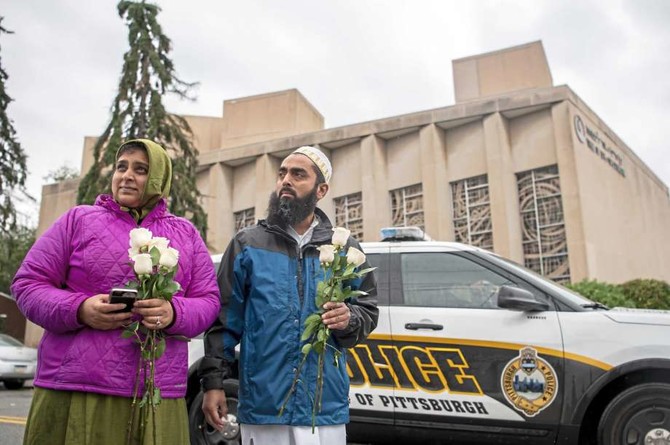
Muslim Americans raise over $170,000 for victims of Pittsburgh synagogue shooting

A Muslim American group raised over $170,000 to help those affected by the mass shooting at a synagogue in Pittsburgh. (File/AP)
Updated 30 October 2018
Follow

Muslim Americans raise over $170,000 for victims of Pittsburgh synagogue shooting

  • A Muslim American group raised over $170,000 to help those affected by the mass shooting at a synagogue in Pittsburgh
  • Authorities believe the attack was motivated by religious hatred

DUBAI: A Muslim American group raised over $170,000 to help those affected by the mass shooting at a synagogue in Pittsburgh through an online crowdfunding campaign.

The online crowdfunding campaign called Muslims Unite for Pittsburgh Synagogue has raised the funds for survivors and families. It was launched by two American-Muslim charities, CelebrateMercy and MPower Change.

“We wish to respond to evil with good, as our faith instructs us and send a powerful message of compassion through action,” the groups said.

Authorities believe the attack was motivated by religious hatred, and 46-year-old Robert Bowers has been charged for the incident. He was charged Monday with 29 felony counts, including 11 counts of use of a firearm to commit murder and 11 counts of obstruction of the exercise of religious beliefs resulting in death.

Meanwhile, others have also joined efforts to raise funds for the victims of the attack. A graduate student in Washington has increased his fundraising goal from $500 to $1 million.

Shay Khatiri’s fundraiser had raised nearly $545,000 as of Monday morning. The Johns Hopkins School of Advanced International Studies student says the funds will go directly to the Tree of Life congregation.

Khatiri says he’s a political refugee from Iran who has been a recipient of the Jewish community’s generosity.


Macron pushes back against Trump’s tariff threats, calls for stronger European sovereignty at Davos

Updated 5 sec ago
Follow

Macron pushes back against Trump’s tariff threats, calls for stronger European sovereignty at Davos

  • French president calls for stronger European sovereignty and fair trade rules, signaling Europe will not bow to economic coercion amid US tariff threats 

LONDON: French President Emmanuel Macron warned about global power and economic governance, implicitly challenging US President Donald Trump’s trade and diplomatic approach, at the World Economic Forum in Davos on Tuesday.

Without naming Trump, Macron described a world sliding toward a “law of the strongest,” where cooperation is replaced by coercion and economic pressure becomes a tool of dominance.

His comments come as Europe faces renewed threats of tariffs and coercive measures from Washington following the fallout over Greenland and other trade disputes.

Macron, wearing sunglasses on stage, warned political and business leaders of a world under pressure, marked by rising instability, weakened international law, and faltering global institutions.

“We are destroying the systems that help us solve shared problems,” he said, warning that uncontrolled competition, especially in trade, puts collective governance at risk.

In recent days, Trump has threatened punitive tariffs on European exports, including a 200 percent levy on French wine, after Macron refused to join the “Board of Peace” for Gaza.

Trump also announced a 10 percent tariff on exports from Britain and EU countries unless Washington secured a deal to purchase Greenland from Denmark, a move European officials have privately called economic blackmail.

Macron rejected what he described as “vassalization and bloc politics,” warning that submitting to the strongest power would lead to subordination rather than security.

He also criticized trade practices that demand “maximum concessions” while undermining European export interests, suggesting that competition today is increasingly about power rather than efficiency or innovation.

Macron also said that Europe has long been uniquely exposed by its commitment to open markets while others protect their industries.

“Protection does not mean protectionism,” he said, emphasizing that Europe must enforce a level playing field, strengthen trade defense instruments, and apply the principle of “European preference” where partners fail to respect shared rules.

Macron warned against passive moral posturing, arguing that it would leave Europe “marginalized and powerless” in an increasingly harsh world. His dual strategy calls for stronger European sovereignty alongside effective multilateralism.

The timing of the speech underscored its urgency. Trump recently published private messages from NATO leaders and Macron, following a diplomatic controversy over Greenland.

Macron closed his Davos speech with a clear statement of principles: “We prefer respect to bullying, science to obscurantism, and the rule of law to brutality.”