

Pakistan’s Shinwari tribe wants visa-free movement across Torkham border

1 / 4
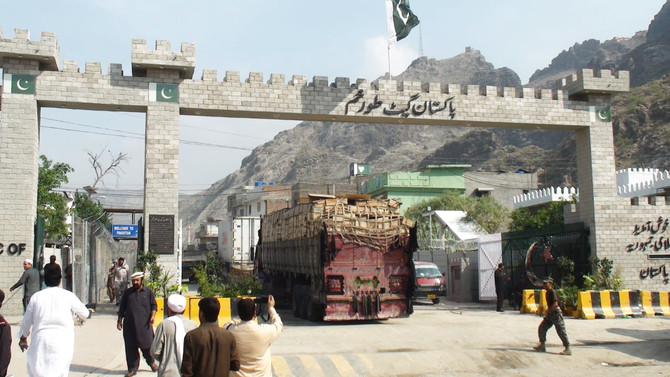
A loaded truck passes through the Torkham border. (AN photo)
2 / 4
Security officials and bystanders look on as a loaded truck passes through Torkham border. (AN photo)
3 / 4
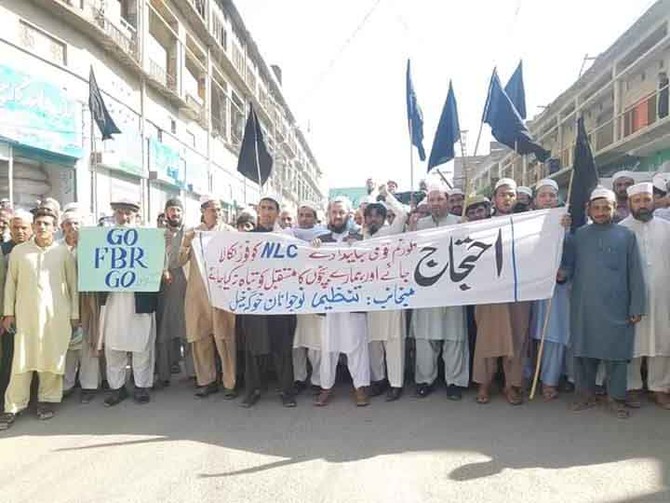
Hundreds of Shinwari tribesmen march in Landi Kotal, a town in Khyber tribal region, demanding visa-free movement on Torkham border to Afghanistan and other incentives. (AN photo)
4 / 4
Shinwari tribesmen visit a congested bazaar at Landi Kotal, a town in Khyber tribal district, in connection of their demands. (AN photo)
Updated 28 October 2018
Follow

Pakistan’s Shinwari tribe wants visa-free movement across Torkham border

  • Members of the Shinwari tribe were allowed to use special cards for their cross-border movement before 2016
  • They have threatened to go on an indefinite hunger strike if their demand is not met

PESHAWAR: Thousands of Pakistani tribesmen belonging to the Shinwari clan, which straddles the Pak-Afghan frontier, protested in Landi Kotal on Sunday, demanding visa-free movement across the Torkham border.

“We’re not being allowed to visit the other side of the border in Afghanistan, even though we have our businesses, shops, and properties there,” Zarqeeb Shinwari, president of the Custom Clearing Association at the Torkham border, told Arab News. “We cannot even visit our relatives on the other side.”

The Shinwaris were allowed to use special rahdari (passage) cards before 2016 that facilitated their cross-border movement. In the past couple of months, however, Pakistani authorities have started asking them for travel documents to cross into Afghanistan, he added.

Shakil-ur-Rehman, a senior government official at the Torkham border, claimed that the local administration had already taken notice of the protest by tribesmen, adding it would hold a meeting with the Shinwaris to tackle the issue in the next few days.

“We’re going to have a meeting tomorrow, or the day after, and hopefully resolve their legitimate problems,” Rehman told Arab News, without elaborating on why these restrictions were placed on the movement of the local tribe.

However, Merajuddin Shinwari, another tribesman, claimed that things were not streamlined at the Torkham border and there was “total chaos and maladministration” that adversely affected the businesses of tribesmen, even though these commercial ventures constituted their sole source of income.

Zarqeeb said at least half a million members of the Shinwari tribe who lived on the Pakistani side had their relatives, properties and businesses in Afghanistan. He pointed out that all these individuals should be allowed a relaxation from visa formalities and other such restrictions.

Pakistani authorities had promised to facilitate people in this way who lived within the 15-kilometer range of the Torkham town, a pledge which, he noted, should be fulfilled in its letter and spirit.

Afghan authorities had no problem when these tribesmen visited the other side of the border, he added.

Zarqeeb also warned that his tribe was planning to hold a similar protest next Sunday. “After that, we will go on an indefinite hunger strike until our legitimate demands are met,” he said.

Officials confirmed that members of the Shinwari tribe living on both sides of the border were exempt from using formal travel documents since they were issued temporary cards by the administration of Khyber tribal district.


No casualties as blast derails Jaffar Express train in Pakistan’s south

Updated 26 January 2026
Follow

No casualties as blast derails Jaffar Express train in Pakistan’s south

  • Passengers were stranded and railway staffers were clearing the track after blast, official says
  • In March 2025, separatist militants hijacked the same train with hundreds of passengers aboard

QUETTA: A blast hit Jaffar Express and derailed four carriages of the passenger train in Pakistan’s southern Sindh province on Monday, officials said, with no casualties reported.

The blast occurred at the Abad railway station when the Peshawar-bound train was on its way to Sindh’s Sukkur city from Quetta, according to Pakistan Railways’ Quetta Division controller Muhammad Kashif.

No group immediately claimed responsibility for the bomb attack, but passenger trains have often been targeted by Baloch separatist outfits in the restive Balochistan province that borders Sindh.

“Four bogies of the train were derailed due to the intensity of the explosion,” Kashif told Arab News. “No casualty was reported in the latest attack on passenger train.”

The Jaffar Express stands derailed near Abad Railway Station in Jacobabad following a blast on January 26, 2026. (AN Photo/Saadullah Akhtar)

Another railway employee, who was aboard the train and requested anonymity, said the train was heading toward Sukkur from Jacobabad when they heard the powerful explosion, which derailed power van among four bogies.

“A small piece of the railway track has been destroyed,” he said, adding that passengers were now standing outside the train and railway staffers were busy clearing the track.

In March last year, fighters belonging to the Balochistan Liberation Army (BLA) separatist group had stormed Jaffar Express with hundreds of passengers on board and took them hostage. The military had rescued them after an hours-long operation that left 33 militants, 23 soldiers, three railway staff and five passengers dead.

The passenger train, which runs between Balochistan’s provincial capital of Quetta and Peshawar in the country’s northwest, had been targeted in at least four bomb attacks last year since the March hijacking, according to an Arab News tally.

The Jaffar Express stands derailed near Abad Railway Station in Jacobabad following a blast on January 26, 2026. (AN Photo/Saadullah Akhtar)

Pakistan Railways says it has beefed up security arrangements for passenger trains in the province and increased the number of paramilitary troops on Jaffar Express since the hijacking in March, but militants have continued to target them in the restive region.

Balochistan, Pakistan’s southwestern province that borders Iran and Afghanistan, is the site of a decades-long insurgency waged by Baloch separatist groups who often attack security forces and foreigners, and kidnap government officials.

The separatists accuse the central government of stealing the region’s resources to fund development elsewhere in the country. The Pakistani government denies the allegations and says it is working for the uplift of local communities in Balochistan.