Greece: Ancient wrecks, pottery found at ships’ ‘graveyard’

1 / 4
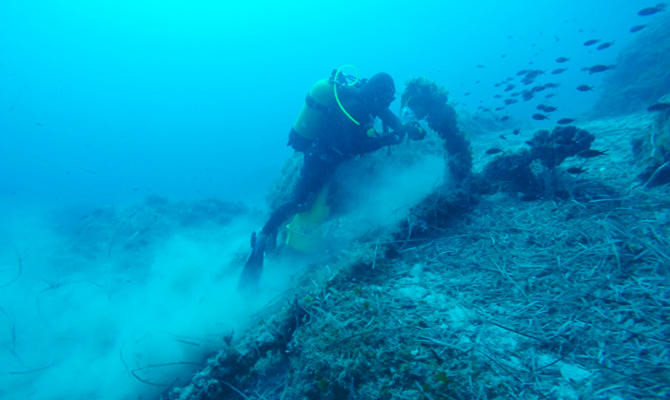
This undated handout photo provided by the Greek Culture Ministry on Monday, Oct. 15 , 2018, shows a diver searches on the seabed near the island of Fourni. (AP)
2 / 4
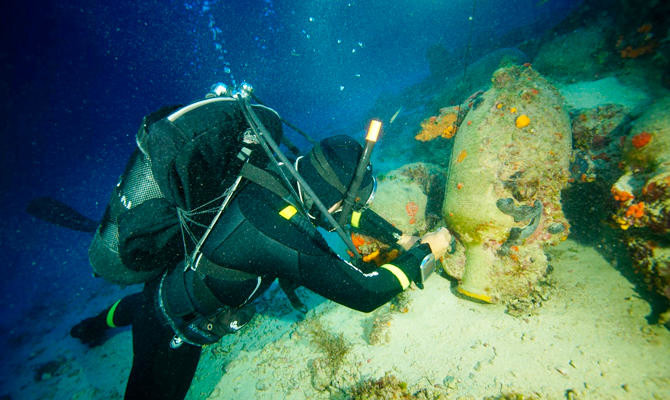
This undated handout photo provided by the Greek Culture Ministry on Monday, Oct. 15 , 2018, divers inspect items on the seabed from an ancient shipwreck discovered off the island of Fourni. (AP)
3 / 4
This undated handout photo provided by the Greek Culture Ministry on Monday, Oct. 15 , 2018, showing items on the seabed from an ancient shipwreck discovered off the island of Fourni. (AP)
4 / 4
This undated handout photo provided by the Greek Culture Ministry on Monday, Oct. 15 , 2018, shows a man holding a 2nd-century A.D. terracotta lamp with the incised name of its maker, the Corinthian artisan Octavius, on the base, one of a group found on the seabed off the island of Fourni. (AP)
Updated 23 October 2018
Follow

Greece: Ancient wrecks, pottery found at ships’ ‘graveyard’

  • The five new finds, all trading ships, raise to 58 the total number of ancient, mediaeval and more recent wrecks located since 2015 around the lobster-shaped Fourni complex

ATHENS, Greece: A Greek-US team of marine archaeologists has located three more ancient shipwrecks with pottery cargoes, including 1,900-year-old branded designer lamps, and two from much later times in a rich graveyard of ships in the eastern Aegean Sea, a project official said Tuesday.
All were found last month off Fourni island and its surrounding islets that lie at the junction of two main ancient shipping routes, in notoriously treacherous waters between the larger islands of Ikaria and Samos.
The older wrecks date to the 4th and 2nd centuries B.C. and the 5th-6th centuries A.D., while the more recent ones are from the 18th or 19th century, said archaeologist George Koutsouflakis, joint leader of the project.
He said they were discovered at depths of 10-40 meters (33-130 feet). Because that is relatively shallow, the wrecks bore traces of looting by illegal antiquities hunters or of damage by fishing nets.
The five new finds, all trading ships, raise to 58 the total number of ancient, mediaeval and more recent wrecks located since 2015 around the lobster-shaped Fourni complex. Two of its 13 islets bear the ominous name Anthropofas, or Man-eater, in reference to the seamen who drowned off them.
The project started in 2015, in cooperation with the US-based RPM Nautical Foundation, a non-profit organization involved in several Mediterranean underwater projects. Archaeologists received significant help from local fishermen, who provided information on wreck sites.
Apart from the cargoes of amphorae — jars that contained wine, oil and foodstuffs — found in September, divers also recovered a group of 2nd-century A.D. terracotta lamps, incized with the names of the Corinthian artisans who made them, Octavius and Lucius.
They may have been slave workers who later gained their freedom and set up their own pottery workshops, a Greek Culture Ministry statement said.
The project is planned to continue over the next five years, the ministry said.


Arts festival’s decision to exclude Palestinian author spurs boycott

Randa Abdel Fattah. (Photo/Wikipedia)
Updated 12 January 2026
Follow

Arts festival’s decision to exclude Palestinian author spurs boycott

  • A Macquarie University academic who researches Islamophobia and Palestine, Abdel-Fattah responded saying it was “a blatant and shameless act of anti-Palestinian racism and censorship,” with her lawyers issuing a letter to the festival

SYDENY: A top Australian arts festival has seen ​the withdrawal of dozens of writers in a backlash against its decision to bar an Australian Palestinian author after the Bondi Beach mass shooting, as moves to curb antisemitism spur free speech concerns.
The shooting which killed 15 people at a Jewish Hanukkah celebration at Sydney’s Bondi Beach on Dec. 14 sparked nationwide calls to tackle antisemitism. Police say the alleged gunmen were inspired by Daesh.
The Adelaide Festival board said last Thursday it would disinvite Randa ‌Abdel-Fattah from February’s ‌Writers Week in the state of South Australia because “it ‌would not ​be ‌culturally sensitive to continue to program her at this unprecedented time so soon after Bondi.”

FASTFACTS

• Abdel-Fattah responded, saying it was ‘a blatant and shameless act of anti-Palestinian racism and censorship.’

• Around 50 authors have since withdrawn from the festival in protest, leaving it in doubt, local media reported.

A Macquarie University academic who researches Islamophobia and Palestine, Abdel-Fattah responded saying it was “a blatant and shameless act of anti-Palestinian racism and censorship,” with her lawyers issuing a letter to the festival.
Around 50 authors have since withdrawn from the festival in protest, leaving it in doubt, local media reported.
Among the boycotting authors, Kathy Lette wrote on social media the decision to bar Abdel-Fattah “sends a divisive and plainly discriminatory message that platforming Australian Palestinians is ‘culturally insensitive.'”
The Adelaide Festival ‌said in a statement on Monday that three board ‍members and the chairperson had resigned. The ‍festival’s executive director, Julian Hobba, said the arts body was “navigating a complex moment.”

 a complex and ‍unprecedented moment” after the “significant community response” to the board decision.
In the days after the Bondi Beach attack, Jewish community groups and the Israeli government criticized Prime Minister Anthony Albanese for failing to act on a rise in antisemitic attacks and criticized protest marches against Israel’s war in ​Gaza held since 2023.
Albanese said last week a Royal Commission will consider the events of the shooting as well as antisemitism and ⁠social cohesion in Australia. Albanese said on Monday he would recall parliament next week to pass tougher hate speech laws.
On Monday, New South Wales state premier Chris Minns announced new rules that would allow local councils to cut off power and water to illegally operating prayer halls.
Minns said the new rules were prompted by the difficulty in closing a prayer hall in Sydney linked to a cleric found by a court to have made statements intimidating Jewish Australians.
The mayor of the western Sydney suburb of Fairfield said the rules were ill-considered and councils should not be responsible for determining hate speech.
“Freedom ‌of speech is something that should always be allowed, as long as it is done in a peaceful way,” Mayor Frank Carbone told Reuters.