KOCHI/NEW DELHI: A senior leader of India’s ruling party warned on Friday that protesters in the southern state of Kerala would take the law into their hands if officials attempted to let women enter a hill temple at the center of a raging controversy.
A political tinge for the controversy could help Prime Minister Narendra Modi’s party gain ground in Kerala, where it has never made much headway, and won just one of 98 seats it contested in the last elections to the state assembly in 2016.
Protests against women entering the Hindu temple grew on Friday, with hundreds of hard-liners blocking three women from entering the Sabarimala temple for a third day.
The demonstrators were defying a Supreme Court verdict that overturned a decades-old ruling by a lower court denying entry to women of menstrual age, whom some Hindu communities consider to be ritually unclean.
“If the government is trying to implement its agenda in Sabarimala, we will prevent it, even by taking the law into our hands,” said K. Surendran, the general secretary of Modi’s Hindu nationalist Bharatiya Janata Party in the state.
“Sabarimala is not a place for anybody to tamper with.”
Surendran accused the state’s Communist Party government, which has tried to implement the verdict, of provoking devotees after police gave protection to some women who sought to reach the remote site.
He did not elaborate on what the party plans to do, however.
Three dozen priests staged a sit-in against the verdict overturning the ban that kept women aged between 10 and 50 out of the temple, where a celibate deity, Lord Ayyappan, is worshipped.
Television broadcast images of scores of police attempting to calm emotional protesters, who consider the verdict a challenge to tradition and interference in religious affairs. The Supreme Court called the tradition patriarchal.
Though Hindus form a majority of the state’s population of more than 35 million, it is home to millions of Muslims and Christians.
The controversy has fired up Hindu religious sentiment, with some residents supporting the view that the temple devotees’ feelings ought to be respected.
Members of Modi’s BJP in the state have also strongly backed those seeking to block the entry of women.
Hindu hard-liners, including members of the BJP’s youth wing, have clashed with police and attacked women, including journalists, who have tried to get to the temple.
Two women who got close were forced to turn back in the face of protests and a threat by the head priest to shut the temple if they entered, senior Kerala police official S. Sreejith told reporters on Friday.
A third woman turned back at the request of police, citing the tension.

Indian temple controversy turns political as protests grow
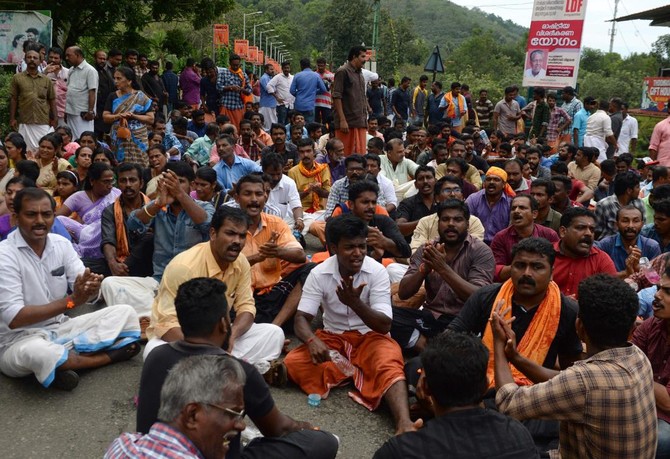
- Three dozen priests staged a sit-in against the verdict overturning the ban that kept women aged between 10 and 50 out of the temple.
- Though Hindus form a majority of the Kerala's population of more than 35 million, it is home to millions of Muslims and Christians.
Geoeconomic confrontation tops global risks in 2026: WEF report
- Also armed conflict, extreme climate, public polarization, AI
- None ‘a foregone conclusion,’ says WEF’s MD Saadia Zahidi
DUBAI: Geoeconomic confrontation has emerged as the top global risk this year, followed by state-based armed conflict, according to a new World Economic Forum report.
The Global Risks Report 2026, released on Wednesday, found that both risks climbed eight places year-on-year, underscoring a sharp deterioration in the global outlook amid increased international competition.
The top five risks are geoeconomic confrontation (18 percent of respondents), state-based armed conflict (14 percent), extreme weather events (8 percent), societal polarization (7 percent) and misinformation and disinformation (7 percent).
The WEF’s Managing Director Saadia Zahidi said the report “offers an early warning system as the age of competition compounds global risks — from geoeconomic confrontation to unchecked technology to rising debt — and changes our collective capacity to address them.
“But none of these risks are a foregone conclusion.”
The report assesses risks across three timeframes: immediate (2026); short-to-medium term (next two years); and long term (next 10 years).
Economic risks show the largest overall increase in the two-year outlook, with both economic downturn and inflation jumping eight positions.
Misinformation and disinformation rank fifth this year but rise to second place in the two-year outlook and fourth over the 10-year horizon.
The report suggests this reflects growing anxiety around the rapid adoption of artificial intelligence, with adverse outcomes linked to AI surging from 30th place in the two-year timeframe to fifth in the 10-year outlook.
Uncertainty dominates the global risk outlook, according to the report.
Surveyed leaders and experts view both the short- and long-term outlook negatively, with 50 percent expecting a turbulent or stormy global environment over the next two years, rising to 57 percent over the next decade.
A further 40 percent and 32 percent, respectively, describe the outlook as unsettled across the two- and 10-year timeframes, while just 1 percent anticipate a calm global outlook in either period.
Environmental risks ease slightly in the short-term rankings. Extreme weather fell from second to fourth place and pollution from sixth to ninth. Meanwhile, critical changes to Earth systems and biodiversity loss dropped seven and five positions, respectively.
However, over the next decade, environmental threats re-emerge as the most severe, with extreme weather, biodiversity loss, and critical changes to Earth systems topping the global risk rankings.
Looking ahead over the next decade, around 75 percent of respondents anticipate a turbulent or stormy environmental outlook, making it the most pessimistic assessment across all risk categories.
Zahidi said that “the challenges highlighted in the report underscore both the scale of the potential perils we face and our shared responsibility to shape what comes next.”
Despite the gloomy outlook, Zahidi signaled a positive shift in global cooperation.
“It is also clear that new forms of global cooperation are already unfolding even amid competition, and the global economy is demonstrating resilience in the face of uncertainty.”
Now in its 21st year, the Global Risks Report highlights a core message: global risks cannot be managed without cooperation.
As competition intensifies, rebuilding trust and new forms of collaboration will be critical, with the report stressing that today’s decisions will shape future outcomes.
The report was released ahead of WEF’s annual meeting, which will be held in Davos from Jan. 19 to 23.


