China says interning Muslims brings them into ‘modern’ world

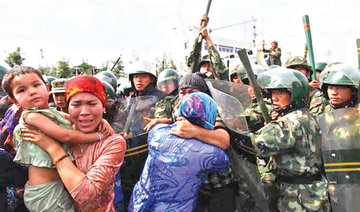
In this Nov. 4, 2017 file photo, Uighur security personnel patrol near the Id Kah Mosque in Kashgar in western China's Xinjiang region. (AP)
Updated 17 October 2018
Follow

China says interning Muslims brings them into ‘modern’ world

  • Despite growing alarm from the US and the United Nations, China has maintained that Xinjiang’s vast dragnet of police surveillance is necessary for countering latent extremism and preserving stability

BEIJING: China on Tuesday characterized its mass internment of Muslims as a push to bring into the “modern, civilized” world a destitute people who are easily led astray — a depiction that analysts said bore troubling colonial overtones.
The report is the ruling Communist Party’s latest effort to defend its extrajudicial detention of Central Asian Muslim minorities against mounting criticism.
China’s resistance to Western pressure over the camps highlights its growing confidence under President Xi Jinping, who has offered Beijing’s authoritarian system as a model for other countries.
About 1 million Uighurs, Kazakhs and other minorities have been arbitrarily detained in mass internment camps in China’s far west Xinjiang region, according to estimates by a UN panel. Former detainees say they were forced to disavow their Islamic beliefs in the camps, while children of detainees are being placed in dozens of orphanages across the region.
The report by the official Xinhua News Agency indicated that key to the party’s vision in Xinjiang is the assimilation of the indigenous Central Asian ethnic minorities into Han Chinese society — and in turn, a “modern” lifestyle.
Xinjiang Gov. Shohrat Zakir said the authorities were providing people with lessons on Mandarin, Chinese history and laws. Such training would steer them away from extremism and onto the path toward a “modern life” in which they would feel “confident about the future,” he said.
“It’s become a general trend for them to expect and pursue a modern, civilized life,” Zakir said, referring to the trainees. He said the measures are part of a broader policy to build a “foundation for completely solving the deeply-rooted problems” in the region.
China has long viewed the country’s ethnic minorities as backward, said James Leibold an expert on Chinese ethnic polices at Melbourne’s La Trobe University.
Leibold described Beijing’s perspective on minorities as: “They’re superstitious, they’re deviant, they’re potentially dangerous. The role of the party-state is to bring them into the light of civilization, to transform them.”
Despite growing alarm from the US and the United Nations, China has maintained that Xinjiang’s vast dragnet of police surveillance is necessary for countering latent extremism and preserving stability. The Turkic-speaking Uighurs (pronounced WEE-gurs) have long resented restrictions placed on their religious practices. They say they experience widespread discrimination in jobs and access to passports.
In the Xinhua report, Zakir said authorities provide free vocational training in skills geared toward manufacturing, food and service industries. Zakir said “trainees” are paid a basic income during the training, in which free food and accommodations are provided.
The report appeared aimed at disputing accounts provided by former detainees, who have said they were held in political indoctrination camps where they were forced to denounce Islam and profess loyalty to the party.
Ethnic Uighurs and Kazakhs have told The Associated Press that ostensibly innocuous acts such as praying regularly, viewing a foreign website or taking phone calls from relatives abroad could land one in a camp.
Zakir said the training centers were for people “who are influenced by terrorism and extremism, and those suspected of minor criminal offenses” who could be exempted from criminal punishment.
Zakir did not say whether such individuals were ever formally charged with any crime or provided a chance to defend themselves against the allegations. The report also did not say if attendance was mandatory, though former detainees have said they were forcibly held in centers policed by armed guards.
Maya Wang, senior China researcher at Human Rights Watch, said the system deprived detainees of basic legal protections such as access to lawyers.
The authorities’ attempts to justify the camps “illustrate what the ‘rule of law’ in China means — that the party bends it to its will and uses it as a weapon against perceived political enemies,” Wang said in an email.
Zakir did not say how many people were in such courses, but said some would be able to complete their courses this year.
Zakir seemed to try to counter reports of poor living conditions within the camps, saying that “trainees” were immersed in athletic and cultural activities. The centers’ cafeterias provide “nutritious, free diets,” and dormitories are fully equipped with TVs, air conditioning and showers, he said.
Omir Bekali, a Xinjiang-born Kazakh citizen, said he was kept in a cell with 40 people inside a heavily guarded facility.
Bekali said he was kept in a locked room with eight other internees. They shared beds and a wretched toilet. Baths were rare.
Before meals, they were told to chant “Thank the party! Thank the motherland!” During daily mandatory classes, they were told that their people were backward before being “liberated” by the party in the 1950s.
The idea that one’s beliefs can be transformed through indoctrination dates back to the Mao Zedong era, when self-criticisms and public humiliation were routinely employed to stir up ideological fervor.
The program’s philosophies can be traced even further back to the late imperial era, when Xinjiang’s “natives” were seen as requiring education in the Confucian way, according to Michael Clarke, a Xinjiang expert at Australian National University.
Amnesty International called the Xinhua report an insult to detainees and the families of people who have gone missing in the crackdown.
“No amount of spin can hide the fact that the Chinese authorities are undertaking a campaign of systematic repression,” the human rights group said.


Rubio defends US ouster of Venezuela’s Maduro to Caribbean leaders unsettled by Trump policies

Updated 26 February 2026
Follow

Rubio defends US ouster of Venezuela’s Maduro to Caribbean leaders unsettled by Trump policies

BASSETERRE, St. Kitts and Nevis: US Secretary of State Marco Rubio on Wednesday defended the Trump administration’s military operation to capture Venezuela’s Nicolás Maduro, telling Caribbean leaders, many of whom objected to that move, that the country and the region were better off as a result.
Speaking to leaders from the 15-member Caribbean Community bloc at a summit in the country of St. Kitts and Nevis, Rubio brushed aside concerns about the legality of Maduro’s capture last month that have been raised among Venezuela’s island-state neighbors and others.
“Irrespective of how some of you may have individually felt about our operations and our policy toward Venezuela, I will tell you this, and I will tell you this without any apology or without any apprehension: Venezuela is better off today than it was eight weeks ago,” Rubio told the leaders in a closed-door meeting, according to a transcript of his remarks later distributed by the US State Department.
Rubio said that since Maduro’s ouster and the effective takeover of Venezuela’s oil sector by the United States, the interim authorities in the South American country have made “substantial” progress in improving conditions by doing “things that eight or nine weeks ago would have been unimaginable.”
The Caribbean leaders have gathered to debate pressing issues in a region that President Donald Trump has targeted for a 21st-century incarnation of the Monroe Doctrine meant to ensure Washington’s dominance in the Western Hemisphere. The Republican administration has declared a focus closer to home even as Washington increasingly has been preoccupied by the possibility of a US military attack on Iran.
Rubio downplays antagonism in US regional push
In his remarks to the group, America’s top diplomat tried to play down any antagonistic intent in what Trump has referred to as the “Donroe Doctrine.” Rubio said the administration wants to strengthen ties with the region in the wake of the Venezuela operation and ensure that issues such as crime and economic opportunities are jointly addressed.
“I am very happy to be in an administration that’s giving priority to the Western Hemisphere after largely being ignored for a very long time,” Rubio said. “We share common opportunities, and we share some common challenges. And that’s what we hope to confront.”
He said transnational criminal organizations pose the biggest threat to the Caribbean while recognizing that many are buying weapons from the United States, a problem he said authorities are tackling.
Rubio also said the US and the Caribbean can work together on economic advancement and energy issues, especially because many leaders at the four-day summit have energy resources they seek to explore. “We want to be your partner in that regard,” he said.
Rubio said the US recognizes the need for fair, democratic elections in Venezuela, which lies just miles away from Trinidad and Tobago at the closest point.
“We do believe that a prosperous, free Venezuela who’s governed by a legitimate government who has the interests of their people in mind could also be an extraordinary partner and asset to many of the countries represented here today in terms of energy needs and the like, and also one less source of instability in the region,” he said.
Rubio added: “We view our security, our prosperity, our stability to be intricately tied to yours.”
Trump plays up Maduro’s ouster
Trump, in his State of the Union address Tuesday night, called the operation that spirited Maduro out of Venezuela to face drug trafficking charges in New York “an absolutely colossal victory for the security of the United States.”
The US had built up the largest military presence in the Caribbean Sea in generations before the Jan. 3 raid. That has now been exceeded by the surge of American warships and aircraft to the Middle East as the administration pressures Iran to make a deal over its nuclear program.
In the Caribbean, Trump has stepped up aggressive tactics to combat alleged drug smuggling with a series of strikes on boats that have killed over 150 people and he has tightened pressure on Cuba. Regional leaders have complained about administration demands for nations to accept third-country deportees from the US and to chill relations with China.
One regional leader who has backed the US escalation is Trinidad and Tobago Prime Min­is­ter Kam­la Persad-Bisses­sar, whom Rubio thanked for her “public support for US military operations in the South Caribbean Sea,” the State Department said.
Persad-Bissessar told reporters that her conversation with Rubio focused on “Haiti; we talked about Cuba of course; we talked about engagements with Venezuela and the way forward.”
She was asked if she considered the latest US military strikes in Caribbean waters as extrajudicial killings: “I don’t think they are, and if they are, we will find out, but our legal advice is they are not.”
Rubio had other one-on-one meetings with heads of government, including from St. Kitts and Nevis, Haiti, Jamaica and Guyana.
Caribbean leaders point to shifting global order
Trump said during the State of the Union that his administration is “restoring American security and dominance in the Western Hemisphere, acting to secure our national interests and defend our country from violence, drugs, terrorism and foreign interference.”
Terrance Drew, prime minister of St. Kitts and Nevis and chair of the Caribbean Community bloc, said the region “stands at a decisive hour” and that “the global order is shifting.”
Drew and other leaders said Cuba’s humanitarian situation must be addressed.
“It must be clear that a prolonged crisis in Cuba will not remain confined to Cuba,” Jamaican Prime Minister Andrew Holness warned. “It will affect migration, security and economic stability across the Caribbean basin.”
The US Treasury Department on Wednesday slightly eased restrictions on the sale of Venezuelan oil to Cuba, which instituted austere fuel-saving measures in the weeks after the US raid in Venezuela.
That move came hours before Cuba’s government announced that its soldiers killed four people aboard a speedboat registered in Florida that had opened fire on officers in Cuban waters.