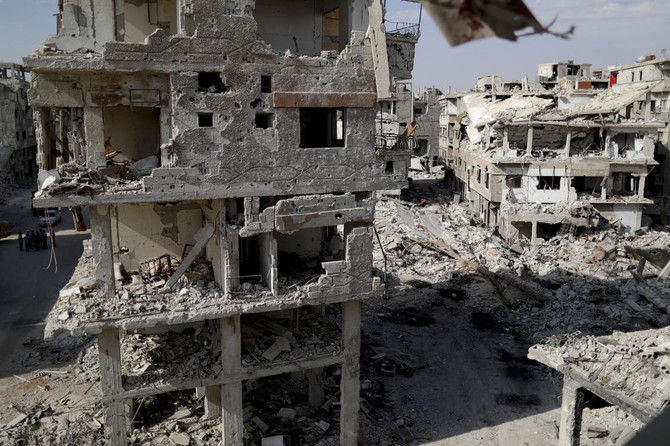
YARMOUK, Syria: The Yarmouk district in Damascus has switched hands many times in Syria’s war: from rebels, to Daesh militants, and back to government forces. But Abu Nimr did not budge.
He has remained in his family home with his dog through bombs, siege, and fierce battles for more than seven years, raising pigeons on his roof even as people fled in droves.
Since the army clawed back the enclave around five months ago, he has helped clear heaps of rubble from the streets and repair abandoned houses.
“My siblings and I lived in this building. They’re all married. They left so their kids could go to school,” Abu Nimr told Reuters in the Yarmouk Palestinian camp in the Syrian capital.
“I thought I’d stay here alone, keep an eye on the family property, and hoped things would be resolved within days. But seven years passed, God kept me patient.”
Abu Nimr, who is originally Palestinian, owned a shop selling sweets like baklawa before the conflict.
At the onset, he stored food from the empty houses of his relatives. As supplies dwindled, he often slept hungry.
“I took a decision seven years ago that weapons are not my thing. Bloodshed is not easy,” he said.
Abu Nimr, 36, did odd jobs over the years and spent time with his dog Balo. “He was my friend through the siege, and I relied on him to guard the house when I went out.”
When the fighting got too close, he would hide in the furthest room with a hammer in case he had to dig himself out.
The violence has turned his neighborhood into a ghost town, with twisted metal and collapsed walls still blocking some streets. Others are closed off with signs warning of land mines.
By the time the last battle came this year, after scores of residents had escaped or died, only 16 people were left in his neighborhood.
But he refused to leave. “The people fled? The warplanes dropped bombs? The militants entered? It doesn’t matter.”
Now, Abu Nimr wants to bring life back to Yarmouk and hopes people will be able to return soon.
Former neighbors and residents call him from other parts of Syria or abroad, asking him to check on their homes. They send him some money to clean up and repair damages.
State employees and volunteers have opened all of the main roads, he said. “We help with what we can.”
“Praise God, now things are much better.” If not for the war, Abu Nimr believes he would be married with kids now. “If people come back and it gets better, I will re-open a sweets shop right away.”

In Syria’s Yarmouk, a pigeon keeper and his dog held out through years of war
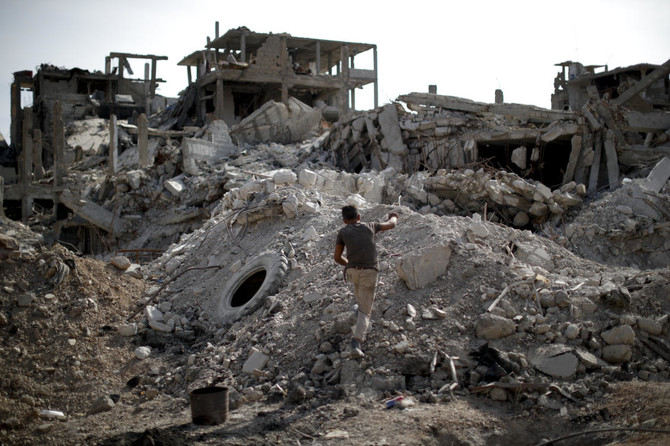
- The violence has turned the neighborhood into a ghost, with twisted metal and collapsed walls still blocking some streets town
- Palestinian Abu Nimr wants to bring life back to Yarmouk and hopes people will be able to return soon
Israel uses cargo ships to repatriate doctors stranded abroad by war
A ZIM official told Reuters on Tuesday that its cargo ships were shuttling between Limassol and Haifa
More shuttles are planned this week to repatriate what could be hundreds of doctors
JERUSALEM: Israeli authorities are using container ships to bring back dozens of essential medical staff stuck abroad after the air war with Iran broke out on Saturday, disrupting travel, according to Israel’s cargo firm ZIM Shipping.
A ZIM official told Reuters on Tuesday that its cargo ships were shuttling between Limassol in Cyprus and the Israeli port of Haifa, in an operation coordinated between the Transportation Ministry, major Israeli hospitals and the company.
So far, 40 doctors have returned in two sailings — including one on Tuesday — and more shuttles are planned this week to repatriate what could be hundreds of doctors, to deal with Israelis injured by Iranian missiles.
“It’s the easiest way to get them home when there are no flights,” said the official, who asked not to be named.
The doctors were away either at conventions or on holidays and now sought to “go back as fast as possible to their jobs in case of emergencies,” he added.
ZIM was re-routing ships from usual shipping routes between Israel and Mediterranean ports such as in Greece and Italy, and making makeshift arrangements on the cargo vessels to keep the doctors safe and comfortable during the 15-hour voyage from Cyprus. Israel and the US began bombing Iran on Saturday, triggering a wave of retaliatory strikes across the Middle East that have led to flight chaos, with hundreds of thousands of passengers stranded worldwide due to the closure of airspaces.
US and Israeli officials said the campaign could last weeks.
Israeli airlines have begun repatriation flights via Taba in Egypt, which borders the Red Sea resort city of Eilat in southern Israel. However, passengers must then travel north to major cities, which takes hours by car or bus.
“This (cargo ship option) is far more efficient and easy,” the official said.
More shuttles are planned this week to repatriate what could be hundreds of doctors
JERUSALEM: Israeli authorities are using container ships to bring back dozens of essential medical staff stuck abroad after the air war with Iran broke out on Saturday, disrupting travel, according to Israel’s cargo firm ZIM Shipping.
A ZIM official told Reuters on Tuesday that its cargo ships were shuttling between Limassol in Cyprus and the Israeli port of Haifa, in an operation coordinated between the Transportation Ministry, major Israeli hospitals and the company.
So far, 40 doctors have returned in two sailings — including one on Tuesday — and more shuttles are planned this week to repatriate what could be hundreds of doctors, to deal with Israelis injured by Iranian missiles.
“It’s the easiest way to get them home when there are no flights,” said the official, who asked not to be named.
The doctors were away either at conventions or on holidays and now sought to “go back as fast as possible to their jobs in case of emergencies,” he added.
ZIM was re-routing ships from usual shipping routes between Israel and Mediterranean ports such as in Greece and Italy, and making makeshift arrangements on the cargo vessels to keep the doctors safe and comfortable during the 15-hour voyage from Cyprus. Israel and the US began bombing Iran on Saturday, triggering a wave of retaliatory strikes across the Middle East that have led to flight chaos, with hundreds of thousands of passengers stranded worldwide due to the closure of airspaces.
US and Israeli officials said the campaign could last weeks.
Israeli airlines have begun repatriation flights via Taba in Egypt, which borders the Red Sea resort city of Eilat in southern Israel. However, passengers must then travel north to major cities, which takes hours by car or bus.
“This (cargo ship option) is far more efficient and easy,” the official said.
© 2026 SAUDI RESEARCH & PUBLISHING COMPANY, All Rights Reserved And subject to Terms of Use Agreement.