

Afghan Taliban give ‘peace a priority’

In this file photo, The Taliban’s political bureau in Doha, Qatar. The group said on Saturday that it has met with the new US envoy for Afghanistan, Zalmay Khalilzad in Doha on Friday. (AP/photo)
Updated 14 October 2018
Follow

Afghan Taliban give ‘peace a priority’

  • Confirm first round of talks with US envoy
  • Analysts view move as significant progress in stalled talks

KABUL: Signaling a thaw in the frozen Afghan peace process, the Taliban on Saturday confirmed reports that they had held talks with US’ newly-appointed envoy for the reconciliation process.

Zalmay Khalilzad met with representatives of the group to kickstart negotiations and address their concerns that the presence of US-led foreign troops was the main deterrent in achieving peace and stability in the country.

The meeting was the first of its kind since Khalilzad took office as the US’ special envoy for Afghanistan reconciliation last month and marks the first time a high-ranking US official has held talks with the militant group after they were ousted from power in late 2001.

Last week, Khalilzad flew into Kabul to discuss measures that could set the wheels of negotiations in motion, by trying to bring President Ashraf Ghani’s government and the Taliban on the same table. He later visited Pakistan, Saudi Arabia, the UAE and finally Qatar where he met with Taliban’s emissaries on Friday.

He returned to Kabul on Saturday to brief President Ghani and other authorities about his meetings. Palace officials in Kabul confirmed the meeting but did not provide further details on the discussions.

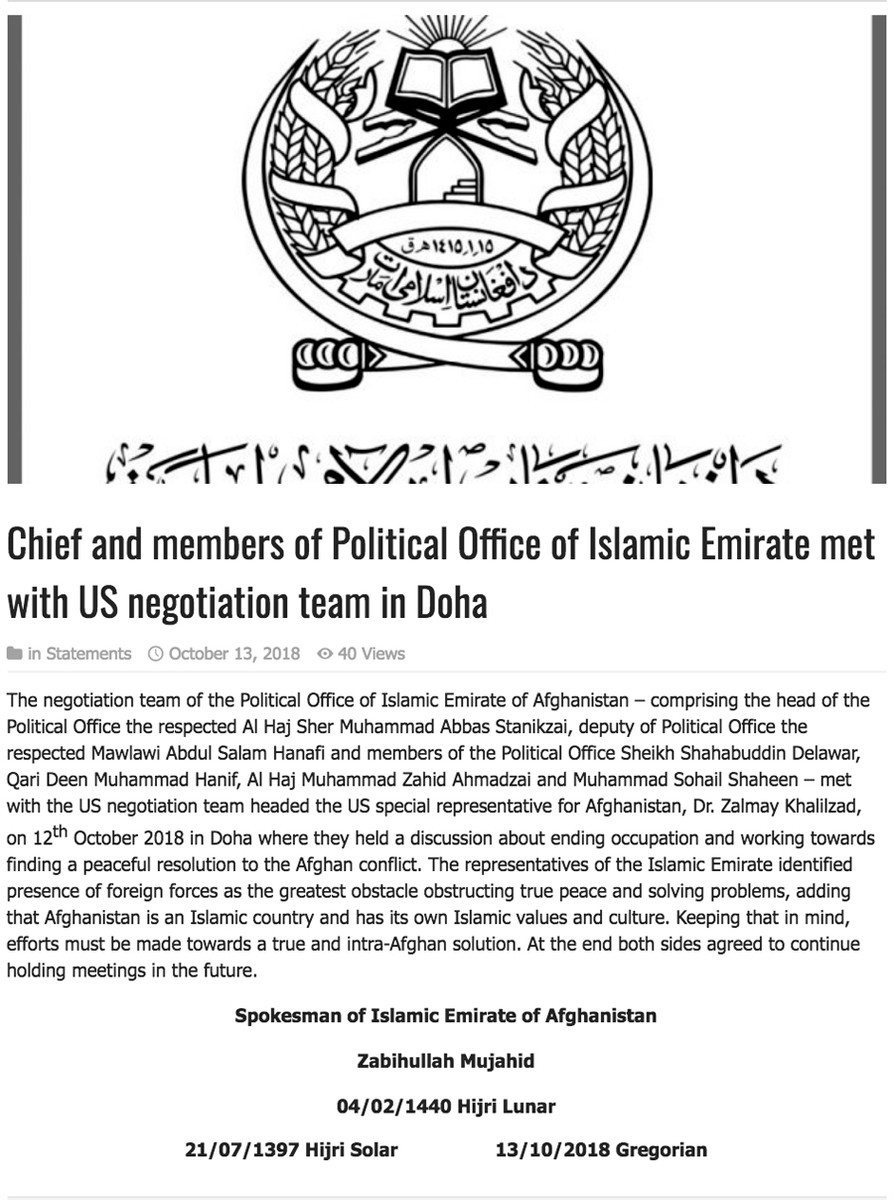
In a statement sent to the media, Zabihullah Mujahid, a Taliban spokesman, said that both sides agreed to hold further talks, specifically on the issue of the “occupation” of Afghanistan and to work towards a peaceful solution to the war. “The representatives of the Islamic Emirate (Taliban) called the presence of foreign troops as the main hindrance for solution of the problems and for restoration of genuine peace,” Mujahid said. 
Terming the talks and Khalilzad’s return to Kabul “as progress”, Nazar Mohammad Mutmaen, an analyst familiar with Taliban leaders, said: “It is the first high-level meeting of US officials with the Taliban and shows that both sides are giving peace a priority,” he told Arab News.

He said Khalilzad’s meeting, set for last month, was delayed because US officials had insisted that President Ghani’s government be represented in the talks and the issue of occupation removed from the agenda – conditions that were opposed by the Taliban.

The meeting comes a week ahead of crucial parliamentary elections that have faced a delay of more than three years and in which President Ghani has vowed to get re-elected. During Khalilzad’s meeting with government leaders last week, the Taliban – breaking months of silence – had warned against the elections, with threats to derail it.

The talks took place more than a year after US President Donald Trump introduced his new South Asia strategy that saw increased air attacks against militants in Afghanistan. However, despite the move, the Taliban have continued to gain ground in the country, questioning the effectiveness of the strategy and US’ role in the process.


Islamophobic attacks on public transport growing in UK

Updated 5 sec ago
Follow

Islamophobic attacks on public transport growing in UK

  • Muslim travelers restricting journeys over fear of abuse and assault, community groups warn
  • Authorities must ‘take urgent and meaningful action,’ says British Muslim Trust CEO

LONDON: Islamophobic attacks are on the rise on public transport across Britain, according to new information revealed by The Guardian, as community organizations warn that Muslims are restricting their journeys over fear of abuse and assault.

A freedom of information request showed that racial hate crimes recorded by British Transport Police across England, Wales and Scotland grew from 2,827 cases in 2019-2020 to 3,258 in 2024-25.

The environment of public transport “creates a particular dynamic where aggressors are often emboldened by alcohol, can isolate their targets and then exit at the next stop,” The Guardian reported.

Hate crimes of a religious nature climbed from 343 cases in 2019-20 to 419 in 2023-24.

Akeela Ahmed, CEO of the British Muslim Trust, said the data reflects the stories her organization has collected from Muslims across the country.

She urged local authorities, transport operators and community safety groups to “take urgent and meaningful action” to address the issue.

“For visible Muslims in particular, the top deck of a bus or a half-empty train carriage can mean threatening behaviour, verbal abuse or even violent attack simply because of their faith,” Ahmed said, adding that Islamophobic attacks on public transport reported to the BMT are “some of the most complex and distressing cases we have handled to date.

“Many Muslims now feel compelled to micro-analyse every movement, expression or gesture out of fear that it may be misinterpreted, recorded and weaponised against them.”

A significant number of physical and verbal attacks against Muslims target children traveling to and from school, Ahmed said, describing this trend as the “most alarming” of all.

“The lack of CCTV coverage on buses and at many stops means perpetrators routinely evade accountability,” she added.

Carol Young, deputy director of the Coalition for Racial Equality, said the recorded figures cited by The Guardian “are probably the tip of the iceberg,” adding: “Anecdotally, we know that using public transport may not feel safe for everyone and some people may avoid using it or restrict their use to certain times of day.”

In response to a request by The Guardian for comment, a spokesperson for British Transport Police said: “Abuse, intimidation and violence — especially that which is motivated by hate — will never be tolerated, and we have acted swiftly and decisively when we receive reports of hate crimes on the rail network.

“If you are a victim of hate crime, or if you witness an incident that makes you feel uncomfortable, please do not suffer in silence.”