The price of Assad’s victory: Syrian civilians starved of humanitarian aid

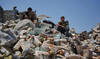
Residents of the Syrian town of Douma receive blankets distributed by relief workers and the United Nations as part of a humanitarian assistance provided by France. (AFP)
Updated 09 October 2018
Follow

The price of Assad’s victory: Syrian civilians starved of humanitarian aid

  • Eastern Ghouta near Damascus, and rural parts of Homs province have been without the vital support they once relied on
  • Aid became politicized early on, and two separate operations developed

BEIRUT/JEDDAH:  Tens of thousands of Syrian civilians in areas recaptured by Assad regime troops have lost access to humanitarian aid because relief agencies can no longer reach them.

International aid groups have been forced to halt their crucial health, food and protection services because they have no regime authorization to work.

Vulnerable civilians in Syria’s south, Eastern Ghouta near Damascus, and rural parts of Homs province have been left without the vital support they once relied on.

“The aid that used to come from international agencies to the south completely stopped,” said Mohammad Al-Zoabi, 29, from Al-Mseifra in southern Syria. 

“There’s a lack of flour, medical supplies, and hospitals in general after medical points and field clinics were closed.”

The UN said 66 aid trucks entered the south from Jordan in June, but none in July when regime troops seized the area. Residents said doctors and Syrian aid workers had fled, were wanted by security forces for working in opposition areas or had requested — but were denied — regime permission to resume relief work.
The International Rescue Committee (IRC), Mercy Corps, and Save the Children have all halted aid programs. 

“During the course of the war, as areas have changed hands to government control, the IRC has stopped providing support in those areas,” IRC country director Lorraine Bramwell said.

Residents in Talbisseh, a town in Homs seized by the regime in May, said medicine and food had become unavailable or unaffordable.

“There was one functioning hospital and three medical points in Talbisseh before the regime came, but they all shut down because now they need licenses from the ministries,” said Sami, 20.

Meanwhile, opposition forces have completed the withdrawal of heavy weapons from the frontline in Idlib province. 

Turkish President Recep Tayyip Erdogan and Russian President Vladimir Putin agreed in September to establish a demilitarized buffer zone zone there to prevent a massive regime assault.


Iranian hardline clerics seek swift naming of new supreme leader

Updated 3 sec ago
Follow

Iranian hardline clerics seek swift naming of new supreme leader

  • Calls by the clerics suggest that at least some in the clerical establishment are uncomfortable with leaving a three-man council in charge
DUBAI: Two influential and ‌hardline Iranian clerics have called for the swift selection of a new supreme leader to help guide the nation amid a new wave of US and Israeli strikes, Iranian media reported on Saturday.
The calls by the clerics suggest that at least some in the clerical establishment are uncomfortable with leaving a three-man council in charge, even temporarily under constitutional rules, after the killing of Supreme Leader Ayatollah Ali ‌Khamenei.
US President ‌Donald Trump has said the ‌US ⁠should have a role ⁠in choosing the new leader, a demand Iran has rejected.
Naser Makarem Shirazi, a grand ayatollah, which means he commands a broad following for his religious rulings, said an appointment was needed swiftly to “help better organize the country’s affairs,” state media reported.
Last ⁠week, two senior Shi’ite religious authorities ‌also issued fatwas, or religious ‌decrees, calling on Muslims around the world to avenge ‌the killing of Khamenei. Makarem Shirazi said it was ‌a religious duty for Muslims “until the evil of these criminals is eradicated from the world.”
Grand Ayatollah Hossein Nouri Hamedani also urged members of the Assembly of Experts, ‌a clerical body charged with choosing the new leader, to accelerate the process ⁠of ⁠picking Khamenei’s successor, state media reported.
Following rules laid out in Iran’s constitution, a three-man council comprising the president, a senior cleric and the head of the judiciary, has taken on the supreme leader’s role until the Assembly of Experts decides.
The constitution states a supreme leader should be chosen within three months, although with war raging, it is not immediately clear how quickly the 88-member Assembly of Experts can convene. Sources have said some clerics have held some consultations online.