

Saudi archaeological exhibition to go on display at Louvre Abu Dhabi

1 / 4
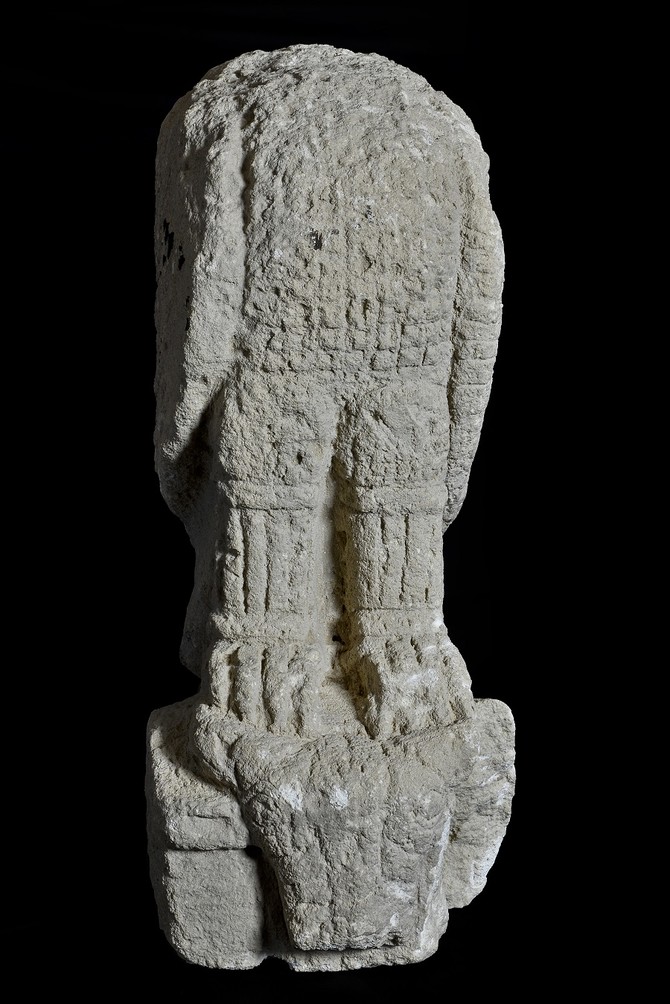
Statue of an eagle standing on a bull’s head: 1-100 CE United Arab Emirates, Ed-Dur Stone. (Department of Tourism and Archaeology – Umm Al Quwain)
2 / 4
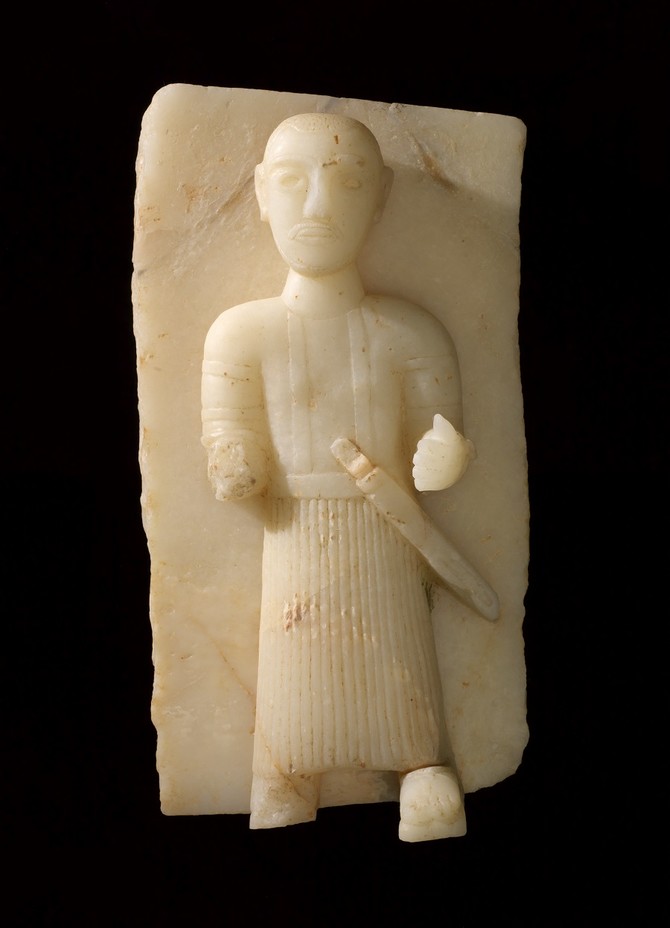
Stele representing a man with dagger: 1st–3rd century BCE Calcite alabaster, 57 × 30 cm Qaryat al-Faw. (Saudi Commission for Tourism and National Heritage)
3 / 4
Burial mask: 1-100 CE Saudi Arabia, Eastern Province, Thaj, Tell al-Zayer Gold. (Saudi Commission for Tourism and National Heritage)
4 / 4
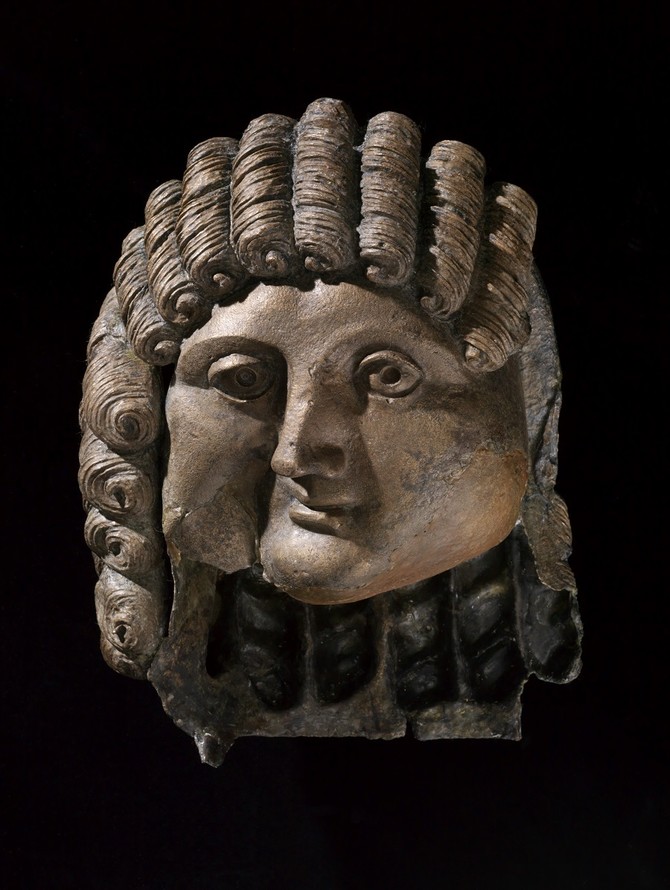
Head of a man: 100 BCE-200 CE Saudi Arabia, Qaryat al-Faw Cast bronze. (Saudi Commission for Tourism and National Heritage)
Updated 30 September 2018
Follow

Saudi archaeological exhibition to go on display at Louvre Abu Dhabi

ABU DHABI: Saudi Arabian artifacts exhibition, Roads of Arabia: Archaeological Treasures of Saudi Arabia, is set to open in the Louvre Abu Dhabi on November 8th under the patronage of Abu Dhabi Crown Prince Sheikh Mohamed bin Zayed Al Nahyan.

The exhibition, the second of the museum’s new culture season, will explore the rich history of the Arabian Peninsula through archaeological and cultural artefacts, including a selection of rare pieces from the United Arab Emirates.

The exhibition was conceived through cooperation between Saudi Commission for Tourism & National Heritage (SCTH) and the Musée du Louvre in Paris, where it was first exhibited in 2010. It is one of the most renowned Saudi exhibitions on a global scale, introducing Arabia's cultural and historical heritage to over five million visitors worldwide. The exhibition has presented 14 acclaimed editions throughout Europe, the USA and Asia, sharing the story of this unique region with audiences around the world, before coming to Louvre Abu Dhabi where it will be enriched by selected pieces from the UAE.

“The United Arab Emirates and Kingdom of Saudi Arabia have always been connected by a common heritage and history,” says H.E. Mohamed Khalifa Al Mubarak, Chairman of the Department of Culture and Tourism – Abu Dhabi. “This year’s edition of the exhibition will be a reflection of the rich, shared cultural heritage and deep-rooted history between the two nations.”

Roads of Arabia: Archaeological Treasures of Saudi Arabia explores five chapters in the history of the Arabian Peninsula, spanning early prehistoric settlements; maritime exploration; caravan trading routes that linked the region with Asia, Mesopotamia and the Mediterranean; routes of holy pilgrimage emerging in the 7th century CE; and the social and economic developments between the 14th and 16th centuries that set the stage for the modern day region.

“The Arabian Peninsula has been a place of exchange, culture and civilisation since earliest Antiquity, and Louvre Abu Dhabi is deeply rooted in the region’s unique history and context,” says Manuel Rabaté, Director of Louvre Abu Dhabi. “The exhibition is an important opportunity for us to re-examine and celebrate this rich heritage through a remarkable series of artefacts, expanding on the regional pieces in our permanent collection to tell an Arabian story from a new perspective.”

Jamal S. Omar, Vice President of Antiquities and Museums Department at STCH, underscores the significance of the exhibition, given the special relationship between the two neighbouring countries and their shared cultural and historical heritage. It is especially notable, he adds, in that this is the exhibition’s first showing in the Arabian Peninsula outside of Saudi Arabia, shedding light on the ancient civilizations and trade routes of the Arabian Peninsula. The exhibition has been followed closely by His Royal Highness Prince Sultan bin Salman bin Abdul Aziz, President of the STCH, in view of the esteem that Saudi Arabia has for the United Arab Emirates, its rulers and its people. "Although the exhibition focuses on Saudi Arabia's civilizations, it also highlights the civilizations of the Arabian Peninsula including major hubs along the ancient trade routes, which were important links in the cultural and historical narrative of this highly strategic region," Mr. Omar comments.

“From overland camel caravans and maritime trading routes to paths walked by religious pilgrims, the roads of Arabia have always been of vital importance to economic development, early settlement and the exchange of ideas, customs and cultures across the region and beyond,” says Dr. Souraya Noujaim, Scientific, Curatorial and Collection Management Director at Louvre Abu Dhabi. “These roads are the thread of this exhibition, which presents a journey retracing exchanges, circulation and encounters in the Arabian Peninsula. Dynamic archaeological research in recent years has shed new light on the longstanding history and diversity of the region, and excitingly, the exhibition now includes a selection of objects from the UAE.”

The expanded exhibition to be displayed at Louvre Abu Dhabi is curated by Mr. Omar, Dr. Noujaim, and Noëmi Daucé, Chief Curator for Archaeology at Louvre Abu Dhabi. Louvre Abu Dhabi is assisted by two scientific advisors from the Musée du Louvre: Marianne Cotty from the Department of Near Eastern Antiquities and Carine Juvin from the Department of Islamic Art.

For the first time, the exhibition will feature important archaeological pieces from the United Arab Emirates, including a pearl found in Umm Al Quwain dating from 5500-5300 BCE (loaned by Umm Al Quwain Museum); a stone decorated with a wild camel from the late 3rd millennium BCE (loaned by Al Ain Museum), a remarkable 1st millennium BCE pieces from Saruq al Hadid (loaned by Dubai Municipality), as well as objects from Julfar (loaned by the National Museum of Ras Al Khaimah).

These will be displayed alongside significant artefacts from the Kingdom of Saudi Arabia, including outstanding funerary Neolithic stela, a 3rd-century BCE bronze statue head (loaned by the Department of Archaeology at King Saud University); a 1st-century BCE gold funerary mask from Eastern Province (loaned by the National Museum in Riyadh), 9th-century engraved steles (loaned by King Fahad National Library); 4th-millennium BCE Anthropomorphic stele (loaned by the National Museum in Riyadh); a door of the Kaaba dating to 1355 (loaned by the National Museum in Riyadh), and a key of the Kaaba (loaned by the Department of Islamic Art at the Musée du Louvre).

Alongside the exhibition opening, Louvre Abu Dhabi will organise a three-day celebration featuring a performance called “On the Roads of Arabia” – a creation from music, dances and poetry by 80 artists from the Arabian Peninsula, Africa, Mediterranean, Indian Ocean, India, Indonesia and China with a contemporary, calligraphic street art drawing designed by Tunisian artist Koom. The cultural program accompanying Roads of Arabia: Archaeological Treasures of Saudi Arabia will also feature film screenings selected by Hind Mezaina, curatorial talks, as well as a range of education workshops and guided tours related to the exhibition.

Entrance to the exhibition is free with the museum ticket. Visitors can tour the exhibition through a multimedia guide that is available in Arabic, English and French.



‘I feel seen,’ says Saudi storyteller Noura Alashwali

Saudi visual storyteller Noura Alashwali’s debut graphic novel began as a way to process grief in private. (Supplied)
Updated 03 January 2026
Follow

‘I feel seen,’ says Saudi storyteller Noura Alashwali

  • Ministry of Culture-backed incubator helped Jeddah local create her first graphic novel

JEDDAH: Visual storyteller Noura Alashwali is one of a generation of Saudi artists whose personal journeys mirror the Kingdom’s cultural transformation, meaning their creative impulses are increasingly backed by public institutions and have an audience ready to listen.

“Creative expression was never just a hobby for me; it was a need,” Alashwali, 37, told Arab News. “From a young age, whether through writing or drawing, creativity felt like a part of who I was. And it still is.”

It was her education at Dar Al-Hekma University, where she obtained a degree in graphic design, that gave structure and language to an instinct she had carried since childhood. 

Saudi visual storyteller Noura Alashwali’s debut graphic novel began as a way to process grief in private. (Supplied)

“My earliest memory of drawing with pen and paper is when I was four years old, and I still have those drawings,” she said. Like many artists, she experimented with various mediums as she grew older. Eventually, she found her way to a Saudi art center that she described as “a very popular and wonderful place to learn art.”

At university, Alashwali’s work turned digital. “When I learned about the major, I immediately felt that I belonged. Graphic design is about visual communication. It’s not just about creating art, but about communicating ideas, thoughts, and stories.”

Those ideas would take on a personal weight in 2023 with “Deema and the Old Letters,” her debut graphic novel.

When an idea comes to me (now), I take it more seriously. I honor it and commit to it. I say, ‘Thank you for choosing me. I’m going do my best to manifest you.’

Noura Alashwali, Saudi storyteller

“It was a way for me to process my grief after my mother passed away in 2023,” Alashwali explained. “I was simply writing and drawing while processing very heavy emotions.” 

Noura Alashwali's creativity was supported by the Literature, Publishing and Translation Commission's Authors’ Incubator Program in 2024. (Supplied)

What transformed that intimate archive into a published work was institutional support. In early 2024, Alashwali came across an open call from the Ministry of Culture’s Literature, Publishing and Translation Commission for its Authors’ Incubator program. 

The inclusion of graphic novels and comics among the supported genres caught her attention. She assembled her materials into a PDF, applied, and was accepted.

For the six-month Riyadh-based program she was paired with a mentor, Dr. Hanan Al-Ghadi from Princess Nourah University, and supported logistically. By November 2024, she had signed with Rashm, a publishing house collaborating with the commission.

Alashwali contrasts the protagonist’s depression with the warmth of Jeddahwi landscapes. (Supplied)

Beyond the mentorship and funding, the experience reshaped her sense of self.

“It felt like a dream. Because of institutional support from the Ministry of Culture, I feel validated. I feel seen,” she said. “It encouraged me to take my practice seriously — not just as self-expression, but as something that contributes to the Saudi cultural scene.”

Initiatives such as the incubator program do not merely teach skills; they signal that deeply personal stories of grief, love and memory have a place in the public cultural sphere.

Alashwali contrasts the protagonist’s depression with the warmth of Jeddahwi landscapes. (Supplied)

While Alashwali hopes her work will be translated into English, publishing in Arabic for Saudi readers was the natural choice. “It’s great to contribute to the local scene with an Arabic graphic novel,” she said.

“Deema and the Old Letters” traces a young woman’s journey through pain and grief, using moonlit symbolism and visual poetry to explore art as a means of self-discovery and healing.

“I wanted it to feel intimate and personal. So ‘Deema’ is also designed like a journal,” Alashwali noted.

The protagonist’s depression is juxtaposed with the warmth of Jeddahwi landscapes. 

“Jeddah is home. And when you are home, you’re being your most authentic self,” Alashwali said. “It’s a very kind and happy city; very welcoming and down-to-earth.”

The literature commission’s incubator also expanded Alashwali’s creative world, connecting her to artists from across the Kingdom, including Riyadh, Baha, and the Eastern Province. 

“We have lots of beautiful cultures and stories in Saudi Arabia,” she said. “I have developed close friendships which contributed to my creative practice and personal growth.”

This sense of cross-regional exchange reflects a shift: Artists who once worked in silos are now being given room to meet, collaborate and be heard. 

“What I enjoy most about being a storyteller in Saudi Arabia is that the scene is still fresh. People notice new work and genuinely connect with it,” Alashwali said. “It doesn’t feel overcrowded and overwhelming.”

Besides the literature commission, she has worked with the Visual Arts Commission and the Heritage Commission, including a workshop on creating eyeglass frames using Saudi craft techniques, created in collaboration with Italian gallery Moi Aussi and the Saudi Artisanal Company. 

At Hayy Jameel in December, as part of the three-day “Soul of Palestine” program, Alashwali led a visual storytelling workshop where participants created digital illustrations to celebrate Palestinian heritage and culture.

Earlier in 2025, she participated in the Jeddah Book Fair and the Riyadh International Book Fair. In Jeddah, she worked with younger audiences on transforming emotions into short comics. In Riyadh, the focus shifted to books and artistic practice. 

Across these settings, her metric for success remains emotional rather than technical. “It’s when I feel the participants have opened their hearts and try to transform their emotions into a comic, regardless of the drawing skills,” she explained.

Alashwali’s next project is inspired by conversations with her five-year-old daughter. “One day, after smelling a vanilla perfume she loves, she told me: ‘Mama, I think this is the smell of my heart.’ She believed it completely,” she said. “That idea stayed with me — the thought that the world might be kinder if we could smell hearts. So, the project will take the form of a directory of heart scents.”

Her plans for 2026 are modest. “I hope to dedicate more time and energy to my art,” she said. “If that doesn’t happen, publishing my next book will be enough.”

Underpinning it all is a philosophy she returns to — one espoused in one of her favorite books, “Big Magic,” in which Elizabeth Gilbert writes about ideas as living entities searching for someone to bring them into the world.

“As a Muslim, I believe these ideas are created by God,” said Alashwali. “When an idea comes to me now, I take it more seriously. I honor it and commit to it. I say, ‘Thank you for choosing me. I’m going do my best to manifest you.’”