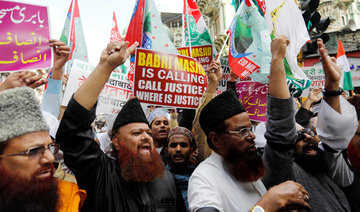
NEW DELHI: The Supreme Court of India upheld a 25-year-old observation of the court declaring prayer in mosques not integral to Islam. In a majority verdict of 2-1, the three court judges rejected a plea to refer the matter to a larger bench.
After the verdict a political commentator remarked it was unfortunate that the judges had been split over the issue, noting that: “Two judges who are Hindu said that mosques are not central to practicing Islam, one judge who has a reservation, is a Muslim.”
The court decision clears the way for it to determine the title suit of the disputed Babri mosque site in Ayodhya, a town in the eastern Indian state of Uttar Pradesh.
Ayodhya’s majority Hindu community have said that their supreme deity Ram, was born at the site of the Babri mosque. They want to build a huge temple there but the Muslim community has opposed the move.
In late 1980s and early 1990s the Hindu Bharatiya Janata Party (BJP) led a political movement. In 1992 tensions came to a head with the demolition of the Babri mosque in 1992 by Hindu fanatics.
In 1994 in a case related to the question of acquisition of religious place by the State, the court said that every immovable property could be acquired. It observed that if prayer and worship can be done at any location that meant place of worship was not integral to prayer. Therefore, offering the ritual five-times-a-day namaz prayers at a mosque was not integral to Islam, unless the mosque had particular significance in Islam.
In 2010 the Allahabad High Court ordered the disputed site at Ayodhya to be divided into three parts — one for the Hindu deity Ram, another for Nirmohi Akhara — a Hindu sect — and the third for Muslims.
The Muslim community challenged the verdict, asking the Supreme Court to hear the case with a larger bench of seven judges, as the case relates to a land belonging to a mosque and has implications for the constitutionally guaranteed freedom of religion.
On Thursday, the Supreme court rejected setting up a larger bench, and decided not to adjust the 1994 court ruling.
“All religions, all mosques, temples and churches are equal. We have already noticed all religious places are liable to be acquired as per the 1994 verdict,” said Justice Ashok Bhushan.
While accepting that the 1994 verdict that a mosque was not necessary for prayer was “questionable,” he added that this “fact does not apply to the title dispute” in the Babri mosque case.
Justice S. Abdul Nazeer disagreed with the two judges and said “whether mosque is integral to Islam has to be decided considering belief of religion and it requires detailed consideration.”
Advocate Hejaz Maqbool, representing some of the Muslim bodies in the Ayodhya dispute, told Arab News: “Today’s verdict is not a setback and the court said that whatever has been observed in the 1994 judgment will not be an issue in deciding the title suit of the Ayodhya dispute.”
But Aatekha Khan, a Delhi-based academician, said she was “disappointed” at the “double standard practiced by the Supreme Court on the crucial issue that affects Muslims emotionally.”
“Vested interests were trying to get the verdict delayed by raising one issue or the other, but the apex court has cleared the way for the final verdict of the Ayodhya dispute,” said Sudesh Verma, Bharatiya Janata Party spokesperson.
He told Arab News: “We are confident that justice will be done now after the issue of whether offering prayer in a mosque is an integral part of Islam or not has been settled.”
So far there has been no official reaction from the opposition Congress party. However, a senior Congress party leader, on the condition of anonymity, told Arab News: “The BJP, which was on a back foot on the issue of corruption in the defense deal, has got an issue to polarize the coming election.”
Political analyst Nilanjan Mukhopadhyay observed: “It is very unfortunate that we have a split verdict in the Supreme Court. Two judges who are Hindu said that mosques are not central to practicing Islam, one judge who has a reservation, is a Muslim. It is not very healthy sign for the republic. It is a sad commentary on the state we have come to.”
“Temple is a live issue. It has come back to the national focus and it serves the political objective of the BJP,” added Mukhopadhyay.