JERUSALEM: Israeli Prime Minister Benjamin Netanyahu said on Thursday that he spoke to Egyptian President Abdel Fattah al-Sisi, whose country has been trying to arrange a Gaza ceasefire, on the sidelines of the UN General Assembly in New York.
Netanyahu's talks with Sisi late on Wednesday focused on "regional developments", the Israeli Prime Minister wrote on Twitter without elaborating.
Egypt has been working to broker a long-term ceasefire between Israel and the Gaza Strip's dominant Hamas Islamist movement amid frequent violence along the Israel-Gaza border, where Palestinians have been holding weekly protests.
Netanyahu and Sisi met in public for the first time in 2017 and Israeli media reports last month said that they had held a secret summit in Egypt in May to discuss a truce in neighbouring Gaza, which is under tight Israeli and Egyptian border restrictions.
Egypt was the first of a handful of Arab countries to recognise Israel under a 1979 peace treaty and the two countries maintain close co-ordination on security as well as energy ties.
On Thursday Israeli and Egyptian companies announced that they would buy into a pipeline that would enable a landmark $15 billion natural gas export deal to begin next year.
Netanyahu and Sisi convened for their previously announced talks several hours after U.S. President Donald Trump said he wanted a two-state solution to resolve the Israeli-Palestinian conflict, in what had appeared to be the clearest expression yet of his administration's support for such an outcome.
But later on Wednesday Trump told a news conference that he would be open to a one-state solution if that was the preference of the parties themselves, a position he had previously stated.
Netanyahu, a right-wing politician who rarely utters publicly the words "Palestinian state" - a concept he conditionally endorsed in 2009 but which far-right coalition partners oppose - said he was not caught by surprise by Trump's initial remarks.
In a statement, Netanyahu said he was confident that a promised U.S. peace plan would back Israel's demand to maintain security control of the West Bank; territory it occupied in a 1967 war and which Palestinians seek as part of a future state.
Palestinians are boycotting Washington's peace efforts after Trump broke with long-standing U.S. policy by recognising Jerusalem as Israel's capital and moved the American Embassy to the contested city.
Palestinian leaders say that a state, with East Jerusalem as its capital, must be based on the pre-1967 war borders and see any future Israeli military presence as a violation of sovereignty.


![]()


Israel's Netanyahu and Egypt's El-Sisi discuss Gaza ceasefire, gas export deal at UN
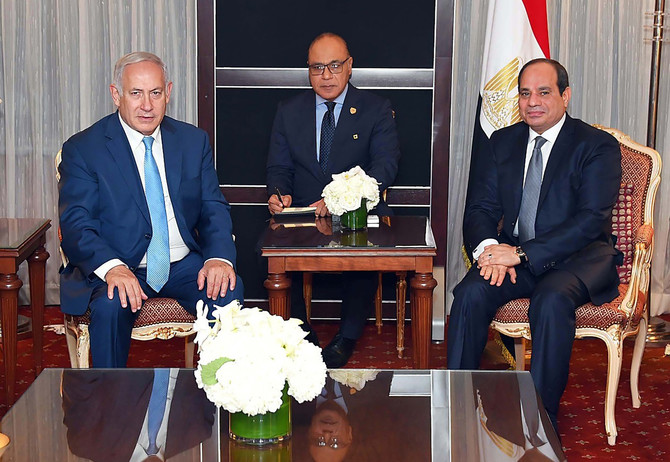
Israel's Netanyahu and Egypt's El-Sisi discuss Gaza ceasefire, gas export deal at UN
- In recent months, mass protests along Gaza’s border with Israel have triggered repeated deadly clashes
- Gaza lies between Israel and Egypt, which along with the UN has been seeking to broker a long-term truce between Israel and Hamas

Lebanon says two dead in Israeli strikes
- Lebanon’s health ministry: An ‘Israeli enemy strike on a vehicle on the Jadra-Siblin road in the Shouf district killed one person and wounded five others’
- one person was killed in an Israeli strike on a vehicle in Odaisseh near the border with Israel
BEIRUT: Israeli strikes on Lebanon on Tuesday killed two people, one of them near Beirut, the Lebanese health ministry reported, with Israel saying it had targeted Hezbollah operatives.
Despite a November 2024 ceasefire that was supposed to end more than a year of hostilities between Israel and Iran-backed militant group Hezbollah, Israel has kept up strikes on Lebanon and has also maintained troops in five southern areas it deems strategic.
Lebanon’s health ministry said an “Israeli enemy strike on a vehicle on the Jadra-Siblin road in the Shouf district killed one person and wounded five others.”
The area is around 30 kilometers (20 miles) south of the capital.
An AFP photographer saw a damaged goods truck with emergency workers and army personnel deployed at the scene.
Earlier, the ministry said one person was killed in an Israeli strike on a vehicle in Odaisseh near the border with Israel.
In separate statements, the Israeli army said it targeted two Hezbollah members, without providing further details.
On Sunday, Israeli strikes killed three people in separate parts of Lebanon according to the health ministry, with Israel saying it killed Hezbollah members.
Around 340 people have been killed by Israeli attacks on Lebanon since the ceasefire agreement went into force, according to an AFP tally of health ministry reports.
Israel usually says the strikes target Hezbollah members and infrastructure, and aim to stop the group from rearming.
Tuesday’s attacks come as the ceasefire monitoring committee, which includes France and the United States, is set to meet later this week.
According to the ceasefire, Hezbollah was required to pull its forces north of the Litani River, about 30 kilometers (20 miles) from the border with Israel, and have its military infrastructure in the vacated area dismantled.
Under a government-approved plan, Lebanon’s army is to disarm Hezbollah south of the Litani by the end of the year, before tackling the rest of the country.
Despite a November 2024 ceasefire that was supposed to end more than a year of hostilities between Israel and Iran-backed militant group Hezbollah, Israel has kept up strikes on Lebanon and has also maintained troops in five southern areas it deems strategic.
Lebanon’s health ministry said an “Israeli enemy strike on a vehicle on the Jadra-Siblin road in the Shouf district killed one person and wounded five others.”
The area is around 30 kilometers (20 miles) south of the capital.
An AFP photographer saw a damaged goods truck with emergency workers and army personnel deployed at the scene.
Earlier, the ministry said one person was killed in an Israeli strike on a vehicle in Odaisseh near the border with Israel.
In separate statements, the Israeli army said it targeted two Hezbollah members, without providing further details.
On Sunday, Israeli strikes killed three people in separate parts of Lebanon according to the health ministry, with Israel saying it killed Hezbollah members.
Around 340 people have been killed by Israeli attacks on Lebanon since the ceasefire agreement went into force, according to an AFP tally of health ministry reports.
Israel usually says the strikes target Hezbollah members and infrastructure, and aim to stop the group from rearming.
Tuesday’s attacks come as the ceasefire monitoring committee, which includes France and the United States, is set to meet later this week.
According to the ceasefire, Hezbollah was required to pull its forces north of the Litani River, about 30 kilometers (20 miles) from the border with Israel, and have its military infrastructure in the vacated area dismantled.
Under a government-approved plan, Lebanon’s army is to disarm Hezbollah south of the Litani by the end of the year, before tackling the rest of the country.
Latest updates


© 2025 SAUDI RESEARCH & PUBLISHING COMPANY, All Rights Reserved And subject to Terms of Use Agreement.