ISLAMABAD: Dealing a blow to the already-strained bilateral ties between India and Pakistan, New Delhi said it would no longer participate in high-level talks to be held in New York this week, with Islamabad’s foreign ministry expressing “deep disappointment” at the move late on Friday.
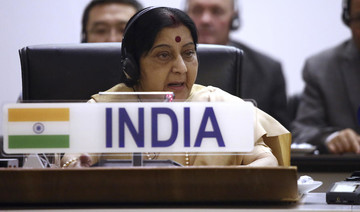
The announcement made by India’s Ministry of External Affairs (MEA) threw the spanner in the works for planned talks between Indian Foreign Minister Sushma Swaraj and her Pakistani counterpart, Shah Mehmood Qureshi which were scheduled to be held on the sidelines of the United Nations General Assembly (UNGA).
The development took place just a day after India had agreed to the meeting.
“The reasons cited by the Indian side for the decision to cancel the Foreign Ministers’ meeting, within 24 hours of its public confirmation, are entirely unconvincing,” Pakistan’s Foreign Ministry said in a statement.
“The so-called ‘disturbing developments’ alluded to in the Indian statement predated the Indian agreement to hold the bilateral meeting in New York,” it added.
On Friday, India accused Pakistan of killing its security personnel in Kashmir, adding that it was “glorifying terrorism” by releasing postage stamps featuring Hizbul Mujahideen fighter, Burhan Wani, who was killed by Indian security forces in 2016.
“When the allegations of Pakistan’s involvement first appeared, the Pakistan Rangers clearly conveyed to (Indian) BSF (Border Security Force) through official channels that Pakistan had nothing to do with it,” excerpts from the statement said, adding that the “Pakistan Rangers also extended help in efforts to locate the soldier’s body. These facts were known to the Indian authorities and a part of the Indian media also reported that Pakistan had refuted its involvement.”
Accusing India of indulging in a “motivated and malicious propaganda,” Pakistan said it “categorically rejected these allegations once again and would be prepared to conduct a joint investigation to establish the truth.”
Stamps featuring Wani were issued before the July 25 general elections in Pakistan “as a result of which the government of Prime Minister Imran Khan assumed office,” the statement said.
“We believe by its ill-considered cancelation of the meeting, India has once again wasted a serious opportunity to change the dynamics of the bilateral relationship and put the region on the path of peace and development,” the Foreign Ministry said, echoing sentiments expressed by Qureshi earlier on Friday.
Reacting to India’s decision to cancel the talks, Qureshi said: “Pakistan had requested for the meeting in the larger interest of the region.”
“It seems that India is already preparing for its elections due in the country next year,” he said in comments to local news outlet Express Tribune, adding that there is a group in New Delhi that does not want the talks to take place.
In a tit-for-tat measure, Qureshi said Islamabad too would not feel the need to respond in haste if India were to approach Pakistan for dialogue in the future. “Pakistan extended the offer despite possessing evidence of Indian interference in Balochistan,” he said.
He concluded his statement by reiterating the need for a dialogue, saying that it was the only way to resolve issues.
Extending an invitation for talks between Qureshi and Swaraj, Prime Minister Imran Khan had written a letter to Indian PM Narendra Modi on September 14 as an official proposal for the meeting. At the time, he had reasoned that an informal meeting of the South Asian Association of Regional Cooperation (Saarc), on the sidelines of the UNGA, would be the ideal platform to restart the derailed talks.
On Thursday, MEA spokesperson, Raveesh Kumar, had confirmed that India would participate in the talks but not before quickly clarifying that “this should not be confused with the resumption of any dialogue; this is just a meeting on the request of Pakistan” and that this “this does not indicate any change in our policy as far as our stand on terrorism and cross-border terrorism is concerned.”
The United States had also welcomed the meeting between Pakistan and India, expressing hope that the stage for a “good, strong relationship between the two neighbors” would be set.
Pakistan’s Information Minister tweeted his disappointment at India’s decision saying that “the world is watching, Pakistan stands for peace, while Indian policies are being guided by extremist ideologies.”

Pakistan ‘deeply disappointed’ after India calls off talks
- Foreign ministers from both nations were to meet on sidelines of UNGA
- New Delhi has once again wasted opportunity to change dynamics of relations, Islamabad says
Pakistani students recount perilous journey home from Iran as Middle East conflict escalates
- 792 Pakistanis repatriated via land and air corridors, officials say
- Many evacuees are students enrolled in Iranian universities
ISLAMABAD: Hundreds of Pakistani students are fleeing Iran this week as escalating hostilities in the Middle East spill across key population centers, forcing them to abandon studies and undertake perilous overland journeys back home.
Iran has been rocked since last week by joint US and Israeli strikes that killed Supreme Leader Ayatollah Ali Khamenei, followed by retaliatory missile attacks targeting American military bases across the Gulf region. The escalation has disrupted air travel, heightened military activity along Iran’s southern coastline and turned strategic locations such as Bandar Abbas, near the Strait of Hormuz through which roughly 20 percent of global oil supplies pass, into flashpoints.
Among those returning is Misbah Hussain, a 22-year-old medical student from Pakistan’s coastal district of Badin in Sindh province. Her education in Iran’s Hormozgan province, which borders the Strait of Hormuz, was abruptly cut short by missile strikes near her university hostel.
“I cannot put those scenes into words,” said Hussain, describing the attacks near her hostel at the Hormozgan University of Medical Sciences in the Iranian coastal city of Bandar Abbas.
She said she had traveled by road from Bandar Abbas to the Pakistan-Iran border, changing three to four different cabs along the way as the security situation deteriorated. After crossing into Pakistan, she continued her journey to Karachi via the coastal highway in a vehicle arranged by the local administration, before heading onward to her hometown of Badin, where, she said, her family would witness her “second life.”
“Missiles landed a short distance from where we were staying,” she said, “and continued during our journey back. We could see missiles hitting along the way. There were moments when we felt we might not survive.”
Bandar Abbas, Iran’s main southern port, has seen intensified military activity in recent days as regional airspace remains largely restricted. Students described sirens, outgoing missile launches and the constant fear of further escalation.
“I had gone there 13 days ago, and the conditions worsened,” Hussain added, noting that examinations were abruptly canceled as students fled the city.
The students’ journey home has proved arduous. From Bandar Abbas, they traveled east through Iran’s Sistan-Baluchestan province toward the Gabd-Rimdan border crossing into Pakistan’s southwestern province of Balochistan. The route, normally a commercial corridor, has become a critical evacuation pathway for the roughly 35,000 Pakistanis currently residing in Iran, according to officials.
Nazir Hussain, another student at the university, described a chaotic departure marked by transport shortages and inflated fares.
“We left Iran under extreme fear,” Nazir told Arab News over the phone as he neared his home city of Hyderabad. “Transport was unreliable, drivers exploited the situation by charging excessive fares. At every stage, we felt uncertain and unsafe.”
The overland journey to the Gabd border spans nearly 800 kilometers (about 497 miles) from Bandar Abbas. Students said they could not wait for formal evacuation arrangements.
“We couldn’t wait for the government help to arrive. We just left a warzone, and this is what we could do, but the journey was extremely painful,” Nazir said.
After crossing into Pakistan, many students were assisted by local authorities in Gwadar before undertaking another nearly 700-kilometer (435-mile) journey to major cities such as Karachi and Hyderabad.
Speaking at a press conference, Pakistan’s Deputy Prime Minister and Foreign Minister Ishaq Dar said on Tuesday a 24-hour crisis management unit has been activated to assist Pakistani nationals across the Gulf, where an estimated 4.5 million Pakistanis live and work.
According to government figures, 792 Pakistanis have been repatriated from Iran so far, including 650 who crossed through the Gabd-Rimdan and Taftan border crossings in the past 48 hours. A significant number of those returning are students enrolled in Iranian universities.
“The safety of Pakistanis abroad and the sovereignty of Pakistan remain our foremost priorities,” Dar told reporters in Islamabad, adding that Azerbaijan has been designated as an additional evacuation base for Pakistanis in northern Iran.
Despite official assurances that authorities are working “round the clock,” some students say support on the ground has been limited.
“Assistance with transport and communication could make an enormous difference for students stranded in dangerous situations,” Nazir said. “But, unfortunately, in our case it didn’t exist.”
Officials estimate that around 3,000 Pakistani students remain in Iran. With airspace disruptions and ongoing hostilities, many face the difficult decision of staying in a volatile environment or risking long overland travel to reach safety.
“We had only heard about death before,” student Misbah Hussain said. “This time we saw it with our own eyes.”