NEW YORK: Rihanna is now Ambassador Rihanna, after her home country tasked her with promoting investment and tourism.
Prime Minister Mia Amor Mottley said that Rihanna — real name Robyn Rihanna Fenty — has been conferred the title of ambassador extraordinary and plenipotentiary.
While the singer will not be formally accredited to another country, Mottley said that Rihanna — whose more colorful songs include “Bitch Better Have My Money” — would be in charge of bringing investment as well as encouraging education and tourism.
“I couldn’t be more proud to take on such a prestigious title in my home country. Every Barbadian is going to have to play their role in this current effort, and I’m ready and excited to take on the responsibility,” Rihanna said in a statement dated Thursday.
Rihanna, 30, grew up in a troubled home in Barbados and was propelled to fame after visiting US producer Evan Rogers recognized her talents.
The singer, who since achieving stardom has lived primarily in Los Angeles and New York, has scored 14 number-one singles on the US Billboard chart, more than any artist except The Beatles, Elvis Presley and Mariah Carey.


Barbados appoints Ambassador Rihanna

Barbados appoints Ambassador Rihanna
- Rihanna's home country tasked her with promoting investment and tourism
- The singer has scored 14 number-one singles on the US Billboard chart


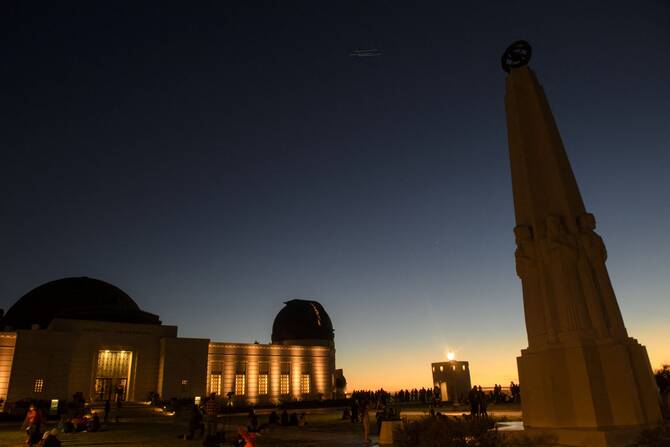
6 planets will parade across the night sky at the end of February
NEW YORK: Six planets are linking up in the sky at the end of February, and most will be visible to the naked eye.
It’s what’s known as a planetary parade, which happens when multiple planets appear to line up in the sky at once. The planets aren’t in a straight line, but are close together on one side of the sun.
Skygazers can usually spot two or three planets after sunset, according to NASA. Hangouts of four or five that can be glimpsed with the naked eye are less common and occur every few years. Last year featured lineups of six and all seven planets.
When will they be visible?
On Saturday, Mercury, Venus, Jupiter and Saturn will be visible to the naked eye if clear skies allow. Uranus and Neptune can only be spotted with binoculars and telescopes.
What time is optimal for viewing?
Go outside about an hour after sunset and venture away from tall buildings and trees that will block the view. Look to the western sky and spot Mercury, Venus and Saturn close to the horizon. Jupiter will be higher up, along with Uranus and Neptune.
How to know if you’ve spied a member of the parade?
“If it’s twinkling, it’s a star. If it is not twinkling, it’s a planet,” said planetary scientist Sara Mazrouei with Humber Polytechnic in Canada.
The parade should be visible over the weekend and in the days after. Eventually, Mercury will bow out and dip below the horizon.
At least one bright planet is visible on most nights, according to NASA.
Glimpsing many in the sky at once is a fun way to connect with astronomers of centuries’ past, said planetary scientist Emily Elizondo with Michigan State University.
Ancient astronomers used to make sense of the universe “just by looking up at the stars and the planets,” Elizondo said, “which is something that we can do today.”


