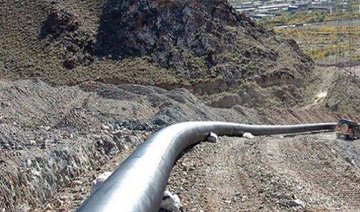
ISLAMABAD: Pakistan on Monday increased natural gas prices by up to 20 percent, Petroleum Minister Chaudhry Mohammad Sarwar said, in effect slashing consumer subsidies that were a fiscal drag on the government’s budget.
Sarwar said the move would help ease part of the 152 billion rupee ($1.24 billion) deficit for state-owned Sui Northern and Sui Southern, the two main suppliers of natural gas that are bleeding cash and subsidising consumers and industries.
The decision was taken by the Economic Coordination Committee chaired by new Prime Minister Imran Khan, who has vowed radical economic reforms.
“It was a tough decision for us to take,” Sarwar said, adding that the price hike was “10 to 20 percent,” depending on how much gas the user consumed.
The new measures would inject “58 billion rupees to stabilize the two companies,” Sarwar added.
The price hike is some way off the 46 percent rise recommended by Pakistan’s regulator, which is roughly the increase needed if the gas providers were to break even and de facto subsidies be terminated.
Such price rises are politically sensitive in Pakistan, which has enjoyed decades of cheap gas due to its natural resources.
However, over the past decade those gas reserves have not been enough and Pakistan experienced a number of shortages until it began importing liquefied natural gas (LNG), which is more expensive than domestic gas.
Sarwar said Pakistani consumers would be given relief via a reduction in most taxes on LNG, except a 10 percent sales tax.
Pakistan is struggling to avert a currency crisis that could force it to seek a bailout from the International Monetary Fund. The country’s current-account deficit has ballooned in recent years, while the fiscal deficit has shot up to 6.8 percent of the economy in the year that ended June 30.

Pakistan raises gas prices to trim subsidies amid budget woes
- Petroleum Minister says the move would help ease part of the 152 billion rupee ($1.24 billion) deficit for state-owned Sui Northern and Sui Southern, the two main suppliers of natural gas that are bleeding cash and subsidising consumers and industries
- The decision was taken by the Economic Coordination Committee chaired by new Prime Minister Imran Khan
UK announces ‘major reset’ of Pakistan development partnership with new trade, climate, education initiatives
- UK commits to increased investment-led cooperation in climate, business regulation and higher education
- London shifts from aid donor to investment-focused partner as bilateral trade crosses $7.3 billion
ISLAMABAD: The United Kingdom on Wednesday unveiled what it called a “major reset” in its development partnership with Pakistan, announcing new investment-focused cooperation, education programs and a bilateral climate compact during a visit by UK Minister for Development Jennifer Chapman.
The trip marks the first federal-level development dialogue between the two governments in eight years and reflects London’s shift from a traditional aid-donor role toward investment-based partnerships. The British government said the new approach aims to use UK expertise to help partner economies build capacity and unlock domestic growth.
Pakistan-UK trade has also reached a record high, crossing £5.5 billion ($7.3 billion) for the first time, with more than 200 British firms now active in Pakistan, an increase London says signals growing two-way commercial confidence.
“Pakistan is a crucial partner for the UK. We work together to tackle the drivers behind organized crime and illegal migration, keeping both our countries safer,” Chapman was quoted as saying in a statement by the British High Commission in Islamabad.
“Our strong bilateral trading relationship brings jobs and growth to us both. And we’re working together to tackle climate change, a global threat.”
The minister and Prime Minister Shehbaz Sharif on Tuesday jointly launched a package of business regulatory reforms aimed at improving Pakistan’s investment climate and making it easier for UK firms to operate. Officials said the initiative supports Pakistan’s economic recovery agenda and creates new commercial avenues for British companies.
A second key announcement was the next phase of the Pak-UK Education Gateway, developed with the British Council and Pakistan’s Higher Education Commission. The expanded program will enable joint research between universities in both countries, support climate- and technology-focused academic collaboration, and introduce a startup fund to help commercialize research. The Gateway will also promote UK university courses delivered inside Pakistan, giving students access to British degrees without traveling abroad.
Accompanied by Pakistan’s Minister for Climate Change Dr. Musadik Malik, Chapman also launched a Green Compact, a framework for climate cooperation, green investment, environmental protection and joint work at global climate forums.
The UK emphasized it remains one of Pakistan’s largest development partners, citing ongoing work in education, health, climate resilience and anti-trafficking capacity building.
During the visit to Pakistan, Chapman will meet communities benefiting from UK-supported climate programs, which London says helped 2.5 million Pakistanis adapt to climate impacts in the past year, and observe training of airport officers working to prevent human trafficking.
“We remain firm friends of Pakistan, including in times of crisis, as shown through our floods response,” Chapman said. “And we know to accelerate growth in both our countries, we must work together in partnership to tackle the problems we face.”