

Super Typhoon Mangkhut smashes into Philippines

1 / 3
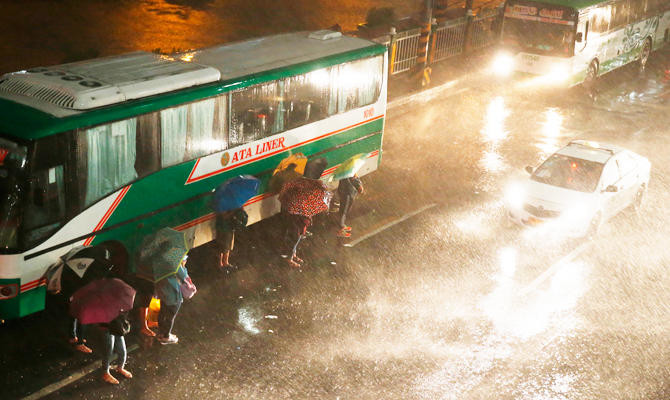
Motorists brave the rain and strong winds brought about by Typhoon Mangkhut which barrelled into northeastern Philippines before dawn Saturday, Sept. 15, 2018 in Manila, Philippines. (AP)
2 / 3
Commuters brave the rain and strong winds brought about by Typhoon Mangkhut which barrelled into northeastern Philippines before dawn Saturday, Sept. 15, 2018, in Manila, Philippines. (AP)
3 / 3
Commuters brave the rain and strong winds brought about by Typhoon Mangkhut which barrelled into northeastern Philippines before dawn Saturday, Sept. 15, 2018, in Manila, Philippines. (AP)
Updated 15 September 2018
Follow

Super Typhoon Mangkhut smashes into Philippines

  • An average of 20 typhoons and storms lash the Philippines each year, killing hundreds of people and leaving millions in near-perpetual poverty
  • The storm is not forecast to directly hit Hong Kong, though it will feel Mangkhut’s wind and rain through Sunday

TUGUEGARAO, Philippines: Super Typhoon Mangkhut slammed into the northern Philippines on Saturday with violent winds and torrential rains, as authorities warned millions in its path of potentially heavy destruction.
The massive storm, which forecasters have called the strongest typhoon this year, blew in windows, hurled debris and knocked out power lines when it made landfall on the island of Luzon in the pre-dawn darkness.
It packed powerful gusts of up to 255 kilometers (160 miles) per hour and sustained winds of 205 kilometers per hour while heading west across the disaster-prone archipelago toward China.
“As much as possible, stay indoors,” Chris Perez, a forecaster for the state weather service, warned the roughly four million people in the path of the storm after it landed at 1:40 am (1740 Friday GMT).
An average of 20 typhoons and storms lash the Philippines each year, killing hundreds of people and leaving millions in near-perpetual poverty.
Thousands of people fled their homes in high-risk areas ahead of the storm’s arrival because of major flooding and landslide risks.
Authorities hiked the storm alert on Friday to its second highest level in northern Luzon provinces and mobilized rescue teams.
The elevated warning level carried risks of “very heavy” damage to communities hit by the typhoon and a storm surge that was forecast to hit six meters in some areas, the weather service said.
Residents started lashing down their roofs and gathering supplies days before the arrival of the storm that forecasters said is the most powerful of 2018.

“Among all the typhoons this year, this one (Mangkhut) is the strongest,” Japan Meteorological Agency forecaster Hiroshi Ishihara told AFP on Friday.
“This is a violent typhoon. It has the strongest sustained wind (among the typhoons of this year),” he added.
After blasting the Philippines, Mangkhut is predicted to hurtle toward China’s heavily populated southern coast this weekend.
“They (authorities) said this typhoon is twice as strong as the last typhoon, that’s why we are terrified,” Myrna Parallag, 53, told AFP after fleeing her home in the northern Philippines.
“We learned our lesson last time. The water reached our roof,” she said, referring to when her family rode out a typhoon at home in 2016.
The country’s deadliest on record is Super Typhoon Haiyan, which left more than 7,350 people dead or missing across the central Philippines in November 2013.
Poor communities reliant on fishing are some of the most vulnerable to fierce typhoon winds and the storm surges that pound the coast.
“The rains will be strong and the winds are no joke... We may have a storm surge that could reach four storys high,” Michael Conag, a spokesman for local civil defense authorities, told AFP.
The storm is not forecast to directly hit Hong Kong, though it will feel Mangkhut’s wind and rain through Sunday.
However, the Hong Kong Observatory warned that the massive typhoon will pose a “severe threat” to China’s southern coast before moving on to northern Vietnam.


Ukrainians defy cold, Russian strikes at sub-zero street party

Updated 9 sec ago
Follow

Ukrainians defy cold, Russian strikes at sub-zero street party

KYIV: Music blasts from speakers and lights strobe in the dark as revellers, clad in puffer jackets and bobble hats, brave Kyiv’s freezing cold at an outdoor party despite blackouts triggered by Russian strikes.
Moscow has been pummelling Ukraine’s power grid with drones and missiles, plunging millions into darkness and cold as temperatures dip as low as -20C.
“People are tired of sitting without power, feeling sad... It’s a psychological burden on everyone’s mental health,” Olena Shvydka, who threw the street party with the support of her neighbors, told AFP.
“Now we’re letting off some steam, so to speak.”
Across the country, around 58,000 workers were racing to restore power, with additional crews deployed to the capital where, according to Ukrainian President Volodymyr Zelensky, the situation was “extremely tough.”
A massive Russian strike on Kyiv cut off heating to half the city’s apartment buildings earlier this month.
The ongoing hours-long power outages are the worst yet of the war, which will hit the four-year mark next month.
In Shvydka’s building, equipped with a generator, heating is “almost always” there but the blackouts have been dragging on for hours.
“We didn’t have electricity for 18 hours two days ago, then for 17 hours three days ago,” she said. This was when the idea for the street party was born.

- ‘Civilized resistance’ -

“In our community chat, we decided to do something to support the general spirit of our residential complex,” Yevgeniy, Shvydka’s neighbor, told AFP.
“Despite the very difficult situation, people want to hold on and celebrate. And they are waiting for victory no matter what,” said Yevgeniy, a retired military officer who did not give his full name.
When neighbors started setting up generators, mixers and lights, “the temperature was about -10C. Now it’s probably -15C or more,” Shvydka said.
Clutching hot drinks in paper cups, warming around braziers or bopping to the thudding music, the crowd was undeterred, refusing to cave in despite the ongoing Russian invasion.
“What the Russians are trying to do to us is instil fear, anxiety, and hatred,” Olga Pankratova, a mother of three and a former army officer, told AFP.
“These kinds of gatherings provide some kind of civilized resistance to the force that is being directed at us — rockets, explosions, flashes. It unites us,” Pankratova said.
The loudspeakers started blasting Bon Jovi’s “It’s My Life.”
Hands in the air, the revellers belted out the rock anthem’s lyrics.
“It is impossible to defeat these people,” Yevgeniy said, looking around the party.
“The situation is very difficult — but the people are invincible.”