

Snakes on a plate: Vietnam’s coiled cuisine

1 / 6
This photo taken on August 24, 2018 shows chef Dinh Tien Dung collecting snake blood on a glass of rice wine at a specialty restaurant in Yen Bai province. (AFP)
2 / 6
This photo taken on August 24, 2018 shows a customer consuming a snake sausage dish served at a specialty restaurant in Yen Bai province. (AFP)
3 / 6
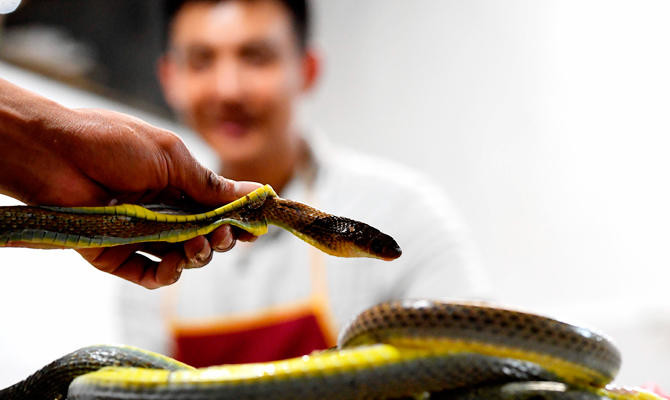
This photo taken on August 24, 2018 shows Dang Quoc Khanh holding a snake in his breeding farm in Yen Bai province. (AFP)
4 / 6
This photo taken on August 24, 2018 shows chef Dinh Tien Dung cleaning the snakes at a specialty restaurant in Yen Bai province, Vietnam. (AFP)
5 / 6
This photo taken on August 24, 2018 shows a cook preparing snake dish at a specialty restaurant in Yen Bai province. (AFP)
6 / 6
This photo taken on August 24, 2018 shows chef Dinh Tien Dung preparing to cook a snake at a specialty restaurant in Yen Bai province while an assistant looks on. (AFP)
Updated 11 September 2018
Follow

Snakes on a plate: Vietnam’s coiled cuisine

  • It’s delicious, good for your health and good for your bones

YEN BAI, Vietnam: With their meat served up in a wide array of dishes and blood added to rice wine, snakes make a reputedly satisfying — and nourishing — meal in Vietnam.
Caught in the jungles of the north of the country, snake flesh is traditionally believed to help with cooling overheated body temperatures, relieving headaches and easing digestion.
Restaurants will cook it steamed or fried with lemongrass and chilli and serve it with a rice wine mixed with snake blood, said chef Dinh Tien Dung, who works at a restaurant in Yen Bai province three hours northwest of the capital Hanoi.
Holding a snake’s head with one hand, Dinh Tien Dung slit its body near the head with a knife and squeezed blood out of it, dripping it into a cup of rice wine.
“We make use of every part of the snake except its head and its scales,” said the 32-year-old.
Locals believe that only men over 50 should drink snake wine, as younger males are likely to experience “backache or impotence,” said restaurant owner Duong Duc Doc.

As for its flesh, the benefits to eating it are numerous, said snake-catcher Dang Quoc Khanh, a 35-year-old who has been trapping serpents in the jungle since he was a young boy.
“Snake meat is a very good food,” he said, “It’s delicious, good for your health and good for your bones.”
But wildlife expert Ioana Dungler from Four Paws International said killing wild snakes and disturbing the jungles’ ecosystem is unnecessary as global meat production should be sufficient.
“The whole process of these animals ending on a plate or in a drink is very painful... and it’s done for purposes that are not justified,” Dungler told AFP.


Filipinos master disaster readiness, one roll of the dice at a time

Updated 29 December 2025
Follow

Filipinos master disaster readiness, one roll of the dice at a time

  • In a library in the Philippines, a dice rattles on the surface of a board before coming to a stop, putting one of its players straight into the path of a powerful typhoon

MANILA: In a library in the Philippines, a dice rattles on the surface of a board before coming to a stop, putting one of its players straight into the path of a powerful typhoon.
The teenagers huddled around the table leap into action, shouting instructions and acting out the correct strategies for just one of the potential catastrophes laid out in the board game called Master of Disaster.
With fewer than half of Filipinos estimated to have undertaken disaster drills or to own a first-aid kit, the game aims to boost lagging preparedness in a country ranked the most disaster-prone on earth for four years running.
“(It) features disasters we’ve been experiencing in real life for the past few months and years,” 17-year-old Ansherina Agasen told AFP, noting that flooding routinely upends life in her hometown of Valenzuela, north of Manila.
Sitting in the arc of intense seismic activity called the “Pacific Ring of Fire,” the Philippines endures daily earthquakes and is hit by an average of 20 typhoons each year.
In November, back-to-back typhoons drove flooding that killed nearly 300 people in the archipelago nation, while a 6.9-magnitude quake in late September toppled buildings and killed 79 people around the city of Cebu.
“We realized that a lot of loss of lives and destruction of property could have been avoided if people knew about basic concepts related to disaster preparedness,” Francis Macatulad, one of the game’s developers, told AFP of its inception.
The Asia Society for Social Improvement and Sustainable Transformation (ASSIST), where Macatulad heads business development, first dreamt up the game in 2013, after Super Typhoon Haiyan ravaged the central Philippines and left thousands dead.
Launched six years later, Master of Disaster has been updated this year to address more events exacerbated by human-driven climate change, such as landslides, drought and heatwaves.
More than 10,000 editions of the game, aimed at players as young as nine years old, have been distributed across the archipelago nation.
“The youth are very essential in creating this disaster resiliency mindset,” Macatulad said.
‘Keeps on getting worse’ 
While the Philippines has introduced disaster readiness training into its K-12 curriculum, Master of Disaster is providing a jolt of innovation, Bianca Canlas of the Department of Science and Technology (DOST) told AFP.
“It’s important that it’s tactile, something that can be touched and can be seen by the eyes of the youth so they can have engagement with each other,” she said of the game.
Players roll a dice to move their pawns across the board, with each landing spot corresponding to cards containing questions or instructions to act out disaster-specific responses.
When a player is unable to fulfil a task, another can “save” them and receive a “hero token” — tallied at the end to determine a winner.
At least 27,500 deaths and economic losses of $35 billion have been attributed to extreme weather events in the past two decades, according to the 2026 Climate Risk Index.
“It just keeps on getting worse,” Canlas said, noting the lives lost in recent months.
The government is now determining if it will throw its weight behind the distribution of the game, with the sessions in Valenzuela City serving as a pilot to assess whether players find it engaging and informative.
While conceding the evidence was so far anecdotal, ASSIST’s Macatulad said he believed the game was bringing a “significant” improvement in its players’ disaster preparedness knowledge.
“Disaster is not picky. It affects from north to south. So we would like to expand this further,” Macatulad said, adding that poor communities “most vulnerable to the effects of climate change” were the priority.
“Disasters can happen to anyone,” Agasen, the teen, told AFP as the game broke up.
“As a young person, I can share the knowledge I’ve gained... with my classmates at school, with people at home, and those I’ll meet in the future.”