

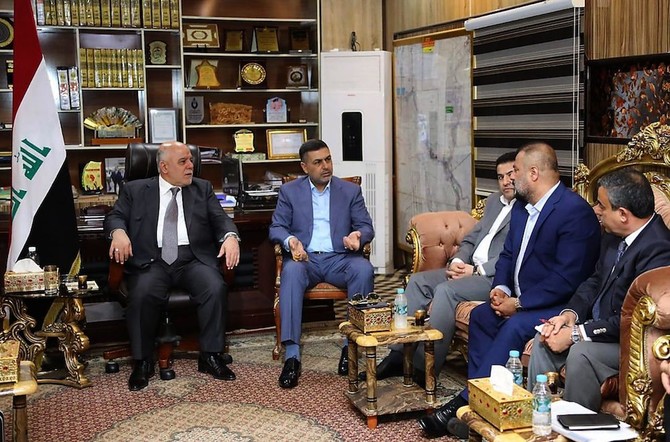

BASRA: Prime Minister Haider Al-Abadi sought to ease tensions in southern Iraq on Monday with a visit to Basra, rocked by deadly protests over alleged corruption and government neglect.
At least 14 demonstrators were killed and many government and political buildings torched, calm returned to the city late on Saturday as Al-Abadi’s rivals in Baghdad said they wanted to form Iraq’s next government without him.
For five days last week protesters had flooded the streets, clashing with security forces and torching the provincial headquarters, the Iranian consulate and the offices of armed groups.
Organisers have attempted to dissociate themselves from the violence and called for a halt to the demonstrations. Witnesses and local officials say the protests were hijacked by various armed groups.
On Monday, Al-Abadi met with officials in Basra who have accused Baghdad of neglecting the southern province and failing to redistribute oil wealth.
His visit came just 48 hours after the prime minister came under fire at an emergency meeting of parliament, where he faced calls to resign as his alliance with Muqtada Al-Sadr, one of the country’s most popular cleric, crumbled over the deadly unrest.
Al Sadr distanced himself from his one-time ally Al-Abadi, while a rival alliance of pro-Iranian former paramilitary fighters said it would work with Al-Sadr to form a new government that excludes the premier.
The announcement endangered Al-Abadi’s hopes of holding onto his post.
The embattled premier shot back on Monday from Basra by accusing unnamed “political parties who have armed wings” of having tried “to set Basra province on fire,” according to state broadcaster Al-Iraqiya.
His remarks came as Grand Ayatollah Ali Sistani, the spiritual leader of Iraq's Shiite majority, hinted on Monday that he was opposed to Al-Abadi staying in the post.
Sistani, who is widely respected across Iraq, spoke of the political and economic challenges facing the country and said the next prime minister should not be someone who has already served.
In Basra, Al-Abadi also denounced violence against diplomatic missions, Al-Iraqiya reported.
“Attacking a consulate or diplomatic post is unacceptable,” Al-Abadi was quoted as saying.
Protesters on Friday stormed Iran’s consulate, which had been evacuated in advance.
Iran is a key power broker in Iraq and many of the militias and political parties whose offices were torched in last week’s unrest are known to be close to Tehran.
Basra has been at the centre of protests that broke out in July in the southern province before spreading to other parts of the country, as demonstrators demanded jobs and condemned corruption among Iraqi officials.
Anger in Basra flared on Tuesday over a growing health crisis, after more than 30,000 people were hospitalised by pollution in the city’s water supply.


