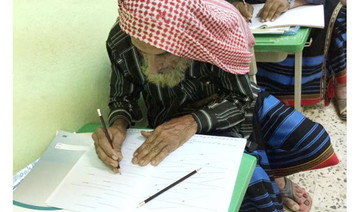
RIYADH: Saudi Arabia celebrated International Literacy Day on Saturday with a pledge to raise its literacy rate from 94.4 percent to 100 percent in the near future.
With illiteracy rates cut to below 5.6 percent, the Kingdom leads many Arab and Asian countries in achieving literacy targets.
The current 94.4 percent literacy rate was achieved while boosting enrolment in thousands of schools, vocational colleges and universities with the aim of achieving 100 percent literacy in the near future.
The Ministry of Education on Saturday said that a major “Lifelong Learning Initiative” was part of Vision 2030, targeting men and women with the sole aim of eradicating illiteracy.
International Literacy Day was celebrated worldwide under the banner of “Literacy and Skills Development.” Despite progress, literacy challenges persist, while demands for skilled work evolve rapidly.
The UN Educational, Scientific and Cultural Organization (UNESCO) promotes literacy day to underline the significance of literacy in the development of all nations.
Referring to the efforts of government agencies, the Education Ministry said that “there is added focus on adult education, which is in response to the need of the community and the local market.
More than 15,450 adults attend adult education centers in the Kingdom where they receive training in about 680 vocational programs. This is in addition to the growing number of students in primary and secondary schools across the Kingdom.
The ministry said that “literacy is at the heart of basic education for all and essential in eradicating poverty, reducing child mortality, curbing population growth, achieving gender equality and ensuring sustainable development and peace.”
Audrey Azoulay, UNESCO director-general, said: “Today, worldwide, more than 260 million children and adolescents are not enrolled in school, while six out of 10 children and adolescents — around 617 million — fail to acquire the minimum skills in literacy and numeracy.”
Azoulay said that about 750 million young people and adults — two-third of whom are women — cannot read and write.
The UNESCO chief called on education leaders to “make the ideal of a fully literate global society a reality.”
“The literacy rate of the Kingdom has significantly improved,” said Prof. Abdulkarim Al-Shaikh, a faculty member at the King Saud University.
“The Saudi government has launched many initiatives to promote and encourage education and skill development. These will go a long way in contributing to the development of our nation,” he said.
Higher education programs are being pushed in line with the objectives of Vision 2030. The allocation of SR192 billion ($51 billion) to the education sector in the 2018 annual budget reflects King Salman’s determination to ensure literacy and education opportunities in the Kingdom.