Built to last — Karachi’s stonemasons leave their mark

1 / 17
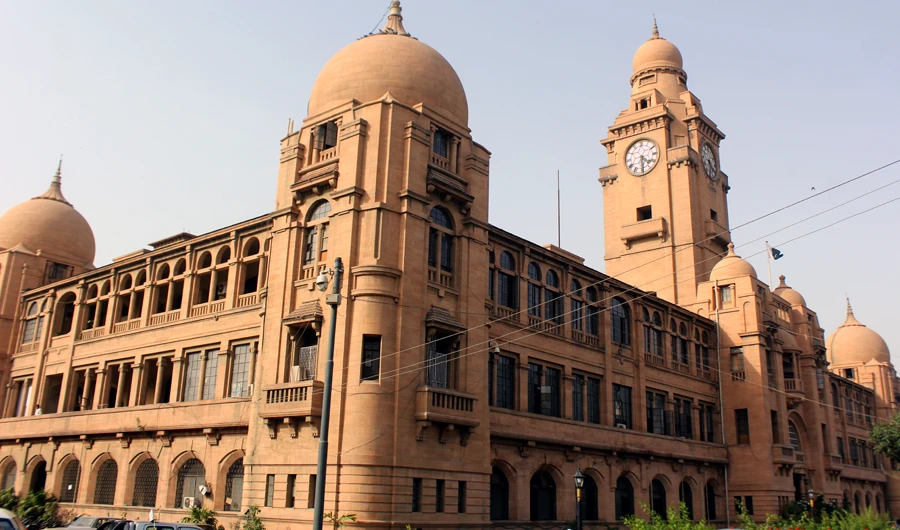
This historic Karachi Metropolitan Corporation Building located at M. A. Jinnah road of the city was constructed in 1930. Like over two hundreds government and private residential buildings in downtown Karachi, this building was also constructed by the Silawat stonemasons and builders. (AN Photo by M.F. Sabir)
2 / 17
This Frere Hall building, which was completed in 1865, was Karachi's town hall and is now being used as an exhibition center and library. This is one of iconic buildings of Karachi being constructed by Silawat stonemasons and builders. (AN Photo by M.F.Sabir)
3 / 17
This Sindh High Court building was completed on November 22, 1929. One of the stonemasons who worked to complete this building is being laid to rest in Silawat Graveyard, where this building has been designed on the plaque of his grave ( AN Photo by M.F. Sabir)
4 / 17
On left, Jaisalmer Fort of Rajasthan, India, the original town of Silawat community, has been designed on plague/headstone of one of the graves in Silawat graveyard. The grave on right has historic ‘Beech Wali Masjid’ of Ranchor Line, Karachi being designed on it ( AN Photo by M.F. Sabir)
5 / 17
The name plagues/headstones of graves in Silawat graveyard of Karachi has been decorated with designs of different historical government and private residential buildings of Karachi (AN Photo by M.F. Sabir)
6 / 17
This grave in Silawat Graveyard of Karachi has design of the Sindh High Court on it. The deceased buried in this grave is said to be one of the craftsmen who constructed the SHC’s iconic building ( AN Photo by M.F. Sabir)
7 / 17
Merewether Clock Tower, which was constructed as a memorial for Sir William L. Merewether, a Commissioner of Sindh from 1867 to 1877, was being designed by James Strachan, the Municipal Engineer, and constructed by Ibrahim s/o Pir Bux and his team in 1886. Ibrahim, who died in 1945, is being buried in this grave with design of the clock tower. (AN Photo by M.F. Sabir)
8 / 17
Merewether Clock Tower, which was constructed as a memorial for Sir William L. Merewether, a Commissioner of Sindh from 1867 to 1877, was being designed by James Strachan, the Municipal Engineer, and constructed by Ibrahim s/o Pir Bux and his team in 1886. Ibrahim, who died in 1945, is being buried in this grave with design of the clock tower. (AN Photo by M.F. Sabir)
9 / 17
10 / 17
This footstone of a grave has design of judges’ chamber in Sindh High Court ( AN Photo by M.F. Sabir)
11 / 17
The name plagues/headstones of graves in Silawat graveyard of Karachi has been decorated with designs of different historical government and private residential buildings of Karachi (AN Photo by M.F. Sabir)
12 / 17
Silawat graveyard Karachi (AN photo by M.F. Sabir)
13 / 17
This grave of Ali Muhammad, founder of Pakistan Masjid Ranchore Line has design of the mosque on his grave. The mosque being built of the community of stonemasons within a day has now been reconstructed on modern lines, Shakeel Silawat community leader told Arab News ( AN photo by M.F. Sabir)
14 / 17
Beech Wali Masjid, Ranchore line Karachi. The minaret on right side has been designed on the grave of its builder being buried in Silawat graveyard Karachi ( AN photo by M.F. Sabir)
15 / 17
This iconic building of the D. J. Sindh Govt. Science College Karachi is one of the many buildings being constructed by Silawat community of Karachi ( AN Photo by Arab News)
16 / 17
The Silawat community of stonemasons, who came to Karachi in early nineteen century, played an important part in the construction of this historical Empress Market. The building constructed between 1884 and 1889 is situated in downtown Karachi. One of the busiest markets, Express Market offers commodities ranging from condiments, fruit, vegetables and meat to stationery material, textiles and pets (AN Photo by M.F. Sabir)
17 / 17
This iconic Merewether Clock Tower was constructed as a memorial for Sir William L. Merewether, a Commissioner of Sindh from 1867 to 1877. It was designed by James Strachan, the Municipal Engineer, and constructed by Ibrahim s/o Pir Bux and his team in 1886. Ibrahim, who died in 1945, is being buried in this grave with design of the clock tower. (AN Photo by M.F. Sabir)
Updated 06 September 2018
Follow

Built to last — Karachi’s stonemasons leave their mark

  • Members of the Silawat community helped build some of the most iconic buildings of the region
  • Migrated from Rajasthan in the 19th century to settle down in Karachi where they found better employment opportunities

KARACHI: Next time you see the Taj Mahal, remember that there is a little bit of Karachi in it too.

“Our ancestors were among the people who [worked on the stones used in building] the Taj Mahal and the Jaisalmer Fort. You can see images of those buildings here,” Shakir Ali, caretaker of Karachi’s Silawat graveyard, told Arab News, pointing at one of the tombstones in the area. 

The cemetery, located in the Dhobi Ghat area of the city, is just one extension of the Silawats – a community that migrated to Sindh from India’s Rajasthan in the 19th century. 

Statistics from the 2017 population census estimate that there are more than 10,000 Silawats residing in Karachi, with the graveyard built as the final resting ground for the community members.

It is hard to miss the images of some of the most iconic buildings from the region that adorn the tombstones in the cemetery. “Our forefathers were highly-skilled builders who played a vital role in constructing some of the most prominent buildings in this region,” Ziauddin Parwaz, a community elder looking at the graveyard’s upkeep, said. 

“Everyone knows the British engineers who built the structures in Karachi. However, few realize that it was the skill of our elders that made the construction of those structures possible,” he added with a hint of resentment. 

Some of the buildings whose architecture traces its roots to the craftsmanship of the Silawat community include: the Frère Hall, Sindh High Court, Merewether Clock Tower, Empress Market, Karachi Port Trust, Radio Pakistan, DJ College, NJV School and Karachi Metropolitan Corporation.

At the entrance of the cemetery is the tomb of Ibrahim [known only by one name] who died in 1945 and is considered one of the finest stonemasons of his time. His gravestone now adorns the design of the Merewether Clock Tower since he was one of the artisans who helped dress the iconic structure. 

Similarly, an outline of the Pakistan Mosque can be seen on the grave of its builder, Ali Muhammad. While two other burial places have images of the Sindh High Court and the Judges’ Chamber marked on their headstone and footstone, designs of various residential buildings adorn other gravestones too. 

Ibrahim and Muhammad might probably be the last of the legion. With millennials from the community opting to take up other professions, the art of stonemasonry is unfortunately dying a slow death.  

However, this has not prevented the younger Silawats from taking pride in the accomplishments of their ancestors – a quality which they inherited from the few elders in their community. “We decorate the graves and their headstones with designs of historic buildings to applaud the achievements of our clan. It’s our tribute to their work,” Parwaz said.

Hailing from the Jaisalmer area of Rajasthan, the community witnessed a steady migration to Ahmednagar, Sukkar, Hyderabad and Karachi.

According to Shakeel Silawat, a senior journalist from the Silawat tribe, his forefathers decided to leave their ancestral land due to a dearth of employment opportunities. After exploring several areas, they finally zeroed in on Karachi -- a port city that was willing to offer more work, at better pay, to builders and stonemasons.

For some like Muhammad Hashim Gazdar -- an engineer-cum-politician who was born in Jaisalmer on February 1, 1893 – life has come a full circle. Gazdar remained the mayor of Karachi from May 1941 to May 1942 before he was elected to the Bombay Legislative Council in 1934. Post partition, he was appointed as the deputy speaker of the Sindh Assembly. His final resting place is the Silawat graveyard.

Gazdar is just one among several from the community who are still remembered for their contribution to the city. When the Endowment Fund Trust (EFT) began the conservation process of the historic Karachi Press Club building a few years ago, it invited members from the Silawat community to check the quality of stones. “The EFT replaced the stones on the recommendation of our elders, showing that our tribe’s expertise in the field is still valued,” Shakeel Silawat said.

Imran Khan not a ‘national security threat,’ ex-PM’s party responds to Pakistan military

Updated 06 December 2025
Follow

Imran Khan not a ‘national security threat,’ ex-PM’s party responds to Pakistan military

  • Pakistan’s military spokesperson on Friday described Khan’s anti-army narrative as a “national security threat”
  • PTI Chairman Gohar Ali Khan says words used by military spokesperson for Khan were “not appropriate”

ISLAMABAD: Former prime minister Imran Khan’s Pakistan Tehreek-e-Insaf (PTI) party on Saturday responded to allegations by Pakistan military spokesperson Lt. Gen. Ahmed Sharif Chaudhry from a day earlier, saying that he was not a “national security threat.”

Chaudhry, who heads the military’s media wing as director general of the Inter-Services Public Relations (ISPR), spoke to journalists on Friday, in which he referred to Khan as a “mentally ill” person several times during the press interaction. Chaudhry described Khan’s anti-army narrative as a “national security threat.”

The military spokesperson was responding to Khan’s social media post this week in which he accused Chief of Defense Forces Field Marshal Asim Munir of being responsible for “the complete collapse of the constitution and rule of law in Pakistan.” 

“The people of Pakistan stand with Imran Khan, they stand with PTI,” the party’s secretary-general, Salman Akram Raja, told reporters during a news conference. 

“Imran Khan is not a national security threat. Imran Khan has kept the people of this country united.”

Raja said there were several narratives in the country, including those that created tensions along ethnic and sectarian lines, but Khan had rejected all of them and stood with one that the people of Pakistan supported. 

PTI Chairman Gohar Ali Khan, flanked by Raja, criticized the military spokesperson as well, saying his press talk on Thursday had “severely disappointed” him. 

“The words that were used [by the military spokesperson] were not appropriate,” Gohar said. “Those words were wrong.”

NATURAL OUTCOME’

Speaking to reporters earlier on Saturday, Pakistan’s Defense Minister Khawaja Asif defended the military spokesperson’s remarks against Khan.

“When this kind of language is used for individuals as well as for institutions, then a reaction is a natural outcome,” he said. 

“The same thing is happening on the Twitter accounts being run in his [Khan’s] name. If the DG ISPR has given any reaction to it, then I believe it was a very measured reaction.”

Khan, who was ousted after a parliamentary vote of confidence in April 2022, blames the country’s powerful military for removing him from power by colluding with his political opponents. Both deny the allegations. 

The former prime minister, who has been in prison since August 2023 on a slew of charges he says are politically motivated, also alleges his party was denied victory by the army and his political rivals in the 2024 general election through rigging. 

The army and the government both deny his allegations.