

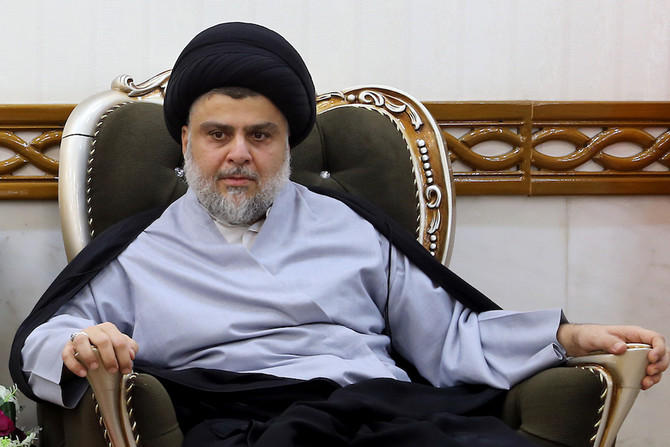

BAGHDAD: Muqtada Al-Sadr has formed the biggest bloc in Iraq’s parliament after months of stalled negotiations, Shiite MPs involved in the talks told Arab News on Sunday.
The breakthrough gives Al-Sadr, one of the country’s most influential clerics, and his allies, the exclusive right to form a government.
The agreement came just ahead of the first session of the Iraqi parliament on Monday, when the largest bloc must be registered.
If the alliance holds, it means that Iran and its allies have failed to take the lead in shaping Iraq’s political landscape and would have to join the Al-Sadr alliance if they want to be part of the next government.
Prime Minister Haider Al-Abadi, who is hoping to extend his position to a second term, is part of the new coalition, but it is unclear whether he will keep his job as he is no longer the only candidate from the alliance.
Al-Sadr sponsored the Sairoon coalition, which won first place in the May election with 54 seats. The cleric has led intensive negotiations over the past three months with almost all the winning political forces.
Al-Sadr, whose followers battled US forces after the 2003 invasion before he turned on Iran, has said he wants to form two parliamentary blocs, in a maverick move to break the cycle of corruption and conflict that plagues Iraq and its politics.
------
READ MORE:
‘Devil is in the detail’ of Al-Sadr’s alliances
Muqtada Al-Sadr threatens to end Iraq coalition effort
Fears over Iranian proxies’ Iraq missile factories
------
The first is a ruling bloc responsible for the formation and administration of the government. The second plays the role of the opposition and oversees the government’s performance. Both blocs have to include Shiite, Sunni and Kurdish parties.
Al-Sadr’s coalition will consist of 148 members, including the 54 from Sairoon, 43 from Al-Abadi’s Nassir, 20 from Hikma, 21 from Wattiniya and other small blocs. Negotiations are still ongoing to convince some Kurdish and Sunni blocs to join, negotiators told Arab News.
Al-Sadr and his allies had aimed to form a coalition of at least 200 seats to achieve a comfortable majority in the 329 seat parliament.
“The ruling coalition will form the government in all its areas, including the positions of the president and the speaker, so we seek to achieve a complete separation between the (political) forces that will be with us and the forces that will be in the opposition,” a senior Al-Sadr negotiator told Arab News.
“We will not repeat the previous scenario and we will not allow any forces to participate in the government and in the opposition at the same time.”
Iraq is a battleground for international powers, particularly Iran and the United States since 2003. A stable government would not be formed without the approval of the two nations.
Al-Sadr and his allies, especially Al-Abadi and Ammar Al-Hakim, the head of Hikma, were in a race with the Iranian supported coalitions, including Al-Fattah, which came second, and the State of Law coalition led by Nuri Al-Maliki, the divisive former prime minister.
Al-Sadr has negotiated with all the winning political forces except Al-Maliki and Qais Al-Khazali, the commander of the Iran-backed armed faction Assaib Ahl Al-Haq, who controls 15 seats within Fattah.
“After the registration of the largest bloc, we will expand the coalition to form the ruling bloc, which we seek to include 200-220 seats,” a negotiator with Al-Hikma told Arab News.
“We are keen to have Al-Fattah (alliance) or a large part of it, but it is certain that the State of Law will be in the opposition.”
The four negotiators of the biggest bloc, who spoke to Arab News, said the talks indicate that Badr (which has 23 seat within Al-Fattah) is likely to join the ruling coalition, but only two of them indicated that Assaib Ahl Al-Haq might go to the opposition.
“The problem of the Fattah leaders was Al-Sadr’s insistence on naming Abadi as the coalition’s only candidate for prime minister, but now this problem is no longer in place and we expect that Fattah will join us after the first session,” the Hikma negotiator said.
Both Brett McGurk, the US envoy to Iraq and General Qassem Soleimani, commander of Iran’s Al-Quds Force, have been personally involved in negotiating with Iraqi political forces in recent weeks.
Al-Abadi, who is supported by the United States, has faced political hurdles since the election, especially in relation towards Iran and its allies in Iraq. Abadi announced his commitment to the financial sanctions imposed by the United States on Iran last month, and has been seeking to limit the influence of Iran over the security institutions by dismissing and freezing several senior officials allied to Iran. Falih Al-Fayadh, the head of the Popular Mobilization Commission and the Iraqi national security adviser was the last one who was dismissed on Friday.
“We will not risk the interests of our people to satisfy Iran or any other country,” Abadi told reporters in Baghdad late on Sunday.
A negotiator for Al-Fattah told Arab News suggested it was too early to say whether they had failed to form the largest coalition instead of Al-Sadr.
“Negotiations are still ongoing and the direction of the results (of the negotiations) could change any minute,” he said.


