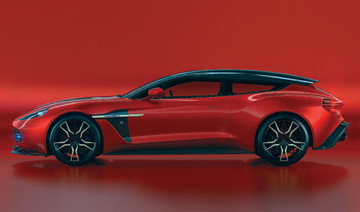
LONDON: Luxury carmaker Aston Martin plans to float on the London Stock Exchange, completing a turnaround for the once perennially loss-making company that could now be valued at up to £5 billion ($6.4 billion).
The 105-year old firm, famed for making the sports car driven by fictional secret agent James Bond, would become the first British carmaker to list in London for years, following the sale of brands such as Jaguar and Bentley to foreign owners.
The initial public offering (IPO), which follows Italian rival Ferrari's New York flotation in 2015, could see Aston valued at up to £5 billion, sources have told Reuters, after it expanded its model line-up and production.
The firm, which last year made its first profit since 2010 and has gone bankrupt seven times in its history, said on Wednesday the IPO would involve a sale of shares by its main owners, Kuwaiti and Italian private equity groups, with at least 25 percent of the stock to be floated.
It said it had filed a registration document with Britain's Financial Conduct Authority, a requirement for firms considering an IPO, at a time when the likes of Tesla boss Elon Musk have slammed the additional pressures of being listed.
Pending a final decision, a prospectus will be published on or around Sept. 20 as the maker of sports cars that can cost hundreds of thousands of pounds hopes to tap into global demand from wealthy buyers who want a slice of the high-end brand.
The carmaker hopes to complete the flotation this year, the same target that British Prime Minister Theresa May is working towards to agree a deal for leaving the EU.
Aston sells roughly 25 percent of its cars to the EU and operates its only plant in Gaydon, central England, with a second one due to begin operations in Wales in 2019.
"We can demonstrate that Brexit is not a major effect for us," Chief Executive Andy Palmer told Reuters.
"If there is a tariff into Europe, it's countered by a tariff into the UK for our competitors so you might lose a little bit of market share in the EU but you pick it up in the UK," he said.
Niche carmakers such as Aston and McLaren are more concerned about customs checks than tariffs as they believe many of their buyers can absorb a price hike.
Like many British-based carmakers, it imports parts from Europe including German-made engines, which could face delays at ports in the event Britain crashes out of the EU without a deal. Palmer said the firm had increased its stock in preparation for any eventuality.
Aston Martin, which has licensed its name for use on apartment blocks and even a submarine, hopes to follow Ferrari by using its exclusivity to appeal to investors.
Aston, which forecasts full-year volumes will rise to between 6,200 and 6,400 vehicles, aims in 2019 to match its recent sales high of roughly 7,300 cars achieved in 2007, just before the financial crisis.
The firm then languished for several years as sales slumped and it failed to invest adequately in new models, spending most of 2014 without a boss before Palmer's appointment.
Since then, the firm's main shareholders have invested £200 million as part of a plan to update its model line-up, produce new lower emissions vehicles and make its first sport utility vehicle (SUV), which is due next year.
It projects volumes will reach nearly 10,000 units in 2020.
Italian group Investindustrial, Kuwait's Investment Dar and five-percent shareholder Daimler, will retain stakes in the firm after the IPO.
Aston made half-year adjusted pretax profit of £42 million, as revenue rose 8 percent to £445 million due to strong demand for its DB11 coupe and Volante models.
The company has suggested for years it would eventually go public, but Palmer said now was the right time as the firm gears up for further growth with its move into the popular SUV market.
"We've got a very solid balance sheet now, very solid results. As we move into the third phase, which is the portfolio expansion, it also means we've got plenty of runway in front of us," he told Reuters.


Aston Martin plans to go public as turnaround picks up speed

Aston Martin plans to go public as turnaround picks up speed
- Carmaker hopes to complete flotation this year
- First British-based automaker to list in London for years


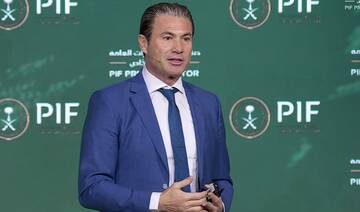
PIF’s Humain invests $3bn in Elon Musk’s xAI prior to SpaceX acquisition
JEDDAH: Humain, an artificial intelligence company owned by Saudi Arabia’s Public Investment Fund, invested $3 billion in Elon Musk’s xAI shortly before the startup was acquired by SpaceX.
As part of xAI’s Series E round, Humain acquired a significant minority stake in the company, which was subsequently converted into shares of SpaceX, according to a press release.
The transaction reflects PIF’s broader push to position Saudi Arabia as a central hub in the global AI ecosystem, as part of its Vision 2030 diversification strategy.
Through Humain, the fund is seeking to combine capital deployment with infrastructure buildout, partnerships with leading technology firms, and domestic capacity development to reduce reliance on oil revenues and expand into advanced industries.
The $3 billion commitment offers potential for long-term capital gains while reinforcing the company’s role as a strategic, scaled investor in transformative technologies.
CEO Tareq Amin said: “This investment reflects Humain’s conviction in transformational AI and our ability to deploy meaningful capital behind exceptional opportunities where long-term vision, technical excellence, and execution converge, xAI’s trajectory, further strengthened by its acquisition by SpaceX, one of the largest technology mergers on record, represents the kind of high-impact platform we seek to support with significant capital.”
The deal builds on a large-scale collaboration announced in November at the US-Saudi Investment Forum, where Humain and xAI committed to developing over 500 megawatts of next-generation AI data center and computing infrastructure, alongside deploying xAI’s “Grok” models in the Kingdom.
In a post on his X handle, Amin said: “I’m proud to share that Humain has invested $3 billion into xAI’s Series E round, just prior to its historic acquisition by SpaceX. Through this transaction, Humain became a significant minority shareholder in xAI.”
He added: “The investment builds on our previously announced 500MW AI infrastructure partnership with xAI in Saudi Arabia, reinforcing Humain’s role as both a strategic development partner and a scaled global investor in frontier AI.”
He noted that xAI’s trajectory, further strengthened by SpaceX’s acquisition, exemplifies the high-impact platforms Humain aims to support through strategic investments.
Earlier in February, SpaceX completed the acquisition of xAI, reflecting Elon Musk’s strategy to integrate AI with space exploration.
The combined entity, valued at $1.25 trillion, aims to build a vertically integrated innovation ecosystem spanning AI, space launch technology, and satellite internet, as well as direct-to-device communications and real-time information platforms, according to Bloomberg.
Humain, founded in August, consolidates Saudi Arabia’s AI initiatives under a single entity. From the outset, its vision has extended beyond domestic markets, participating across the global AI value chain from infrastructure to applications.
The company represents a strategic initiative by PIF to diversify the Kingdom’s economy and reduce oil dependence by investing in knowledge-based and advanced technologies.