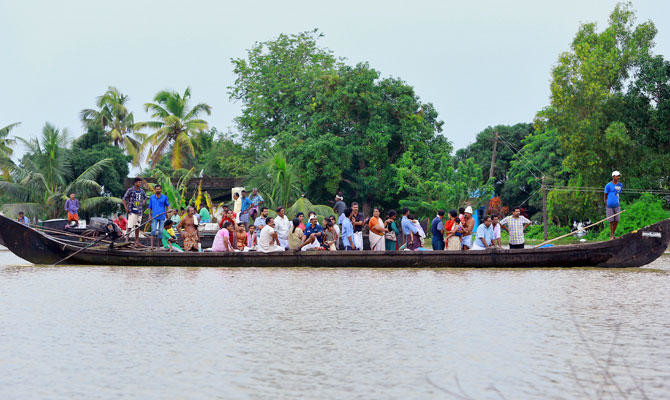

NEW DELHI/ALAPPUZHA: More than a week after the floodwater began subsiding, animal carcasses are still floating in Kerala’s backwaters, and in places a nauseating stench rises like a wall when the wake from a passing boat breaks the surface. These inland lagoons running parallel to the coast are one of the biggest tourist draws in India’s most southwesterly state, but the stain of death and devastation wrought by Kerala’s worst flood in a century will take longer than a season to wash away. The quaint towns and villages scattered between the lush forests and paddy fields bordering the backwaters are now communities in despair.
Houses in low-lying areas are still submerged, roads are waterlogged and the sewage from drains have washed into channels that are too slow-moving to effectively flush out the effluent.
Sudarsanan T.K., a houseboat owner in the town of Alappuzha, had been looking forward to the peak tourist season, but as his home disappeared under 2.5 meters (eight foot) of water his family now have to live aboard the boat he would otherwise be renting to tourists from Europe, China, Malaysia and India. “I’ve nothing left, but this houseboat. I don’t know how I can repay my bank loan in this condition. The bank may take back my boat. I will have nothing at all then,” Sudarsanan, a 64-year-old father of two, told Reuters.
Some 1,500 houseboats are tied up at Alappuzha, going nowhere, with many of the owners still paying off loans taken to buy the boats. Sudarsanan owes about $8,600 on the loan taken eight years ago to buy the boat, and he could have earned up to $7,000 by December if the deluge hadn’t washed away his hopes. Hundreds of people perished in the flood and more than one million of Kerala’s 35 million people were forced to abandon their homes and take shelter in relief camps.
Blessed with natural beauty, fertile land and bountiful seas, Kerala has been dubbed “God’s own country” by its people, but the Marxists running the state government reckon it will need $3.57 billion to rebuild over the next two years.
“Kerala’s GDP growth may fall by 2 percent,” state Finance Minister T.M. Thomas Isaac told Reuters, forecasting growth of 6 percent for the financial year ending next March.
Crops have been lost, the construction industry was dead for a month, and tourism, which contributes 10 percent of the state’s economy but accounts for about 25 percent of jobs creation, has been badly hit.
FESTIVAL WASHOUT
For discerning tourists looking for a more laidback Indian experience, Kerala has it all — long sandy beaches, lazy waterways, charming, historic towns like Kochi and the cool, forested hills of the Western Ghats.
Kerala doesn’t draw numbers like the northern tourist circuit, the so-called “Golden Triangle” running from New Delhi to the Taj Mahal in Agra, and Jaipur’s palaces in the desert state of Rajasthan, but it has carved out a sizable niche.
Last year, one million foreigners visited Kerala, along with 15 million domestic tourists, but state government and industry officials reckon the flood will result in losses for the tourism sector of $357 million.
The floods struck just as Kerala was gearing up for Onam, the harvest festival which is one of the highlights of the state’s cultural calendar.
Festivities, including the spectacular Vallam Kali races involving traditional war canoes, some manned by more than 100 paddlers, were postponed.
“Kerala has lost out on one of the best seasons, as the calamity struck during the 10-day run up to Onam,” said Ranjini Nambiar, who heads a travel consultancy.
Thousands of volunteers have joined a clean-up campaign mounted by the state, and Shilendran M., an executive with the CGH Earth luxury hotel chain, expected some kind of order to be restored within the next few weeks.
“The state administration is working on a war footing,” said Shilendran, whose group has more than a dozen properties in Kerala. “We are limping back to normal.”
Hardly anywhere in the state escaped the calamity.
Ernakulam district, the biggest industrial and tourism contributor to Kerala’s economy and home to the historic city of Kochi, suffered major damage, and its busy international airport was shut for nearly two weeks.
Munnar, a hill resort overlooking the tea and cardamom plantations high in the Ghats was cut off, as bridges were washed away and landslides blocked roads.
Once every dozen years a bright purplish-blue bell-shaped flower called the Neelakurinji, blossoms on the slopes around Munnar — and this was one of those years.
The state tourism had marketed 2018 as the Kurunji year, but people in Kerala are more likely to remember the mud. ($1 = 70.0900 Indian rupees)